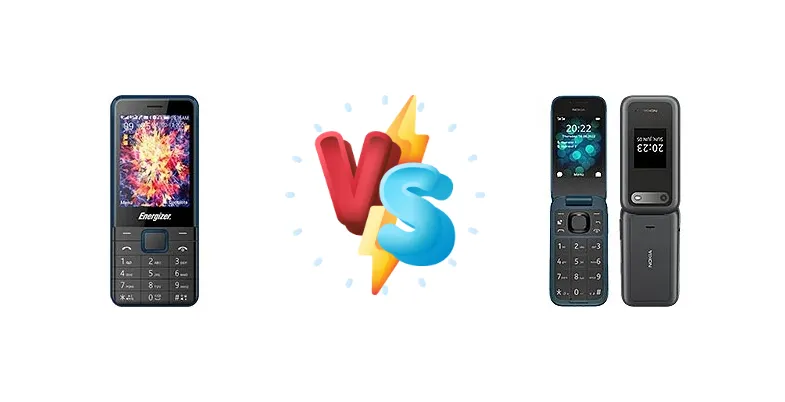
In a world dominated by smartphones, the humble flip phone is experiencing a resurgence. We pit the Energizer E28 against the Nokia 2660 Flip, two contenders aiming to capture the market for users prioritizing simplicity, battery life, and affordability. This comparison focuses on the core hardware differences and how they translate to real-world usability.
🏆 Quick Verdict
For the average user seeking a reliable, no-frills flip phone, the Nokia 2660 Flip emerges as the slightly better choice. Its Unisoc T107 chipset, while modest, offers a more modern architecture than the Energizer E28’s Spreadtrum SC6531E, and the inclusion of a charging cradle adds a convenient usability feature.
| Network |
|---|
| 2G bands | GSM 850 / 900 / 1800 / 1900 | GSM 850 / 900 / 1800 / 1900 |
| 3G bands | - | HSDPA 850 / 900 / 2100 - International |
| 4G bands | - | 1, 3, 5, 7, 8, 20 - EU, RUCIS |
| EDGE | No | - |
| GPRS | Yes | - |
| Speed | - | HSPA, LTE |
| Technology | GSM | GSM / HSPA / LTE |
| | - | 1, 2, 3, 4, 5, 7, 8, 28 - LATAM, BR |
| Launch |
|---|
| Announced | 2021, April. Released 2021, April | 2022, July 12 |
| Status | Discontinued | Available. Released 2022, July 28 |
| Body |
|---|
| Dimensions | 134.5 x 56 x 16.9 mm (5.30 x 2.20 x 0.67 in) | - |
| SIM | Dual SIM (Mini-SIM, Micro-SIM) | · Nano-SIM· Nano-SIM + Nano-SIM |
| Weight | 113 g (3.99 oz) | 123 g (4.34 oz) |
| | Flashlight | - |
| Display |
|---|
| Resolution | 240 x 320 pixels, 4:3 ratio (~143 ppi density) | 240 x 320 pixels, 4:3 ratio (~143 ppi density) |
| Size | 2.8 inches, 24.3 cm2 (~32.2% screen-to-body ratio) | 2.8 inches, 24.3 cm2 |
| Type | TFT LCD, 256K colors | TFT LCD |
| | - | Secondary external 1.77" display |
| Platform |
|---|
| CPU | - | 1.0 GHz Cortex-A7 |
| Chipset | Spreadtrum SC6531E | Unisoc T107 (22 nm) |
| Memory |
|---|
| Call records | Yes | Yes |
| Card slot | microSD | microSDHC |
| Internal | - | 128MB 48MB RAM |
| Phonebook | Yes | Yes |
| Main Camera |
|---|
| Features | LED flash | LED flash |
| Single | QVGA | 0.3 MP |
| Video | Yes | Yes |
| Sound |
|---|
| 3.5mm jack | Yes | Yes |
| 35mm jack | Yes | Yes |
| Loudspeaker | Yes | Yes |
| Comms |
|---|
| Bluetooth | 2.1 | 4.2, A2DP |
| NFC | No | No |
| Positioning | No | No |
| Radio | FM radio | Wireless FM radio |
| USB | microUSB | microUSB 2.0 |
| WLAN | No | No |
| Features |
|---|
| Games | No | Yes |
| Java | No | No |
| Messaging | SMS | SMS, MMS |
| Battery |
|---|
| Charging | - | Compatible with a charging cradle |
| Type | Li-Ion 3000 mAh battery | Li-Ion 1450 mAh, removable |
| Misc |
|---|
| Colors | Black, Gray, Blue, White, Green, Brown, Yellow | Gray, Blue, Red, Lush Green, Pop Pink |
| Models | - | TA-1480, TA-1474, TA-1469 |
| Price | About 20 EUR | € 59.99 / $ 190.00 / £ 69.00 / ₹ 4,499 |
| SAR | - | 0.47 W/kg (head) 1.16 W/kg (body) |
| SAR EU | - | 0.36 W/kg (head) 1.48 W/kg (body) |
Energizer E28
- Extremely affordable price point
- Simple and easy to use interface
- Compact and lightweight design
- Older Spreadtrum chipset may result in slower performance
- Lacks convenient charging cradle
Nokia 2660 Flip
- More modern Unisoc T107 chipset for improved responsiveness
- 22nm process node for better power efficiency
- Convenient charging cradle included
- Slightly higher price compared to the Energizer E28
- Still limited in terms of features and performance
Display Comparison
Neither device boasts a particularly impressive display. Both likely utilize basic TFT panels, typical for this market segment. Detailed specifications regarding resolution, brightness, or color gamut are unavailable, but the focus here is functionality over visual fidelity. The Nokia 2660 Flip’s display size is likely similar to the Energizer E28, prioritizing compactness over viewing area.
Camera Comparison
Both phones likely feature basic cameras intended for occasional snapshots. Given the market segment, image quality will be limited. Detailed camera specifications are unavailable, but it’s safe to assume both utilize low-resolution sensors. The focus isn’t on photography; it’s on providing a functional communication tool.
Performance
The core difference lies in the chipsets. The Nokia 2660 Flip’s Unisoc T107 (22nm) represents a more modern design than the Energizer E28’s Spreadtrum SC6531E. The T107’s 1.0 GHz Cortex-A7 CPU provides a modest performance boost, enabling smoother navigation through menus and faster call setup times. The 22nm manufacturing process also contributes to improved power efficiency, potentially extending battery life. While neither chipset is designed for demanding tasks, the Unisoc T107 offers a tangible advantage in responsiveness.
Battery Life
Battery life is a key strength of feature phones. While specific mAh ratings are unavailable, the Unisoc T107’s 22nm process node in the Nokia 2660 Flip contributes to better power efficiency, potentially translating to longer standby and talk times. The Nokia 2660 Flip’s compatibility with a charging cradle offers a convenient charging solution, especially for users who may struggle with small charging ports.
Buying Guide
Buy the Energizer E28 if you need a bare-bones, extremely affordable flip phone and are comfortable with potentially slower performance due to its older chipset. Buy the Nokia 2660 Flip if you prefer a slightly more refined experience, benefit from the convenience of a charging cradle, and appreciate the efficiency gains of a 22nm process node.
Frequently Asked Questions
❓ Does the Nokia 2660 Flip's charging cradle significantly improve the charging experience?
Yes, the charging cradle offers a more stable and convenient charging solution compared to using a micro-USB cable, particularly for users with limited dexterity or those who prefer a 'drop-and-charge' approach. It also helps protect the phone's charging port from wear and tear.
❓ Will I notice a significant performance difference between the Spreadtrum SC6531E and the Unisoc T107 in everyday use?
While neither chipset is powerful, the Unisoc T107’s Cortex-A7 architecture and 22nm process node provide a noticeable improvement in responsiveness. Expect slightly faster menu navigation and call setup times on the Nokia 2660 Flip compared to the Energizer E28.
❓ Are either of these phones suitable for using with hearing aids?
Both phones support the TTY/TDD standard for compatibility with teletypewriters, which can be used by individuals with hearing impairments. However, specific compatibility with different hearing aid models may vary; checking with the hearing aid manufacturer is recommended.