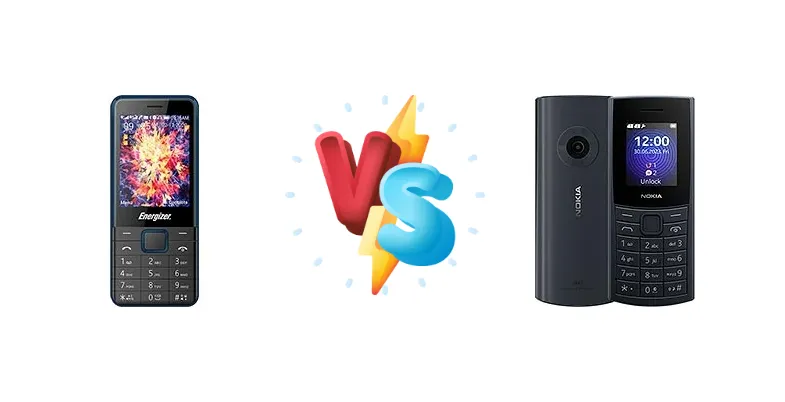
In a market dominated by smartphones, basic feature phones continue to hold appeal for those seeking simplicity, affordability, and long battery life. We pit the Energizer E28, equipped with a Spreadtrum chipset, against the Nokia 110 4G 2nd Edition to determine which offers the best experience for users prioritizing core communication features.
🏆 Quick Verdict
For users needing basic 4G connectivity and potential for slightly more advanced feature phone functionality, the Energizer E28 is the better choice due to its Spreadtrum SC6531E chipset. The Nokia 110 4G 2nd Edition remains a viable option for those prioritizing extreme simplicity and Nokia's brand reputation.
| Network |
|---|
| 2G bands | GSM 850 / 900 / 1800 / 1900 | GSM 900 / 1800 |
| 3G bands | - | HSDPA 850 / 900 / 1700(AWS) / 1900 / 2100 |
| 4G bands | - | LTE |
| EDGE | No | - |
| GPRS | Yes | - |
| Speed | - | HSPA, LTE |
| Technology | GSM | GSM / HSPA / LTE |
| Launch |
|---|
| Announced | 2021, April. Released 2021, April | 2024, December |
| Status | Discontinued | Available. Released 2024, December |
| Body |
|---|
| Dimensions | 134.5 x 56 x 16.9 mm (5.30 x 2.20 x 0.67 in) | 121.5 x 50 x 14.4 mm (4.78 x 1.97 x 0.57 in) |
| SIM | Dual SIM (Mini-SIM, Micro-SIM) | · Nano-SIM· Nano-SIM + Nano-SIM |
| Weight | 113 g (3.99 oz) | 94.5 g (3.35 oz) |
| | Flashlight | - |
| Display |
|---|
| Resolution | 240 x 320 pixels, 4:3 ratio (~143 ppi density) | 120 x 160 pixels, 4:3 ratio (~111 ppi density) |
| Size | 2.8 inches, 24.3 cm2 (~32.2% screen-to-body ratio) | 1.8 inches, 10.0 cm2 (~16.5% screen-to-body ratio) |
| Type | TFT LCD, 256K colors | IPS LCD |
| Platform |
|---|
| Chipset | Spreadtrum SC6531E | - |
| Memory |
|---|
| Call records | Yes | Yes |
| Card slot | microSD | microSDHC |
| Internal | - | 48MB 128MB RAM |
| Phonebook | Yes | Yes |
| Main Camera |
|---|
| Features | LED flash | - |
| Single | QVGA | QVGA |
| Video | Yes | Yes |
| Sound |
|---|
| 3.5mm jack | Yes | - |
| 35mm jack | Yes | Yes |
| Loudspeaker | Yes | Yes |
| Comms |
|---|
| Bluetooth | 2.1 | 5.0, A2DP |
| NFC | No | No |
| Positioning | No | No |
| Radio | FM radio | Wireless FM radio |
| USB | microUSB | USB Type-C |
| WLAN | No | No |
| Features |
|---|
| Games | No | Yes |
| Java | No | No |
| Messaging | SMS | SMS |
| Battery |
|---|
| Type | Li-Ion 3000 mAh battery | Li-Ion 1450 mAh, removable |
| Misc |
|---|
| Colors | Black, Gray, Blue, White, Green, Brown, Yellow | Midnight Blue, Arctic Purple |
| Price | About 20 EUR | About 60 EUR |
Energizer E28
- 4G Connectivity via Spreadtrum SC6531E
- Potential for smoother UI navigation
- Likely supports more features than Nokia 110
- Limited camera quality
- Small display size
Nokia 110 4G 2nd Edition
- Extremely long standby time (potentially)
- Simple and easy to use interface
- Nokia brand reputation for reliability
- Lacks detailed chipset information
- Limited functionality compared to E28
Display Comparison
Given the nature of these devices, detailed display specifications are scarce. Both likely employ low-resolution color displays suitable for basic text and icon visibility. The Nokia 110 4G 2nd Edition, historically, has focused on maximizing battery life, potentially resulting in a lower brightness display compared to the Energizer E28, which may prioritize slightly better visibility due to the chipset's capabilities. Bezels are expected to be substantial on both models.
Camera Comparison
Both devices likely feature basic VGA cameras primarily intended for occasional snapshots. Image quality will be limited on both, and should not be considered a primary purchasing factor. The Energizer E28’s chipset *could* support slightly improved image processing, but expectations should remain low. The absence of detailed camera specs suggests neither phone is geared towards photography.
Performance
The Energizer E28’s Spreadtrum SC6531E chipset represents a significant advantage. This chipset, while not powerful, provides a foundation for 4G connectivity and potentially more responsive menu navigation compared to the Nokia 110 4G 2nd Edition, which lacks publicly available chipset information. The Nokia likely utilizes a simpler, older chipset focused solely on 2G/4G voice and text. This translates to a smoother user experience for data-driven tasks on the Energizer. RAM specifications are unavailable for either device, but are likely minimal (under 128MB) on both.
Battery Life
Both the Energizer E28 and Nokia 110 4G 2nd Edition prioritize long battery life. The Energizer E28’s chipset, while enabling 4G, is designed for low power consumption. The Nokia 110 4G 2nd Edition, with its potentially simpler chipset, may achieve slightly longer standby times. However, actual battery performance will heavily depend on network conditions and usage patterns. Charging times are expected to be slow on both devices, utilizing micro-USB connectivity.
Buying Guide
Buy the Energizer E28 if you need 4G connectivity for occasional data use, want a slightly more modern feature phone experience, and appreciate the potential for future software updates enabled by the chipset. Buy the Nokia 110 4G 2nd Edition if you prioritize absolute simplicity, a long-established brand known for durability, and minimal feature set – ideal for emergency communication or as a secondary device.
Frequently Asked Questions
❓ Does the Energizer E28 support VoLTE (Voice over LTE)?
Given the inclusion of the Spreadtrum SC6531E chipset, which supports 4G, it is highly probable that the Energizer E28 supports VoLTE. This allows for clearer voice calls over 4G networks, but compatibility depends on your carrier.
❓ Can I use WhatsApp on either of these phones?
While technically possible, the experience will be limited. WhatsApp requires a data connection, which both phones offer via 4G. However, the small screen size and limited processing power will make using WhatsApp cumbersome. Basic text messaging is the primary intended use case.
❓ Is the Nokia 110 4G 2nd Edition a good choice for elderly users?
Yes, the Nokia 110 4G 2nd Edition is an excellent choice for elderly users or those who prefer a very simple phone. Its straightforward interface, large buttons, and long battery life make it easy to use for basic communication.