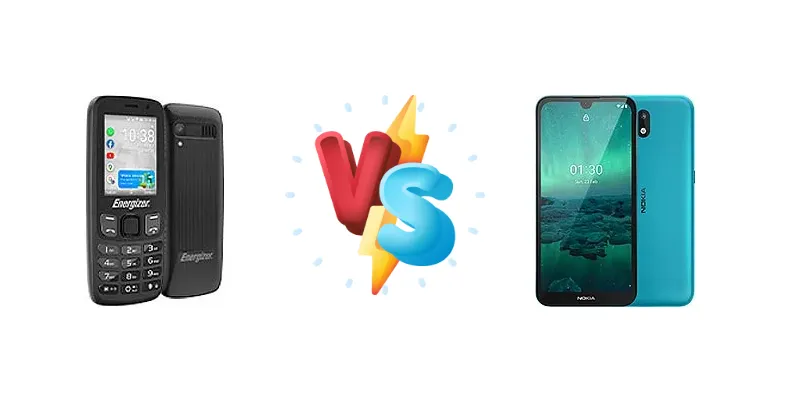
The Energizer E242s and Nokia 1.3 represent the absolute bottom end of the smartphone market, targeting users who prioritize affordability above all else. Both devices run Android (Go Edition) to ensure a usable experience on limited hardware. This comparison dissects their key differences to determine which offers the best value for the money.
🏆 Quick Verdict
For the average user seeking a functional, ultra-budget smartphone, the Energizer E242s edges out the Nokia 1.3. While both offer a basic Android experience, the E242s’ Mediatek MT6739 chipset, despite its age, provides a slight performance advantage over the Qualcomm Snapdragon 215, making it more responsive for everyday tasks.
| Network |
|---|
| 2G bands | GSM 850 / 900 / 1800 / 1900 | GSM 850 / 900 / 1800 / 1900 |
| 3G bands | HSDPA 850 / 900 / 2100 | HSDPA 850 / 900 / 2100 - International |
| 4G bands | 1, 3, 7, 8, 20, 28, 38, 40, 41 | 1, 3, 5, 7, 8, 20, 28 - International |
| Speed | HSPA, LTE | HSPA 42.2/5.76 Mbps, LTE Cat4 150/50 Mbps |
| Technology | GSM / HSPA / LTE | GSM / HSPA / LTE |
| | - | 1, 2, 3, 4, 5, 7, 8, 12, 17, 28, 66 - LATAM |
| Launch |
|---|
| Announced | 2022, April 10 | 2020, March 19. Released 2020, April 02 |
| Status | Available. Released 2022, April 10 | Discontinued |
| Body |
|---|
| Build | - | Glass front, plastic back, plastic frame |
| Dimensions | 130.8 x 53.6 x 13 mm (5.15 x 2.11 x 0.51 in) | 147.3 x 71.2 x 9.4 mm (5.80 x 2.80 x 0.37 in) |
| SIM | Dual SIM (Micro-SIM, dual stand-by) | · Nano-SIM· Nano-SIM + Nano-SIM |
| Weight | 116 g (4.09 oz) | 155 g (5.47 oz) |
| Display |
|---|
| Resolution | 240 x 320 pixels, 4:3 ratio (~167 ppi density) | 720 x 1520 pixels, 19:9 ratio (~295 ppi density) |
| Size | 2.4 inches, 17.8 cm2 (~25.4% screen-to-body ratio) | 5.71 inches, 81.4 cm2 (~77.6% screen-to-body ratio) |
| Type | TFT LCD, 256K colors | IPS LCD, 400 nits (typ) |
| Platform |
|---|
| CPU | Quad-core 1.5 GHz | Quad-core 1.3 GHz Cortex-A53 |
| Chipset | Mediatek MT6739 | Qualcomm QM215 Snapdragon 215 (28 nm) |
| GPU | PowerVR GE8100 | Adreno 308 |
| OS | KaiOS 2.5.3 | Android 10 (Go edition), upgradable to Android 11 (Go edition), Android One |
| Memory |
|---|
| Card slot | microSDHC | microSDXC (dedicated slot) |
| Internal | 4GB 512MB RAM | 16GB 1GB RAM |
| | - | eMMC 5.1 |
| Main Camera |
|---|
| Features | LED flash | LED flash, HDR |
| Single | 0.3 MP | 8 MP, (wide), AF |
| Video | Yes | 720p@30fps |
| Selfie camera |
|---|
| Single | 0.3 MP | 5 MP |
| Video | Yes | 720p@30fps |
| Sound |
|---|
| 3.5mm jack | Yes | Yes |
| 35mm jack | Yes | Yes |
| Loudspeaker | Yes | Yes |
| Comms |
|---|
| Bluetooth | 4.2, A2DP, LE | 4.2, A2DP, LE, aptX HD |
| NFC | No | No |
| Positioning | GPS | GPS, GLONASS, BDS |
| Radio | FM radio | FM radio |
| USB | microUSB | microUSB 2.0, OTG |
| WLAN | Yes | Wi-Fi 802.11 b/g/n |
| Features |
|---|
| Sensors | No | Accelerometer, proximity |
| | Downloadable applications Facebook, Gmail, Whatsapp, etc. | - |
| Battery |
|---|
| Type | Li-Ion 1700 mAh battery, removable | Li-Po 3000 mAh, removable |
| Misc |
|---|
| Colors | Black, Blue, Pink, Gold, Silver | Cyan, Charcoal, Sand |
| Models | - | TA-1216, TA-1205 |
| Price | About 40 EUR | About 170 EUR |
| SAR | - | 0.64 W/kg (head) 1.17 W/kg (body) |
| SAR EU | - | 0.38 W/kg (head) 0.86 W/kg (body) |
Energizer E242s
- Slightly better CPU performance
- Larger battery capacity
- Potentially lower price
- Less reputable brand
- Likely lower quality display
- Limited software support
Nokia 1.3
- More recognizable brand (Nokia)
- Cleaner Android experience
- Potentially better modem performance
- Slower CPU performance
- Smaller battery capacity
- Higher price
Display Comparison
Neither device boasts a standout display. Specifications are unavailable for the E242s display, but given its price point, it's likely a low-resolution IPS LCD. The Nokia 1.3 features a 5.71-inch HD+ (1520 x 720) IPS LCD. The Snapdragon 215’s GPU is less capable of driving higher resolutions or refresh rates, meaning the Nokia 1.3’s display is likely the limiting factor in visual performance. Both will suffer from narrow viewing angles and limited brightness, making outdoor visibility a challenge.
Camera Comparison
Camera performance on both devices will be extremely limited. Details on the E242s camera are scarce, but it likely features a basic single-lens setup. The Nokia 1.3 features a 13MP main camera and a 5MP front camera. While megapixels aren't everything, the larger sensor on the Nokia 1.3 will capture more light. However, the Snapdragon 215’s image signal processor (ISP) is basic, and image quality will be poor in anything less than ideal lighting conditions. Expect soft details, limited dynamic range, and significant noise. The 2MP depth sensor on the Nokia 1.3 is largely inconsequential.
Performance
The core difference lies in the chipsets. The Energizer E242s utilizes the Mediatek MT6739, a quad-core processor clocked at 1.5 GHz. The Nokia 1.3 employs the Qualcomm Snapdragon 215, also a quad-core processor, but clocked slightly lower at 1.3 GHz and built on a more efficient 28nm process. While the clock speed is lower, the Snapdragon 215’s Cortex-A53 cores are architecturally more efficient than the MT6739’s. However, the MT6739 generally benchmarks higher in CPU performance. Both phones will struggle with demanding applications, but the E242s will likely feel slightly snappier in everyday use. Neither device is suitable for gaming beyond very basic titles.
Battery Life
Battery capacity for the E242s is 4000mAh, while the Nokia 1.3 has a smaller 3000mAh battery. The Snapdragon 215’s 28nm process offers better power efficiency, potentially offsetting the smaller battery capacity. However, the MT6739’s higher performance demands will likely consume more power. Both phones will likely achieve a full day of light use, but heavy users will need to charge before the end of the day. Charging speeds are unknown for both devices, but are likely to be slow due to the use of micro-USB ports.
Buying Guide
Buy the Energizer E242s if you need a marginally more responsive experience for basic tasks like calling, texting, and light web browsing. Its chipset offers a small performance boost. Buy the Nokia 1.3 if you prioritize brand reputation and a cleaner, more stock Android experience, and are willing to accept slightly slower performance. The Nokia 1.3 also benefits from Qualcomm’s generally better modem performance, potentially leading to more reliable cellular connectivity.
Frequently Asked Questions
❓ Will the Energizer E242s struggle with popular social media apps like Facebook and WhatsApp?
While it will run them, expect a sluggish experience. The Mediatek MT6739 is a low-end processor, and these apps are not optimized for such limited hardware. Expect slow loading times and occasional lag. Using the 'Lite' versions of these apps (Facebook Lite, WhatsApp Lite) is highly recommended.
❓ Is the Nokia 1.3 a good choice for someone upgrading from a feature phone?
Yes, the Nokia 1.3 is a reasonable entry point into the world of smartphones, particularly for those unfamiliar with Android. Its simpler interface and stock Android experience are less overwhelming than more complex devices. However, be prepared for limited performance and a basic camera.
❓ Can either of these phones handle video streaming services like YouTube?
Both phones can technically stream YouTube videos, but the experience will be limited to lower resolutions (480p or 720p) due to the processors and displays. Expect buffering and occasional stuttering, especially on slower Wi-Fi connections.
❓ What version of Android do these phones run, and will they receive updates?
Both phones run Android (Go Edition), a lightweight version of Android designed for devices with limited resources. Software update support is limited for both devices, especially the Energizer E242s. The Nokia 1.3 may receive a single major Android update, but long-term support is unlikely.