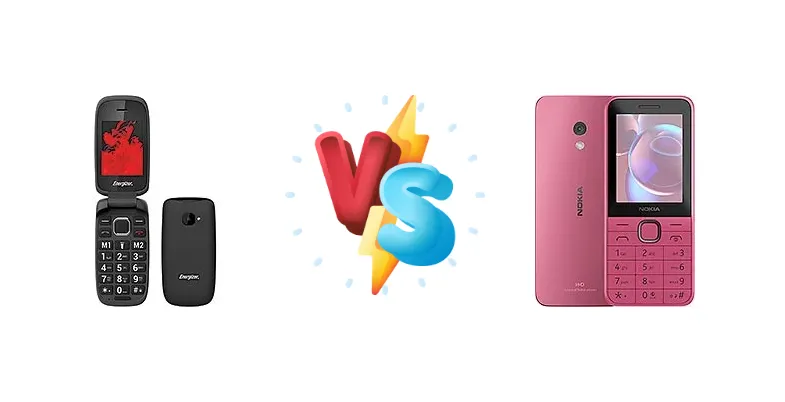
In a market dominated by smartphones, basic feature phones continue to hold appeal for their simplicity and extended battery life. We're pitting the Energizer E20+ against the newly released Nokia 225 4G (2024) to determine which offers the best balance of functionality and value for users prioritizing core communication features.
🏆 Quick Verdict
For the average user seeking a reliable 4G feature phone, the Nokia 225 4G (2024) is the clear winner. Its Unisoc T107 chipset delivers a significantly faster and more responsive experience than the Energizer E20+'s aging Mediatek MT6261D, making everyday tasks like messaging and browsing noticeably smoother.
| Network |
|---|
| 2G bands | GSM 850 / 900 / 1800 / 1900 | GSM 850 / 900 / 1800 / 1900 |
| 3G bands | - | HSDPA 850 / 900 / 2100 |
| 4G bands | - | 1, 3, 5, 7, 8, 20, 28, 38, 40, 41 - EU, EMEA, APAC |
| EDGE | No | - |
| GPRS | Yes | - |
| Speed | - | HSPA, LTE |
| Technology | GSM | GSM / HSPA / LTE |
| Launch |
|---|
| Announced | 2023, November | 2024, April 30 |
| Status | Available. Released 2023, December | Available. Released 2024, May |
| Body |
|---|
| Dimensions | 105 x 52.6 x 19.9 mm (4.13 x 2.07 x 0.78 in) | 121.5 x 52 x 11.6 mm (4.78 x 2.05 x 0.46 in) |
| SIM | Dual SIM (Mini-SIM, dual stand-by) | Nano-SIM + Nano-SIM |
| Weight | - | - |
| Display |
|---|
| Resolution | 240 x 320 pixels, 4:3 ratio (~167 ppi density) | 240 x 320 pixels, 4:3 ratio (~167 ppi density) |
| Size | 2.4 inches, 17.8 cm2 (~32.3% screen-to-body ratio) | 2.4 inches, 17.8 cm2 (~28.2% screen-to-body ratio) |
| Type | TFT | TFT LCD |
| Platform |
|---|
| CPU | Single-core 260 MHz | 1.0 GHz Cortex-A7 |
| Chipset | Mediatek MT6261D | Unisoc T107 (22 nm) |
| Memory |
|---|
| Call records | Yes | Yes |
| Card slot | microSDHC | microSDHC |
| Internal | - | 128MB 64MB RAM |
| Phonebook | Yes | Yes |
| Main Camera |
|---|
| Features | - | LED flash |
| Single | QVGA | 0.3 MP |
| Video | Yes | Yes |
| Sound |
|---|
| 35mm jack | No | Yes |
| Loudspeaker | Yes | Yes |
| Comms |
|---|
| Bluetooth | 3.0 | 5.0, A2DP, LE |
| NFC | No | No |
| Positioning | No | No |
| Radio | FM radio | Wireless FM radio |
| USB | USB Type-C | USB Type-C |
| WLAN | No | No |
| Features |
|---|
| Games | No | Yes |
| Java | No | No |
| Messaging | SMS | SMS |
| Sensors | - | No |
| Battery |
|---|
| Type | 1000 mAh | Li-Ion 1450 mAh, removable |
| Misc |
|---|
| Colors | Black | Pink, Dark Blue |
| Price | About 20 EUR | - |
Energizer E20+
- Potentially lower price point
- Extremely simple interface
- Long standby time (typical of basic feature phones)
- Extremely slow processor
- Limited functionality
- Poor web browsing experience
Nokia 225 4G (2024)
- Significantly faster processor
- Improved web browsing experience
- More responsive user interface
- 4G connectivity for faster data speeds
- Slightly higher price
- Still limited app ecosystem
Display Comparison
Both phones likely feature basic color displays, typical of this market segment. However, detailed display specs (resolution, brightness) are unavailable. The focus here isn't display quality, but usability, and a faster processor (Nokia) will make navigating the interface on any given display more pleasant. We can assume both displays prioritize power efficiency over visual fidelity.
Camera Comparison
Neither phone is intended for serious photography. Both likely feature basic VGA or 2MP cameras. Given the limited processing power on both devices, image quality will be minimal. The camera is primarily for occasional snapshots, and the chipset difference won't dramatically impact the resulting image quality. Focusing on camera specs here is largely irrelevant.
Performance
The core difference lies in the chipsets. The Energizer E20+ utilizes the Mediatek MT6261D, a single-core processor clocked at a mere 260 MHz. This is a very basic processor designed for minimal tasks. In contrast, the Nokia 225 4G (2024) boasts the Unisoc T107, a quad-core processor running at 1.0 GHz. This represents a substantial leap in processing power. The Unisoc T107, built on a 22nm process, is far more efficient and capable of handling modern web browsing and app functionality (even if limited) found on feature phones. The Cortex-A7 architecture in the Unisoc chip is also significantly more advanced than the architecture used in the MT6261D.
Battery Life
While specific battery capacities are not provided, feature phones generally excel in battery life. The more efficient Unisoc T107 in the Nokia 225 4G (2024) will likely contribute to longer standby and talk times compared to the Energizer E20+. However, the actual difference will depend on network conditions and usage patterns. The Nokia's processor efficiency will likely translate to more hours of use per charge.
Buying Guide
Buy the Energizer E20+ if you absolutely need the lowest possible upfront cost and are willing to tolerate a very sluggish user experience. It's a phone for minimalists who only need basic calling and texting. Buy the Nokia 225 4G (2024) if you value a more responsive interface, faster 4G connectivity, and a generally more modern feature phone experience, even at a slightly higher price point.
Frequently Asked Questions
❓ Will the Nokia 225 4G (2024) handle WhatsApp or Facebook Lite smoothly?
The Unisoc T107 processor in the Nokia 225 4G (2024) is significantly more capable of running lightweight apps like WhatsApp and Facebook Lite compared to the Energizer E20+'s Mediatek MT6261D. While not a smartphone experience, you can expect a more responsive and usable experience with these apps on the Nokia.
❓ Is the 4G connectivity on the Nokia 225 4G (2024) actually useful on a feature phone?
Yes, 4G connectivity on the Nokia 225 4G (2024) provides a noticeable improvement in browsing speed and responsiveness compared to 2G or 3G. This is particularly beneficial for accessing web-based services or using apps like WhatsApp, making the overall experience much more enjoyable.
❓ How much faster is the Nokia 225 4G (2024) compared to the Energizer E20+ in real-world use?
The Nokia 225 4G (2024) is substantially faster. The 1.0 GHz quad-core Unisoc T107 versus the 260 MHz single-core Mediatek MT6261D translates to quicker app loading times, smoother web browsing, and a more responsive user interface. Tasks that feel sluggish or unresponsive on the Energizer E20+ will be noticeably faster on the Nokia.