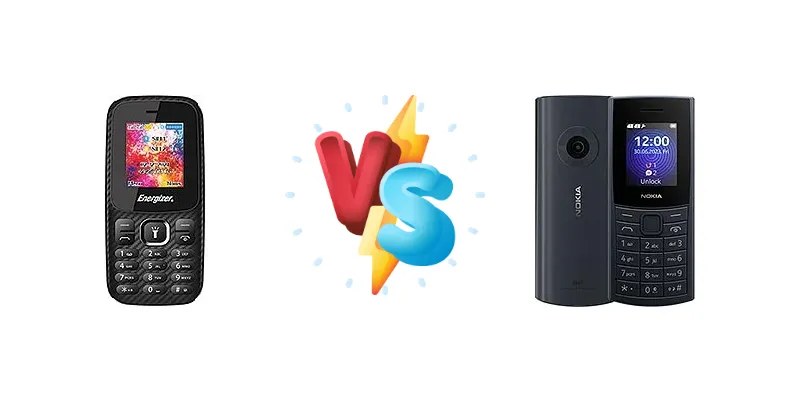
In a world dominated by smartphones, the feature phone persists, offering simplicity and extended battery life. We pit the Energizer E13, powered by a Mediatek chipset, against the Nokia 110 4G 2nd Edition, a popular choice in the ultra-budget segment, to determine which reigns supreme for users prioritizing core communication features.
🏆 Quick Verdict
For users needing a slight performance edge and a known chipset, the Energizer E13 is the better choice. Its Mediatek MT6261D, while basic, provides a defined level of processing power. The Nokia 110 4G 2nd Edition remains a viable option, but lacks publicly available detailed specifications for a comprehensive comparison.
| Network |
|---|
| 2G bands | GSM 850 / 900 / 1800 / 1900 | GSM 900 / 1800 |
| 3G bands | - | HSDPA 850 / 900 / 1700(AWS) / 1900 / 2100 |
| 4G bands | - | LTE |
| EDGE | No | - |
| GPRS | Yes | - |
| Speed | - | HSPA, LTE |
| Technology | GSM | GSM / HSPA / LTE |
| Launch |
|---|
| Announced | 2022, June | 2024, December |
| Status | Available. Released 2022, June | Available. Released 2024, December |
| Body |
|---|
| Dimensions | 116 x 50 x 14.5 mm (4.57 x 1.97 x 0.57 in) | 121.5 x 50 x 14.4 mm (4.78 x 1.97 x 0.57 in) |
| SIM | Dual SIM (Mini-SIM) | · Nano-SIM· Nano-SIM + Nano-SIM |
| Weight | 73 g (2.57 oz) | 94.5 g (3.35 oz) |
| Display |
|---|
| Resolution | 128 x 160 pixels (~116 ppi density) | 120 x 160 pixels, 4:3 ratio (~111 ppi density) |
| Size | 1.77 inches, 9.9 cm2 (~17.0% screen-to-body ratio) | 1.8 inches, 10.0 cm2 (~16.5% screen-to-body ratio) |
| Type | TFT LCD, 256K colors | IPS LCD |
| Platform |
|---|
| CPU | Single-core 312 MHz | - |
| Chipset | Mediatek MT6261D | - |
| Memory |
|---|
| Call records | Yes | Yes |
| Card slot | microSD | microSDHC |
| Internal | - | 48MB 128MB RAM |
| Phonebook | Yes | Yes |
| Main Camera |
|---|
| Single | VGA | QVGA |
| Video | Yes | Yes |
| Sound |
|---|
| 35mm jack | Yes | Yes |
| Loudspeaker | Yes | Yes |
| Comms |
|---|
| Bluetooth | 2.1 | 5.0, A2DP |
| NFC | No | No |
| Positioning | No | No |
| Radio | FM radio | Wireless FM radio |
| USB | microUSB | USB Type-C |
| WLAN | No | No |
| Features |
|---|
| Games | No | Yes |
| Java | No | No |
| Messaging | SMS | SMS |
| Battery |
|---|
| Type | Li-Ion 1000 mAh battery | Li-Ion 1450 mAh, removable |
| Misc |
|---|
| Colors | Black | Midnight Blue, Arctic Purple |
| Price | About 10 EUR | About 60 EUR |
Energizer E13
- Known chipset (Mediatek MT6261D) provides a baseline performance expectation.
- Likely offers a slightly more responsive user interface due to the defined chipset.
- Potential for basic app functionality beyond core communication.
- Single-core processor limits multitasking capabilities.
- Low-resolution display expected.
Nokia 110 4G 2nd Edition
- Strong brand reputation for reliability in the feature phone market.
- Potentially optimized software for efficient operation.
- Long battery life expected, typical of feature phones.
- Lack of publicly available detailed specifications hinders a comprehensive comparison.
- Uncertain chipset performance.
Display Comparison
Neither device is expected to boast a high-resolution or particularly vibrant display. Given the target market, both likely utilize basic LCD panels. Without specific details on the Nokia 110 4G 2nd Edition’s display, it’s difficult to assess relative quality. The focus here is functionality over visual fidelity.
Camera Comparison
Both devices are unlikely to excel in photography. Feature phones typically feature low-resolution cameras primarily for basic image capture. Without specifications for the Nokia 110 4G 2nd Edition, it’s safe to assume its camera capabilities are similar to, or slightly below, the Energizer E13’s expected low-resolution sensor. Image quality should be considered secondary to core communication features.
Performance
The Energizer E13’s Mediatek MT6261D chipset, featuring a single-core 312 MHz CPU, represents a defined level of processing capability. While not powerful by modern standards, it allows for basic functions like calling, texting, and potentially simple games. The Nokia 110 4G 2nd Edition’s chipset remains unspecified, making a direct performance comparison impossible. However, Nokia typically optimizes its software for efficient operation on modest hardware, suggesting a comparable, if undocumented, experience.
Battery Life
Feature phones are renowned for their exceptional battery life. Both the Energizer E13 and Nokia 110 4G 2nd Edition are expected to offer days, if not weeks, of standby time on a single charge. The Energizer E13’s chipset, being a relatively low-power design, contributes to efficient energy consumption. Without battery capacity details for the Nokia 110 4G 2nd Edition, a direct comparison of 0-100% charging times is impossible, but both will likely charge relatively quickly due to their small battery sizes.
Buying Guide
Buy the Energizer E13 if you need a feature phone with a known chipset and a slightly more responsive user experience, even within the limitations of a basic device. Buy the Nokia 110 4G 2nd Edition if you prioritize brand reputation for reliability in the feature phone space and are comfortable with limited publicly available technical details, potentially valuing its established market presence.
Frequently Asked Questions
❓ What kind of network connectivity does the Energizer E13 offer beyond basic 2G?
The Energizer E13, powered by the Mediatek MT6261D, supports 2G and 3G networks. While it doesn't support 4G, it provides a reliable connection for voice calls and text messaging in areas with 2G/3G coverage.
❓ Is the Nokia 110 4G 2nd Edition a good choice for international travel?
The Nokia 110 4G 2nd Edition, as the name suggests, supports 4G connectivity, making it potentially useful for international travel where 4G networks are available. However, compatibility depends on the specific frequency bands supported by the device and the networks in the destination country. Check compatibility before traveling.
❓ Can I use WhatsApp or other messaging apps on the Energizer E13?
While the Energizer E13's chipset *could* theoretically support basic versions of some messaging apps, compatibility is not guaranteed and performance will likely be limited. The single-core processor and limited RAM may struggle to run these apps smoothly. It's primarily designed for voice and SMS communication.