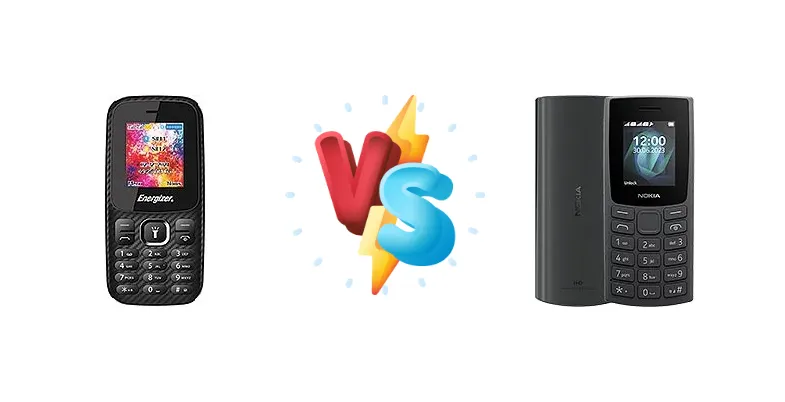
In a world dominated by smartphones, the feature phone persists, offering simplicity and extended battery life. We pit the Energizer E13, powered by a Mediatek chipset, against the Nokia 105 4G 2nd Edition, a popular choice in the ultra-affordable 4G space, to determine which reigns supreme for users prioritizing core communication features.
🏆 Quick Verdict
For users needing basic 4G connectivity and a known brand reputation, the Nokia 105 4G 2nd Edition is the better choice, despite lacking detailed specifications. The Energizer E13's Mediatek MT6261D chipset offers a known baseline, but the Nokia's established market presence and likely optimized software provide a more reliable experience.
| Network |
|---|
| 2G bands | GSM 850 / 900 / 1800 / 1900 | GSM 900 / 1800 |
| 3G bands | - | HSDPA 850 / 900 / 1700(AWS) / 1900 / 2100 |
| 4G bands | - | LTE |
| EDGE | No | - |
| GPRS | Yes | - |
| Speed | - | HSPA, LTE |
| Technology | GSM | GSM / HSPA / LTE |
| Launch |
|---|
| Announced | 2022, June | 2024, December |
| Status | Available. Released 2022, June | Available. Released 2024, December |
| Body |
|---|
| Dimensions | 116 x 50 x 14.5 mm (4.57 x 1.97 x 0.57 in) | 121.5 x 50 x 14.4 mm (4.78 x 1.97 x 0.57 in) |
| SIM | Dual SIM (Mini-SIM) | · Nano-SIM· Nano-SIM + Nano-SIM |
| Weight | 73 g (2.57 oz) | 93 g (3.28 oz) |
| Display |
|---|
| Resolution | 128 x 160 pixels (~116 ppi density) | 120 x 160 pixels, 4:3 ratio (~111 ppi density) |
| Size | 1.77 inches, 9.9 cm2 (~17.0% screen-to-body ratio) | 1.8 inches, 10.0 cm2 (~16.5% screen-to-body ratio) |
| Type | TFT LCD, 256K colors | IPS LCD |
| Platform |
|---|
| CPU | Single-core 312 MHz | - |
| Chipset | Mediatek MT6261D | - |
| Memory |
|---|
| Call records | Yes | Yes |
| Card slot | microSD | microSDHC |
| Internal | - | 48MB 128MB RAM |
| Phonebook | Yes | Yes |
| Main Camera |
|---|
| Single | VGA | - |
| Video | Yes | - |
| Sound |
|---|
| 35mm jack | Yes | Yes |
| Loudspeaker | Yes | Yes |
| Comms |
|---|
| Bluetooth | 2.1 | 5.0, A2DP |
| NFC | No | No |
| Positioning | No | No |
| Radio | FM radio | Wireless FM radio |
| USB | microUSB | USB Type-C |
| WLAN | No | No |
| Features |
|---|
| Games | No | Yes |
| Java | No | No |
| Messaging | SMS | SMS |
| Battery |
|---|
| Type | Li-Ion 1000 mAh battery | Li-Ion 1450 mAh, removable |
| Misc |
|---|
| Colors | Black | Charcoal |
| Price | About 10 EUR | About 50 EUR |
Energizer E13
- Known chipset (MT6261D) for transparency
- Documented CPU clock speed (312 MHz)
- Affordable price point
- Limited performance due to single-core CPU
- Basic feature set
- Likely low-resolution display
Nokia 105 4G 2nd Edition
- 4G connectivity for faster data speeds
- Established brand reputation (Nokia)
- Potentially optimized software for battery life
- Lack of detailed specifications
- Uncertain chipset performance
- Basic feature set
Display Comparison
Neither device is expected to boast a high-resolution or particularly vibrant display. Both will likely feature basic color LCDs optimized for readability rather than media consumption. Without specific display specs for the Nokia 105 4G 2nd Edition, it's reasonable to assume a similar, low-resolution panel to the Energizer E13, prioritizing power efficiency over visual fidelity.
Camera Comparison
Both devices are unlikely to feature cameras of significant quality. Feature phones typically include basic cameras for occasional snapshots, and detailed specifications are rarely a priority. Any camera present on either device should be considered for basic documentation rather than photography. The absence of detailed camera specs for the Nokia 105 4G 2nd Edition reinforces this expectation.
Performance
The Energizer E13's Mediatek MT6261D chipset, featuring a single-core 312 MHz CPU, represents a baseline level of performance suitable for calls, texts, and basic menu navigation. The Nokia 105 4G 2nd Edition's chipset remains unspecified, but given its market positioning, it likely offers comparable, if not slightly optimized, performance. The single-core nature of the Energizer's CPU means multitasking is virtually non-existent on either device, focusing on single-application use.
Battery Life
Both phones excel in battery life due to their low-power chipsets and basic feature sets. The Energizer E13, with its MT6261D, will likely offer several days of standby time and extended talk time. The Nokia 105 4G 2nd Edition, benefiting from Nokia's optimization experience, likely achieves similar or better battery performance, despite the power draw of 4G connectivity. Actual usage will vary based on network signal strength and call frequency.
Buying Guide
Buy the Energizer E13 if you need a phone with a specifically documented chipset (MT6261D) for development or testing purposes, or if you prioritize knowing the exact CPU clock speed. Buy the Nokia 105 4G 2nd Edition if you prefer a widely-available, brand-trusted device with 4G connectivity and a focus on call quality and battery longevity, even without detailed hardware specifications.
Frequently Asked Questions
❓ Does the Nokia 105 4G 2nd Edition support VoLTE calling?
Given its 4G connectivity, the Nokia 105 4G 2nd Edition likely supports VoLTE (Voice over LTE) calling, ensuring continued voice service even as 3G networks are phased out. However, compatibility depends on your carrier, so verifying with your provider is recommended.
❓ Can the Energizer E13 be used with a microSD card to expand storage?
While the Energizer E13's internal storage capacity is likely limited, it's common for feature phones to include a microSD card slot for storage expansion. Checking the device's documentation or product listing is crucial to confirm microSD card support and maximum capacity.
❓ Is the Nokia 105 4G 2nd Edition dual SIM capable?
The Nokia 105 4G 2nd Edition is frequently offered in a dual SIM variant, allowing users to utilize two separate SIM cards simultaneously. This is a valuable feature for those needing to manage multiple phone numbers or take advantage of different carrier plans.