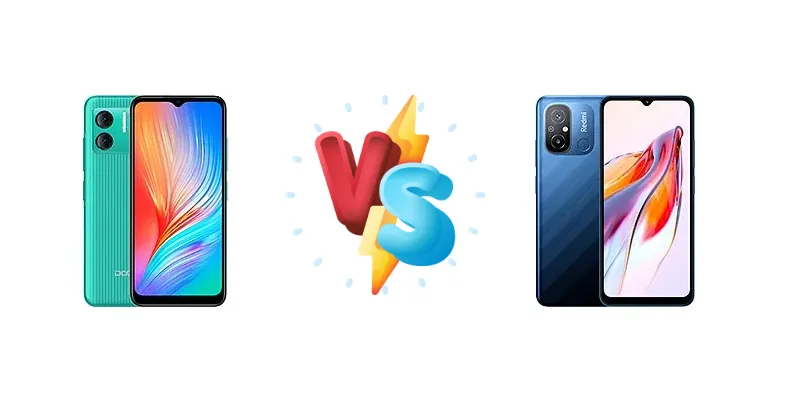
The Doogee X98 and Xiaomi Redmi 12C represent the fiercely competitive sub-$150 smartphone market. Both aim to deliver essential smartphone functionality at an accessible price, but they take different approaches to achieving this. The X98 relies on a simpler, older chipset, while the Redmi 12C opts for a more modern, albeit still entry-level, processor. This comparison will dissect their key differences to determine which device offers the best value.
🏆 Quick Verdict
For the average user prioritizing responsiveness and multitasking, the Xiaomi Redmi 12C is the clear winner. Its Helio G85 chipset, with its octa-core configuration, provides a significantly smoother experience than the Doogee X98’s quad-core Helio A22. While the X98 may offer slightly better battery life due to its less powerful processor, the performance gains of the Redmi 12C outweigh this advantage.
| Network |
|---|
| 2G bands | GSM 850 / 900 / 1800 / 1900 | GSM 850 / 900 / 1800 / 1900 |
| 3G bands | HSDPA 850 / 900 / 1900 / 2100 | HSDPA 850 / 900 / 2100 |
| 4G bands | 1, 3, 5, 7, 8, 20, 34, 38, 39, 40, 41 | 1, 3, 5, 7, 8, 20, 28, 38, 40, 41 - International |
| Speed | HSPA, LTE | HSPA, LTE |
| Technology | GSM / HSPA / LTE | GSM / CDMA / HSPA / EVDO / LTE |
| | - | CDMA2000 1xEV-DO |
| Launch |
|---|
| Announced | 2022, November | 2022, December 31 |
| Status | Available. Released 2022, November 10 | Available. Released 2023, January 01 |
| Body |
|---|
| Dimensions | 165.3 x 76.3 x 8.8 mm (6.51 x 3.00 x 0.35 in) | 168.8 x 76.4 x 8.8 mm (6.65 x 3.01 x 0.35 in) |
| SIM | Nano-SIM + Nano-SIM | Nano-SIM + Nano-SIM |
| Weight | - | 192 g (6.77 oz) |
| Display |
|---|
| Resolution | 720 x 1600 pixels, 20:9 ratio (~269 ppi density) | 720 x 1650 pixels (~268 ppi density) |
| Size | 6.52 inches, 102.6 cm2 (~81.4% screen-to-body ratio) | 6.71 inches, 106.5 cm2 (~82.6% screen-to-body ratio) |
| Type | IPS LCD | IPS LCD, 500 nits (typ) |
| Platform |
|---|
| CPU | Quad-core 2.0 GHz Cortex-A53 | Octa-core (2x2.0 GHz Cortex-A75 & 6x1.8 GHz Cortex-A55) |
| Chipset | Mediatek MT6761 Helio A22 (12 nm) | Mediatek MT6769Z Helio G85 (12 nm) |
| GPU | PowerVR GE8320 | Mali-G52 MC2 |
| OS | Android 12 | Android 12, MIUI 13 |
| Memory |
|---|
| Card slot | microSDXC (uses shared SIM slot) | microSDXC (dedicated slot) |
| Internal | 16GB 3GB RAM | 32GB 2GB RAM, 32GB 3GB RAM, 32GB 4GB RAM, 64GB 3GB RAM, 64GB 4GB RAM, 128GB 3GB RAM, 128GB 4GB RAM, 128GB 6GB RAM |
| | - | eMMC 5.1 |
| Main Camera |
|---|
| Dual | 8 MP, f/1.8, (wide)
Auxiliary lens | 50 MP, (wide), PDAF
0.08 MP (depth) |
| Features | Triple-LED flash, HDR, panorama | LED flash, HDR |
| Single | - | 50 MP, f/1.8, (wide), 1/2.76", PDAF
Auxiliary lens |
| Video | Yes | 1080p@30fps |
| Selfie camera |
|---|
| Single | 5 MP, f/2.2, (wide) | 5 MP, f/2.2, (wide) |
| Video | Yes | 1080p@30fps |
| Sound |
|---|
| 3.5mm jack | - | Yes |
| 35mm jack | Yes | Yes |
| Loudspeaker | Yes | Yes |
| Comms |
|---|
| Bluetooth | 5.0, A2DP, LE | 5.1, A2DP, LE |
| NFC | No | Yes (market/region dependent) |
| Positioning | GPS, GLONASS, BDS, GALILEO | GPS, GLONASS, BDS, GALILEO |
| Radio | FM radio | FM radio |
| USB | USB Type-C 2.0, OTG | microUSB 2.0 |
| WLAN | Wi-Fi 802.11 a/b/g/n/ac, dual-band | Wi-Fi 802.11 a/b/g/n/ac, dual-band, Wi-Fi Direct |
| Features |
|---|
| Sensors | Accelerometer, proximity | Fingerprint (rear-mounted), accelerometer |
| | - | Virtual proximity sensing |
| Battery |
|---|
| Charging | - | 10W wired |
| Type | 4200 mAh | Li-Po 5000 mAh |
| Misc |
|---|
| Colors | Emerald Green, Ocean Blue, Graphite Gray | Graphite Gray, Ocean Blue, Mint Green, Lavender Purple |
| Models | - | 22120RN86G, 22120RN86I, 22126RN91Y, 2212ARNC4L |
| Price | About 100 EUR | £ 132.99 / € 107.41 |
| SAR | - | 1.08 W/kg (head) 0.64 W/kg (body) |
| SAR EU | - | 0.98 W/kg (head) 0.99 W/kg (body) |
Doogee X98
- Potentially longer battery life due to less powerful processor
- Lower price point (potentially)
- Simple and straightforward user experience
- Significantly slower performance compared to the Redmi 12C
- Less responsive user interface
- Limited multitasking capabilities
Xiaomi Redmi 12C
- Faster and more responsive performance with the Helio G85
- Smoother multitasking and app loading times
- Better gaming experience (for light gaming)
- Xiaomi’s software optimization
- Slightly shorter battery life compared to the X98
- Slower 10W charging
- May be slightly more expensive
Display Comparison
Neither device is expected to boast a high-end display. Both utilize 12nm chipsets, suggesting a focus on cost optimization over display technology. While specific display specs (resolution, brightness) are not provided, the Redmi 12C’s larger user base suggests a potentially better-optimized display calibration. The X98, lacking brand recognition in display quality, likely offers a more basic viewing experience. Bezels are expected to be substantial on both devices, typical of this price bracket.
Camera Comparison
Without detailed camera specifications, a direct comparison is difficult. However, it’s safe to assume both devices feature basic camera setups geared towards casual photography. The Redmi 12C, benefiting from Xiaomi’s image processing expertise, likely delivers more consistently pleasing results, even with similar sensor hardware. The X98, lacking the same software optimization, may produce images with less dynamic range and accuracy. The prevalence of 2MP macro lenses on both devices suggests limited utility; these sensors typically offer low image quality and are more of a marketing feature than a practical tool.
Performance
The performance gap is the most significant differentiator. The Xiaomi Redmi 12C’s Mediatek Helio G85 is an octa-core processor featuring two Cortex-A75 cores clocked at 2.0 GHz and six Cortex-A55 cores at 1.8 GHz. This architecture provides a substantial advantage over the Doogee X98’s Mediatek Helio A22, which is a quad-core processor with four Cortex-A53 cores clocked at 2.0 GHz. The G85’s more modern architecture and higher core count translate to faster app loading times, smoother multitasking, and a more enjoyable overall user experience. The Redmi 12C is better suited for running multiple apps simultaneously and handling more demanding tasks. Thermal management is unlikely to be a major concern on either device, given the relatively low power consumption of these chipsets.
Battery Life
Both devices likely feature similar battery capacities (around 5000mAh is typical for this segment). However, the Doogee X98’s less powerful Helio A22 processor will consume less energy, potentially resulting in slightly longer battery life. The Redmi 12C’s 10W charging, while slow by modern standards, is typical for this price point. The difference in battery life is unlikely to be dramatic; users should expect a full day of light to moderate use from both devices. The Redmi 12C’s performance benefits likely outweigh the marginal battery life advantage of the X98.
Buying Guide
Buy the Doogee X98 if you need a basic smartphone for extremely light tasks like calls, texts, and occasional web browsing, and prioritize maximum battery longevity over performance. Buy the Xiaomi Redmi 12C if you prefer a more responsive experience for social media, light gaming, and multitasking, and are willing to accept slightly shorter battery life. The Redmi 12C is the better choice for anyone who doesn't want to constantly fight with lag.
Frequently Asked Questions
❓ Will the Redmi 12C struggle with popular apps like Facebook and WhatsApp?
No, the Helio G85 in the Redmi 12C is more than capable of handling everyday apps like Facebook, WhatsApp, and Instagram. While it won't offer a flagship-level experience, it will provide a smooth and responsive experience for these common tasks. The Doogee X98 may exhibit noticeable lag when running these apps.
❓ Is the 10W charging on the Redmi 12C painfully slow?
Yes, 10W charging is relatively slow compared to modern standards. Expect a full charge to take around 3-4 hours. However, this is typical for smartphones in this price range. The slower charging speed is a trade-off for the lower cost.
❓ Can the Redmi 12C handle any mobile games?
The Redmi 12C can handle light mobile games like Candy Crush or Subway Surfers without issue. More demanding games like PUBG Mobile will be playable at lower settings and frame rates. The Doogee X98 will struggle with even moderately demanding games.
❓ Does the Doogee X98 have any notable software features?
The Doogee X98 likely runs a near-stock version of Android with minimal customization. It doesn't offer the same level of software features or updates as Xiaomi's MIUI, which is found on the Redmi 12C.