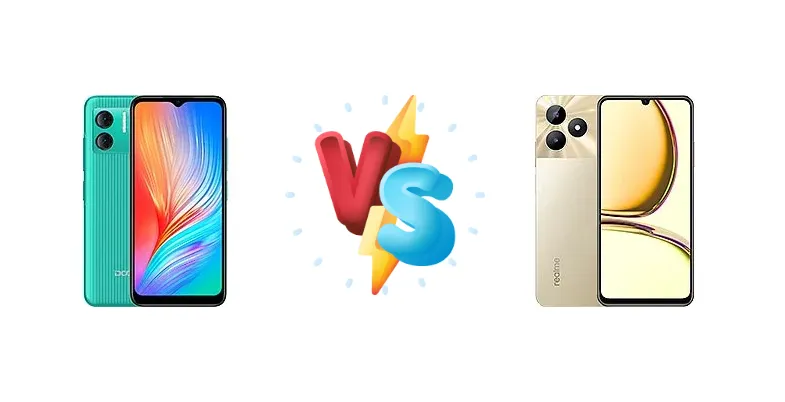
The sub-$150 smartphone market is fiercely competitive. The Doogee X98, a long-standing budget option, faces a new challenger in the Realme C53 (specifically the India variant). This comparison dives deep into the core differences – primarily the chipset – to determine which phone delivers the best experience for everyday tasks and light usage.
🏆 Quick Verdict
For most users, the Realme C53 (India) is the superior choice. Its Unisoc Tiger T612 chipset, with its octa-core configuration, provides a significantly more responsive experience than the Doogee X98’s quad-core Helio A22. While both phones target the ultra-budget segment, the C53 offers a noticeable performance uplift.
| Network |
|---|
| 2G bands | GSM 850 / 900 / 1800 / 1900 | GSM 850 / 900 / 1800 / 1900 |
| 3G bands | HSDPA 850 / 900 / 1900 / 2100 | HSDPA 850 / 900 / 2100 |
| 4G bands | 1, 3, 5, 7, 8, 20, 34, 38, 39, 40, 41 | 1, 3, 5, 8, 38, 40, 41 |
| Speed | HSPA, LTE | HSPA, LTE |
| Technology | GSM / HSPA / LTE | GSM / HSPA / LTE |
| Launch |
|---|
| Announced | 2022, November | 2023, July 19 |
| Status | Available. Released 2022, November 10 | Available. Released 2023, July 26 |
| Body |
|---|
| Build | - | Glass front, plastic frame, plastic back |
| Dimensions | 165.3 x 76.3 x 8.8 mm (6.51 x 3.00 x 0.35 in) | 167.2 x 76.7 x 8 mm (6.58 x 3.02 x 0.31 in) |
| SIM | Nano-SIM + Nano-SIM | Nano-SIM + Nano-SIM |
| Weight | - | 186 g (6.56 oz) |
| Display |
|---|
| Resolution | 720 x 1600 pixels, 20:9 ratio (~269 ppi density) | 1080 x 2400 pixels, 20:9 ratio (~390 ppi density) |
| Size | 6.52 inches, 102.6 cm2 (~81.4% screen-to-body ratio) | 6.74 inches, 109.7 cm2 (~85.5% screen-to-body ratio) |
| Type | IPS LCD | IPS LCD, 90Hz, 560 nits (peak) |
| Platform |
|---|
| CPU | Quad-core 2.0 GHz Cortex-A53 | Octa-core (2x1.8 GHz Cortex-A75 & 6x1.8 GHz Cortex-A55) |
| Chipset | Mediatek MT6761 Helio A22 (12 nm) | Unisoc Tiger T612 (12 nm) |
| GPU | PowerVR GE8320 | Mali-G57 |
| OS | Android 12 | Android 13, Realme UI |
| Memory |
|---|
| Card slot | microSDXC (uses shared SIM slot) | microSDXC (dedicated slot) |
| Internal | 16GB 3GB RAM | 64GB 6GB RAM, 128GB 4GB RAM, 128GB 6GB RAM |
| Main Camera |
|---|
| Dual | 8 MP, f/1.8, (wide)
Auxiliary lens | 108 MP, (wide), PDAF
Auxiliary lens |
| Features | Triple-LED flash, HDR, panorama | LED flash, HDR, panorama |
| Video | Yes | 1080p@30fps |
| Selfie camera |
|---|
| Features | - | HDR |
| Single | 5 MP, f/2.2, (wide) | 8 MP, (wide) |
| Video | Yes | 720p@30fps |
| Sound |
|---|
| 35mm jack | Yes | Yes |
| Loudspeaker | Yes | Yes |
| Comms |
|---|
| Bluetooth | 5.0, A2DP, LE | 5.0, A2DP, LE |
| NFC | No | No |
| Positioning | GPS, GLONASS, BDS, GALILEO | GPS, GLONASS, GALILEO |
| Radio | FM radio | Unspecified |
| USB | USB Type-C 2.0, OTG | USB Type-C 2.0 |
| WLAN | Wi-Fi 802.11 a/b/g/n/ac, dual-band | Wi-Fi 802.11 a/b/g/n/ac, dual-band |
| Features |
|---|
| Sensors | Accelerometer, proximity | Fingerprint (side-mounted), accelerometer, gyro, proximity, compass |
| Battery |
|---|
| Charging | - | 18W wired |
| Type | 4200 mAh | 5000 mAh |
| Misc |
|---|
| Colors | Emerald Green, Ocean Blue, Graphite Gray | Gold, Black |
| Models | - | RMX3762 |
| Price | About 100 EUR | About 110 EUR |
Doogee X98
- Potentially lower price point
- Simple and straightforward user experience
- May have longer standby time due to less powerful processor
- Significantly slower performance
- Limited multitasking capabilities
- Poor gaming performance
Realme C53 (India)
- Faster and more responsive performance
- 18W fast charging support
- Better multitasking capabilities
- May be slightly more expensive
- Potentially shorter battery life under heavy load
- Software updates may be less frequent
Display Comparison
Neither Doogee nor Realme provide detailed display specifications beyond size. Given the price point, expect both to utilize IPS LCD panels. The absence of information regarding peak brightness, color gamut coverage, or refresh rates suggests both displays are geared towards basic visibility rather than media consumption. Bezels are likely to be substantial on both devices, contributing to a less immersive viewing experience. Color accuracy is expected to be standard for this segment.
Camera Comparison
Detailed camera specifications are lacking for both devices. However, it’s safe to assume both will feature a primary camera and potentially a secondary depth or macro sensor. Given the market segment, image quality will be adequate for social media sharing in good lighting conditions, but expect significant noise and limited dynamic range in low light. The absence of Optical Image Stabilization (OIS) on either device means relying on software processing for stabilization. The Realme C53’s image processing algorithms are likely to be more refined, offering slightly better results, but the core sensor quality is likely similar.
Performance
The core difference lies in the chipsets. The Doogee X98’s MediaTek Helio A22 is a quad-core processor built on a 12nm process. This is a basic chipset designed for minimal tasks. The Realme C53 (India) boasts the Unisoc Tiger T612, an octa-core processor (2x1.8 GHz Cortex-A75 & 6x1.8 GHz Cortex-A55) also on a 12nm process. The T612’s octa-core architecture, and inclusion of Cortex-A75 cores, provides a substantial performance advantage in multi-tasking and app loading times. While both are 12nm, the architectural differences mean the T612 will handle more demanding applications with greater ease. The Realme C53 will offer a far smoother experience when switching between apps or browsing the web.
Battery Life
Battery capacity isn’t specified for the Doogee X98, but typical budget phones in this class feature around 4000-5000mAh. The Realme C53 (India) supports 18W wired charging, a feature absent on the Doogee X98. While 18W isn’t fast charging by modern standards, it will significantly reduce charging times compared to a standard 5W or 10W charger. The Realme C53’s faster charging capability, combined with potentially optimized power management from the Unisoc chipset, will likely result in a more convenient user experience.
Buying Guide
Buy the Doogee X98 if your primary need is a very basic smartphone for essential communication – calls, texts, and minimal app usage – and you prioritize absolute affordability. Buy the Realme C53 (India) if you want a smoother, more capable device for social media, light gaming, and a generally more responsive user experience, even if it means spending slightly more.
Frequently Asked Questions
❓ Will the Unisoc Tiger T612 in the Realme C53 handle popular games like PUBG Mobile?
The Unisoc Tiger T612 can run PUBG Mobile, but expect to play at lower graphics settings (Low or Medium) and frame rates to maintain a stable experience. It's not a gaming powerhouse, but it's significantly more capable than the Helio A22 in the Doogee X98, which would struggle even at the lowest settings.
❓ Is the lack of detailed display specs a major concern for everyday use on either phone?
For typical usage – browsing, social media, messaging – the lack of detailed display specs isn't a dealbreaker. Both phones likely offer adequate visibility for these tasks. However, if you frequently watch videos or consume media, you might notice the limitations of a basic IPS LCD panel with potentially low brightness and narrow viewing angles.
❓ How does the software experience differ between Doogee and Realme?
Realme UI, based on Android, is generally considered more polished and feature-rich than Doogee's custom Android skin. Realme typically provides more frequent software updates and security patches, offering a longer software support lifecycle. Doogee's software experience is often more basic and may contain more pre-installed bloatware.