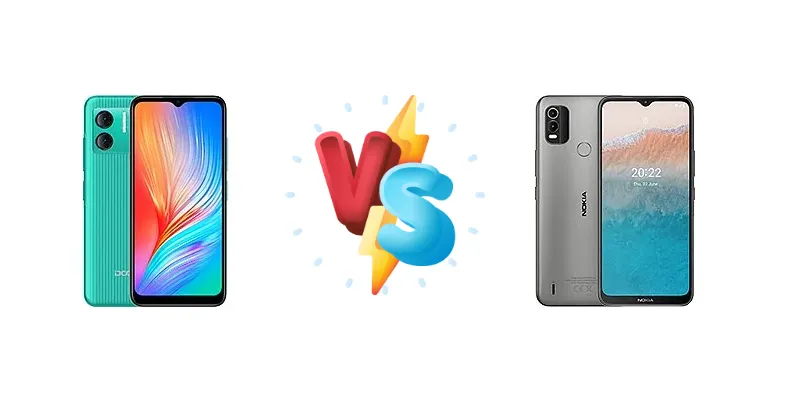
The Doogee X98 and Nokia C21 Plus represent the extreme end of the smartphone price spectrum. Both aim to deliver essential functionality at a minimal cost, but they take different approaches to achieving this. The X98 relies on a Mediatek Helio A22, while the C21 Plus opts for a Unisoc SC9863A. This comparison will dissect the implications of these chipset choices and determine which device offers the best value for budget-conscious users.
🏆 Quick Verdict
For the average user prioritizing multitasking and smoother app switching, the Nokia C21 Plus is the better choice. Its octa-core Unisoc SC9863A, despite being built on a larger process node, provides a noticeable performance advantage over the Doogee X98’s quad-core Helio A22. However, the X98 may offer slightly better sustained performance in very light tasks due to the more efficient manufacturing process.
| Network |
|---|
| 2G bands | GSM 850 / 900 / 1800 / 1900 | GSM 850 / 900 / 1800 / 1900 |
| 3G bands | HSDPA 850 / 900 / 1900 / 2100 | HSDPA 850 / 900 / 2100 |
| 4G bands | 1, 3, 5, 7, 8, 20, 34, 38, 39, 40, 41 | LTE |
| Speed | HSPA, LTE | HSPA 42.2/5.76 Mbps, LTE Cat4 150/50 Mbps |
| Technology | GSM / HSPA / LTE | GSM / HSPA / LTE |
| | - | HSDPA 850 / 900 / 1700(AWS) / 1900 / 2100 |
| Launch |
|---|
| Announced | 2022, November | 2022, February 28 |
| Status | Available. Released 2022, November 10 | Available. Released 2022, April 29 |
| Body |
|---|
| Build | - | Glass front, aluminum frame, plastic back |
| Dimensions | 165.3 x 76.3 x 8.8 mm (6.51 x 3.00 x 0.35 in) | 164.8 x 75.9 x 8.6 mm (6.49 x 2.99 x 0.34 in) |
| SIM | Nano-SIM + Nano-SIM | · Nano-SIM· Nano-SIM + Nano-SIM |
| Weight | - | 178 g or 191 g (6.28 oz) |
| | - | Splash protection |
| Display |
|---|
| Protection | - | Scratch-resistant glass |
| Resolution | 720 x 1600 pixels, 20:9 ratio (~269 ppi density) | 720 x 1600 pixels, 20:9 ratio (~269 ppi density) |
| Size | 6.52 inches, 102.6 cm2 (~81.4% screen-to-body ratio) | 6.52 inches, 102.6 cm2 (~82.1% screen-to-body ratio) |
| Type | IPS LCD | IPS LCD |
| Platform |
|---|
| CPU | Quad-core 2.0 GHz Cortex-A53 | Octa-core (4x1.6 GHz Cortex-A55 & 4x1.2 GHz Cortex-A55) |
| Chipset | Mediatek MT6761 Helio A22 (12 nm) | Unisoc SC9863A (28 nm) |
| GPU | PowerVR GE8320 | IMG8322 |
| OS | Android 12 | Android 11 (Go edition) |
| Memory |
|---|
| Card slot | microSDXC (uses shared SIM slot) | microSDXC (dedicated slot) |
| Internal | 16GB 3GB RAM | 32GB 2GB RAM, 32GB 3GB RAM, 64GB 2GB RAM, 64GB 3GB RAM, 64GB 4GB RAM |
| | - | eMMC 5.1 |
| Main Camera |
|---|
| Dual | 8 MP, f/1.8, (wide)
Auxiliary lens | 13 MP, (wide), AF
Auxiliary lens |
| Features | Triple-LED flash, HDR, panorama | LED flash, HDR, panorama |
| Single | - | 5 MP |
| Video | Yes | 1080p@30fps |
| Selfie camera |
|---|
| Features | - | LED flash |
| Single | 5 MP, f/2.2, (wide) | 5 MP |
| Video | Yes | 720p |
| Sound |
|---|
| 3.5mm jack | - | Yes |
| 35mm jack | Yes | Yes |
| Loudspeaker | Yes | Yes |
| Comms |
|---|
| Bluetooth | 5.0, A2DP, LE | 4.2, A2DP |
| NFC | No | No |
| Positioning | GPS, GLONASS, BDS, GALILEO | GPS |
| Radio | FM radio | FM radio |
| USB | USB Type-C 2.0, OTG | microUSB 2.0 |
| WLAN | Wi-Fi 802.11 a/b/g/n/ac, dual-band | Wi-Fi 802.11 b/g/n |
| Features |
|---|
| Sensors | Accelerometer, proximity | Fingerprint (rear-mounted), accelerometer, proximity |
| Battery |
|---|
| Charging | - | 10W wired |
| Type | 4200 mAh | Li-Ion 4000/5050 mAh |
| Misc |
|---|
| Colors | Emerald Green, Ocean Blue, Graphite Gray | Dark Cyan, Warm Gray |
| Models | - | TA-1433, TA-1431, TA-1426, TA-1424 |
| Price | About 100 EUR | About 120 EUR |
| SAR | - | 0.57 W/kg (head) 0.65 W/kg (body) |
| SAR EU | - | 0.40 W/kg (head) 0.99 W/kg (body) |
Doogee X98
- Potentially more efficient 12nm process
- Simpler software experience (likely)
- Lower price point (potentially)
- Quad-core processor limits multitasking
- Older CPU architecture (Cortex-A53)
- Unknown charging speed
Nokia C21 Plus
- Octa-core processor for smoother performance
- Newer CPU architecture (Cortex-A55)
- Defined 10W charging
- Less efficient 28nm process
- Potentially shorter battery life
- May run Android Go edition (limiting features)
Display Comparison
Neither device boasts a standout display. Details regarding panel type, brightness, and color accuracy are unavailable, suggesting both utilize basic LCD panels common in this price bracket. The focus here is on functionality over fidelity. Bezels are likely to be substantial on both, maximizing screen real estate within a compact form factor. Expect standard 60Hz refresh rates on both devices.
Camera Comparison
Camera performance is unlikely to be a strong suit for either device. Details on sensor sizes and lens apertures are missing, but given the price point, expect basic image quality. The inclusion of a 2MP macro camera on either device is largely a marketing tactic, offering minimal practical benefit. Image processing will be basic, and low-light performance will be poor. The focus should be on capturing memories, not creating professional-quality photos.
Performance
The core difference lies in the chipsets. The Doogee X98’s Mediatek Helio A22 (12nm) features a quad-core Cortex-A53 CPU clocked at 2.0 GHz. This is a relatively older architecture. Conversely, the Nokia C21 Plus utilizes the Unisoc SC9863A (28nm) with an octa-core configuration – four Cortex-A55 cores at 1.6 GHz and four at 1.2 GHz. While the A53 cores in the X98 have a higher clock speed, the C21 Plus’s eight cores and newer A55 architecture provide superior multitasking capabilities. The larger 28nm process node of the Unisoc chip will likely result in higher power consumption, but the benefit of more cores is significant for responsiveness. The X98 may struggle with even moderately demanding apps.
Battery Life
Battery capacity details are unavailable for both devices. However, the Nokia C21 Plus includes 10W wired charging, while the Doogee X98’s charging speed is unknown. The Unisoc SC9863A’s less efficient 28nm process will likely lead to faster battery drain compared to the Helio A22’s 12nm process. The 10W charging on the C21 Plus will be slow, but it’s a defined specification, whereas the X98’s charging speed remains a question mark. Expect all-day battery life with conservative usage on both devices.
Buying Guide
Buy the Doogee X98 if you need a phone for extremely basic tasks like calls, texts, and light social media browsing, and prioritize potential long-term efficiency. Buy the Nokia C21 Plus if you prefer a more responsive experience for everyday use, including running multiple apps simultaneously, and value the benefits of an octa-core processor, even if it means slightly reduced battery life and slower charging.
Frequently Asked Questions
❓ Will the Nokia C21 Plus struggle with popular apps like Facebook or WhatsApp?
While the Unisoc SC9863A isn't a powerhouse, its octa-core configuration should handle Facebook and WhatsApp without significant issues. However, expect some lag when switching between apps or loading complex content. The C21 Plus is designed for basic social media usage, not intensive multitasking.
❓ Is the Doogee X98 suitable for playing mobile games?
The Doogee X98 is not recommended for gaming. The Helio A22’s limited processing power and graphics capabilities will result in a poor gaming experience, even with less demanding titles. Expect low frame rates, stuttering, and long loading times.
❓ Does the Nokia C21 Plus support software updates?
Nokia generally provides a reasonable level of software support for its budget devices, including security updates. However, major Android version updates are less likely. Expect at least a few years of security patches, but don't anticipate upgrading to the latest Android version.
❓ What version of Android do these phones run?
The Nokia C21 Plus likely ships with Android Go edition, a lightweight version of Android designed for devices with limited resources. The Doogee X98 may run a standard version of Android, but it's likely heavily customized and potentially bloated with pre-installed apps.