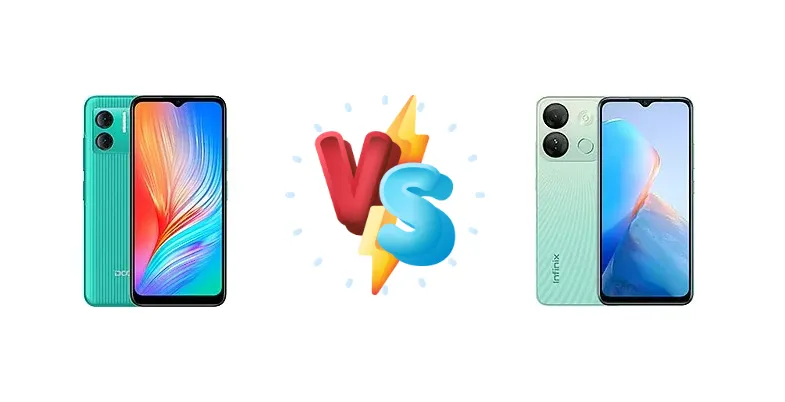
The Doogee X98 and Infinix Smart 7 HD represent the extreme end of the smartphone price spectrum. Both aim to deliver essential smartphone functionality at a minimal cost, but they take different approaches to achieving this. The Doogee X98 leverages a Mediatek Helio A22 chipset, while the Infinix Smart 7 HD opts for an octa-core processor. This comparison will dissect these differences to determine which device offers the best experience for budget-conscious users.
🏆 Quick Verdict
For the average user prioritizing multitasking and responsiveness, the Infinix Smart 7 HD is the better choice. Its octa-core CPU provides a noticeable performance advantage over the Doogee X98’s quad-core Helio A22, despite the latter’s more modern 12nm process. While the Doogee may offer slightly better efficiency, the performance gains of the Infinix outweigh this benefit in everyday use.
| Network |
|---|
| 2G bands | GSM 850 / 900 / 1800 / 1900 | GSM 850 / 900 / 1800 / 1900 |
| 3G bands | HSDPA 850 / 900 / 1900 / 2100 | HSDPA 850 / 900 / 2100 |
| 4G bands | 1, 3, 5, 7, 8, 20, 34, 38, 39, 40, 41 | 1, 3, 5, 8, 38, 40, 41 |
| Speed | HSPA, LTE | HSPA, LTE |
| Technology | GSM / HSPA / LTE | GSM / HSPA / LTE |
| | - | 1, 2, 3, 4, 5, 7, 8, 20, 28, 38, 40, 41 |
| Launch |
|---|
| Announced | 2022, November | 2023, April 14 |
| Status | Available. Released 2022, November 10 | Available. Released 2023, April 14 |
| Body |
|---|
| Build | - | Glass front, plastic back, plastic frame |
| Dimensions | 165.3 x 76.3 x 8.8 mm (6.51 x 3.00 x 0.35 in) | 163.9 x 75.5 x 8.7 mm (6.45 x 2.97 x 0.34 in) |
| SIM | Nano-SIM + Nano-SIM | Nano-SIM + Nano-SIM |
| Weight | - | 196.5 g (6.95 oz) |
| Display |
|---|
| Resolution | 720 x 1600 pixels, 20:9 ratio (~269 ppi density) | 720 x 1612 pixels, 20:9 ratio (~267 ppi density) |
| Size | 6.52 inches, 102.6 cm2 (~81.4% screen-to-body ratio) | 6.6 inches, 104.6 cm2 (~84.6% screen-to-body ratio) |
| Type | IPS LCD | IPS LCD, 500 nits |
| Platform |
|---|
| CPU | Quad-core 2.0 GHz Cortex-A53 | Octa-core 1.6 GHz |
| Chipset | Mediatek MT6761 Helio A22 (12 nm) | - |
| GPU | PowerVR GE8320 | - |
| OS | Android 12 | Android 12 (Go edition) |
| Memory |
|---|
| Card slot | microSDXC (uses shared SIM slot) | microSDXC (dedicated slot) |
| Internal | 16GB 3GB RAM | 64GB 2GB RAM |
| | - | UFS 2.1 |
| Main Camera |
|---|
| Dual | 8 MP, f/1.8, (wide)
Auxiliary lens | 8 MP, f/2.0
0.08 MP, (depth) |
| Features | Triple-LED flash, HDR, panorama | Dual-LED flash, HDR, panorama |
| Single | - | 8 MP, f/2.0
Auxiliary lens |
| Video | Yes | 1080p@30fps |
| Selfie camera |
|---|
| Features | - | LED flash |
| Single | 5 MP, f/2.2, (wide) | 5 MP, f/2.0 |
| Video | Yes | 720p@30fps |
| Sound |
|---|
| 3.5mm jack | - | Yes |
| 35mm jack | Yes | Yes |
| Loudspeaker | Yes | Yes |
| Comms |
|---|
| Bluetooth | 5.0, A2DP, LE | 5.0, A2DP, LE |
| NFC | No | No |
| Positioning | GPS, GLONASS, BDS, GALILEO | GPS |
| Radio | FM radio | FM radio |
| USB | USB Type-C 2.0, OTG | microUSB 2.0, OTG |
| WLAN | Wi-Fi 802.11 a/b/g/n/ac, dual-band | Wi-Fi 802.11 b/g/n |
| Features |
|---|
| Sensors | Accelerometer, proximity | Fingerprint (rear-mounted), accelerometer, proximity |
| Battery |
|---|
| Charging | - | 10W wired |
| Type | 4200 mAh | 5000 mAh |
| Misc |
|---|
| Colors | Emerald Green, Ocean Blue, Graphite Gray | Ink Black, Silk Blue, Jade White, Green Apple |
| Models | - | X6516 |
| Price | About 100 EUR | About 110 EUR |
Doogee X98
- Potentially better power efficiency due to 12nm process.
- Simple and straightforward user experience.
- May be more durable due to simpler hardware.
- Quad-core processor limits multitasking capabilities.
- Likely slower app loading times.
- Limited performance for demanding applications.
Infinix Smart 7 HD
- Octa-core processor provides smoother performance.
- Better multitasking capabilities.
- More responsive user interface.
- Potentially shorter battery life under heavy load.
- May experience more heat during intensive tasks.
- 10W charging is relatively slow.
Display Comparison
Neither device’s display specifications are provided, so a direct comparison is limited. However, given their price points, both likely utilize LCD panels with 720p+ resolutions. The absence of details like peak brightness or color gamut suggests neither prioritizes display quality. Users should expect basic viewing experiences suitable for everyday tasks, but not ideal for media consumption in bright sunlight.
Camera Comparison
Without specific camera sensor details, a meaningful comparison is difficult. Both phones likely feature basic camera setups geared towards casual photography. The absence of information regarding sensor size, aperture, or image stabilization suggests neither device will excel in low-light conditions or offer advanced photographic features. Users should expect acceptable image quality in good lighting, but limitations in challenging environments.
Performance
The core difference lies in the processors. The Doogee X98’s Mediatek MT6761 Helio A22 (12nm) is a quad-core processor clocked at 2.0 GHz. While the 12nm process *suggests* better power efficiency, the quad-core architecture is a significant limitation. The Infinix Smart 7 HD, conversely, features an octa-core processor clocked at 1.6 GHz. The increased core count provides a substantial advantage in multitasking and handling more demanding applications. The higher core count will translate to smoother app switching and a more responsive user interface, even if the clock speed is slightly lower. The Helio A22 is geared towards extremely basic tasks, while the Infinix’s processor offers a more versatile experience.
Battery Life
The Infinix Smart 7 HD includes 10W wired charging, a standard offering in this price range. The Doogee X98’s charging capabilities are unknown. While the Helio A22’s 12nm process *could* contribute to slightly better battery life, the performance demands of the Infinix’s octa-core processor may offset this advantage. Real-world battery performance will depend heavily on usage patterns, but the Infinix’s faster processor may drain the battery more quickly during intensive tasks.
Buying Guide
Buy the Doogee X98 if you primarily need a phone for basic communication – calls, texts, and light app usage – and value potential battery longevity. It’s a suitable option for first-time smartphone users or those needing a simple, reliable device. Buy the Infinix Smart 7 HD if you prefer a smoother, more responsive experience for social media, browsing, and occasional gaming. The octa-core processor provides a significant boost in multitasking and overall usability, making it ideal for users who demand more from their phone.
Frequently Asked Questions
❓ Will the Infinix Smart 7 HD struggle with popular apps like Facebook or WhatsApp?
While the Infinix Smart 7 HD is a budget device, its octa-core processor should handle apps like Facebook and WhatsApp without significant issues. You might experience some slowdown with multiple apps open simultaneously, but for typical social media usage, it should be adequate. The Doogee X98, with its quad-core processor, may exhibit more noticeable lag.
❓ Is the Doogee X98 a good choice for someone who rarely uses their smartphone?
Yes, the Doogee X98 is a suitable option for users with minimal smartphone needs. If you primarily use your phone for calls, texts, and occasional light browsing, the Helio A22 processor will suffice. Its potential for better battery efficiency could also be beneficial if you don't charge your phone frequently.
❓ Can the Infinix Smart 7 HD handle basic mobile games?
The Infinix Smart 7 HD can handle basic mobile games, but don't expect high frame rates or detailed graphics. Games like Candy Crush or simple puzzle games should run smoothly. More demanding titles may require reduced graphics settings and may still experience some lag. The Doogee X98 will likely struggle even with less demanding games.