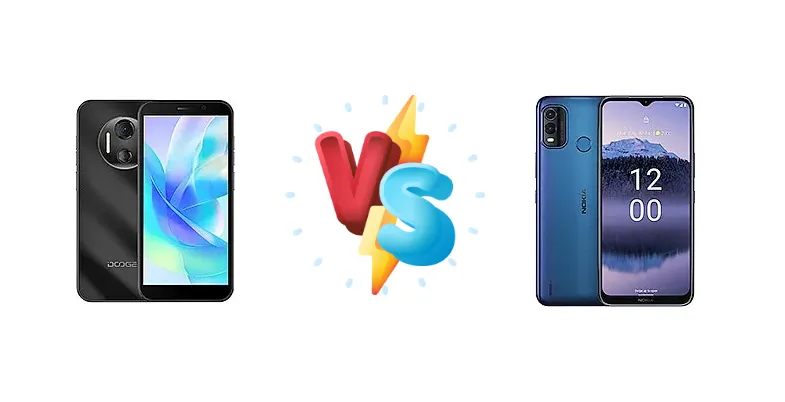
The Doogee X97 and Nokia G11 Plus represent the fiercely competitive sub-$150 smartphone market. Both aim to deliver essential functionality at an accessible price, but they take different approaches to achieving this. The Doogee X97 relies on a tried-and-true, if aging, MediaTek chipset, while the Nokia G11 Plus opts for a newer Unisoc processor. This comparison dives deep into the specifics to determine which device offers the best value.
🏆 Quick Verdict
For most users, the Nokia G11 Plus is the better choice. Its Unisoc T606 chipset, featuring an octa-core configuration, provides a noticeable performance uplift over the Doogee X97’s quad-core Helio A22. While both phones are limited in features, the G11 Plus offers a smoother user experience for everyday tasks, justifying its slight price premium.
| Network |
|---|
| 2G bands | GSM 850 / 900 / 1800 / 1900 | GSM 850 / 900 / 1800 / 1900 |
| 3G bands | HSDPA 800 / 850 / 900 / 1700(AWS) / 1900 / 2100 | HSDPA 850 / 900 / 2100 - International |
| 4G bands | 1, 2, 3, 4, 5, 7, 8, 12, 13, 17, 18, 19, 20, 25, 26, 34, 38, 39, 40, 41, 66 | 1, 3, 5, 7, 8, 20, 28, 38, 40, 41 - International |
| Speed | HSPA, LTE | HSPA 42.2/5.76 Mbps, LTE Cat4 150/50 Mbps |
| Technology | GSM / HSPA / LTE | GSM / HSPA / LTE |
| | - | 1, 3, 5, 8, 40, 41 - India |
| Launch |
|---|
| Announced | 2022, August | 2022, June 29 |
| Status | Available. Released 2022, August | Available. Released 2022, July 20 |
| Body |
|---|
| Build | - | Glass front, plastic frame, plastic back |
| Dimensions | 162 x 76.9 x 9.7 mm (6.38 x 3.03 x 0.38 in) | 164.8 x 75.9 x 8.6 mm (6.49 x 2.99 x 0.34 in) |
| SIM | Nano-SIM + Nano-SIM | · Nano-SIM· Nano-SIM + Nano-SIM |
| Weight | - | 192 g (6.77 oz) |
| | - | Splash protection |
| Display |
|---|
| Resolution | 720 x 1440 pixels, 18:9 ratio (~268 ppi density) | 720 x 1600 pixels, 20:9 ratio (~269 ppi density) |
| Size | 6.0 inches, 92.9 cm2 (~74.6% screen-to-body ratio) | 6.52 inches, 102.6 cm2 (~82.1% screen-to-body ratio) |
| Type | IPS LCD | IPS LCD, 90Hz, 400 nits (typ) |
| Platform |
|---|
| CPU | Quad-core 2.0 GHz Cortex-A53 | Octa-core (2x1.6 GHz Cortex-A75 & 6x1.6 GHz Cortex-A55) |
| Chipset | Mediatek MT6761 Helio A22 (12 nm) | Unisoc T606 (12 nm) |
| GPU | PowerVR GE8320 | Mali-G57 MP1 |
| OS | Android 12 | Android 12, upgradable to Android 13 |
| Memory |
|---|
| Card slot | microSDXC (dedicated slot) | microSDXC (dedicated slot) |
| Internal | 16GB 3GB RAM | 32GB 3GB RAM, 64GB 3GB RAM, 64GB 4GB RAM, 128GB 3GB RAM |
| | - | eMMC 5.1 |
| Main Camera |
|---|
| Dual | 8 MP, f/1.8, (wide)
Auxiliary lens | 50 MP, f/1.8, (wide), 1/2.67", PDAF
Auxiliary lens |
| Features | Triple-LED flash | LED flash |
| Single | - | 8 MP, f/2.0, (wide), 1/4.0" |
| Video | 720p | 1080p@30fps |
| Selfie camera |
|---|
| Single | 5 MP, f/2.2, (wide) | 8 MP, f/2.0, (wide), 1/4.0" |
| Video | 720p | 1080p@30fps |
| Sound |
|---|
| 3.5mm jack | - | Yes |
| 35mm jack | Yes | Yes |
| Loudspeaker | Yes | Yes |
| Comms |
|---|
| Bluetooth | 5.0, A2DP, LE | 5.0, A2DP, LE |
| NFC | No | No |
| Positioning | GPS, GLONASS, BDS, GALILEO | GPS |
| Radio | FM radio | FM radio |
| USB | USB Type-C 2.0, OTG | USB Type-C 2.0, OTG |
| WLAN | Wi-Fi 802.11 a/b/g/n/ac, dual-band | Wi-Fi 802.11 a/b/g/n/ac, dual-band, Wi-Fi Direct |
| Features |
|---|
| Sensors | Accelerometer, proximity, compass | Fingerprint (rear-mounted), accelerometer, proximity |
| Battery |
|---|
| Charging | - | 10W wired |
| Type | 4200 mAh | Li-Ion 5000 mAh |
| Misc |
|---|
| Colors | Black, Blue, Green | Lake Blue, Charcoal Grey |
| Price | About 100 EUR | About 130 EUR |
Doogee X97
- Potentially lower price point
- Simple and straightforward user experience
- May have slightly longer standby time due to less demanding chipset
- Significantly slower performance
- Struggles with multitasking
- Outdated chipset architecture
Nokia G11 Plus
- Faster and more responsive performance
- Octa-core processor handles multitasking better
- More modern chipset architecture
- Slower 10W charging
- Potentially slightly higher price
- Limited RAM may impact long-term performance
Display Comparison
Neither Doogee nor Nokia provide display specifications beyond the basic panel size. Given the price point, both likely utilize LCD panels with 720p+ resolutions. The absence of details like peak brightness or color gamut makes direct comparison difficult. However, the Nokia G11 Plus benefits from the more powerful chipset, potentially allowing for smoother scrolling and animations, improving the perceived display quality. Bezels are expected to be substantial on both devices, reflecting their budget nature.
Camera Comparison
Camera details are sparse for both devices. It’s safe to assume both feature a primary camera and potentially a depth or macro sensor. However, without knowing sensor sizes or apertures, a meaningful comparison is impossible. The image processing capabilities will largely depend on the chipset, giving the Nokia G11 Plus an edge due to its more powerful processor. Expect image quality to be adequate for social media sharing in good lighting conditions on both, but poor in low light. The inclusion of a 2MP macro camera on either device is largely a marketing gimmick and unlikely to produce usable results.
Performance
The core difference lies in the chipsets. The Doogee X97’s MediaTek Helio A22 is a quad-core processor based on a 12nm process. This is a relatively old architecture, designed for basic tasks. The Nokia G11 Plus, however, features the Unisoc T606, an octa-core chip (2x1.6 GHz Cortex-A75 & 6x1.6 GHz Cortex-A55) also on a 12nm process. The T606’s octa-core design, and inclusion of Cortex-A75 cores, provides a significant advantage in multi-tasking and more demanding applications. While both are entry-level, the Unisoc T606 offers a demonstrably smoother experience. The Doogee X97 will struggle with even moderately complex apps, while the G11 Plus can handle them with acceptable performance.
Battery Life
Battery capacity isn't specified for the Doogee X97, but given its market segment, it's likely around 4000-5000mAh. The Nokia G11 Plus doesn’t fare much better, offering only 10W wired charging. While the G11 Plus’s more efficient chipset *may* translate to slightly better battery life, the difference will likely be minimal. Both phones will require overnight charging, and neither offers fast charging capabilities. Real-world usage will dictate battery performance, but expect a full charge to last a day with moderate use on both devices.
Buying Guide
Buy the Doogee X97 if your primary need is a very basic smartphone for calls, texts, and extremely light app usage, and you prioritize minimizing cost above all else. Buy the Nokia G11 Plus if you want a more responsive device capable of handling social media, web browsing, and occasional gaming without significant lag, and you value a slightly more modern chipset architecture.
Frequently Asked Questions
❓ Will the Nokia G11 Plus struggle with popular apps like Facebook or WhatsApp?
While the Nokia G11 Plus isn't a powerhouse, its Unisoc T606 chipset is capable of running apps like Facebook and WhatsApp without significant issues. You might experience some slowdown with multiple apps open simultaneously, but for typical social media usage, it should be adequate. The Doogee X97 will likely exhibit more noticeable lag.
❓ Is the 10W charging on the Nokia G11 Plus a major drawback?
Yes, 10W charging is slow by modern standards. Expect a full charge to take several hours. However, given the limited battery capacity and the intended use case of these phones (basic tasks), it's not a deal-breaker. Overnight charging is recommended for both devices.
❓ Can either of these phones handle basic mobile games like Candy Crush or Subway Surfers?
The Nokia G11 Plus will handle casual games like Candy Crush and Subway Surfers reasonably well, though you may need to lower graphics settings. The Doogee X97 will struggle even with these games, experiencing significant frame rate drops and lag.
❓ What kind of storage options are available on these phones?
Both phones typically come with 32GB or 64GB of internal storage, expandable via microSD card. Given the limited storage, a microSD card is highly recommended for storing photos, videos, and apps.