
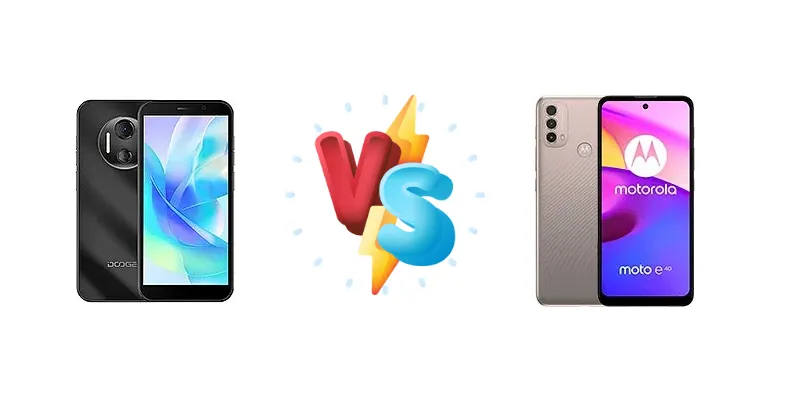
Doogee X97 vs Motorola Moto E40: Which Budget Phone Delivers More?
| Phones Images | |||||
|---|---|---|---|---|---|
|
🏆 Quick Verdict
For the average user prioritizing responsiveness and multitasking, the Motorola Moto E40 is the better choice. Its Unisoc T700, with its octa-core configuration, provides a noticeable performance advantage over the Doogee X97’s quad-core Helio A22, despite the slightly lower clock speed. While both phones are entry-level, the E40 offers a smoother user experience.
| PHONES | ||
|---|---|---|
| Phone Names | Doogee X97 | Motorola Moto E40 |
| Network | ||
|---|---|---|
| 2G bands | GSM 850 / 900 / 1800 / 1900 | GSM 850 / 900 / 1800 / 1900 |
| 3G bands | HSDPA 800 / 850 / 900 / 1700(AWS) / 1900 / 2100 | HSDPA 850 / 900 / 1700(AWS) / 1900 / 2100 |
| 4G bands | 1, 2, 3, 4, 5, 7, 8, 12, 13, 17, 18, 19, 20, 25, 26, 34, 38, 39, 40, 41, 66 | 1, 2, 3, 4, 5, 7, 8, 19, 28, 40, 66 - Brazil |
| Speed | HSPA, LTE | HSPA 42.2/5.76 Mbps, LTE Cat4 150/50 Mbps |
| Technology | GSM / HSPA / LTE | GSM / HSPA / LTE |
| Launch | ||
|---|---|---|
| Announced | 2022, August | 2021, October 07 |
| Status | Available. Released 2022, August | Available. Released 2021, October 11 |
| Body | ||
|---|---|---|
| Build | - | Glass front, plastic frame, plastic back |
| Dimensions | 162 x 76.9 x 9.7 mm (6.38 x 3.03 x 0.38 in) | 165.1 x 75.7 x 9.1 mm (6.5 x 2.98 x 0.36 in) |
| SIM | Nano-SIM + Nano-SIM | · Nano-SIM· Nano-SIM + Nano-SIM |
| Weight | - | 198 g (6.98 oz) |
| Display | ||
|---|---|---|
| Resolution | 720 x 1440 pixels, 18:9 ratio (~268 ppi density) | 720 x 1600 pixels, 20:9 ratio (~270 ppi density) |
| Size | 6.0 inches, 92.9 cm2 (~74.6% screen-to-body ratio) | 6.5 inches, 102.0 cm2 (~81.6% screen-to-body ratio) |
| Type | IPS LCD | IPS LCD, 90Hz |
| Platform | ||
|---|---|---|
| CPU | Quad-core 2.0 GHz Cortex-A53 | Octa-core 1.8 GHz |
| Chipset | Mediatek MT6761 Helio A22 (12 nm) | Unisoc T700 |
| GPU | PowerVR GE8320 | Mali G52 |
| OS | Android 12 | Android 11 |
| Memory | ||
|---|---|---|
| Card slot | microSDXC (dedicated slot) | microSDXC (dedicated slot) |
| Internal | 16GB 3GB RAM | 64GB 4GB RAM |
| - | eMMC 5.1 | |
| Main Camera | ||
|---|---|---|
| Dual | 8 MP, f/1.8, (wide) Auxiliary lens | - |
| Features | Triple-LED flash | LED flash, HDR, panorama |
| Triple | - | 48 MP, f/2.0, 26mm (wide), PDAF 2 MP (macro) Auxiliary lens |
| Video | 720p | 1080p@30fps |
| Selfie camera | ||
|---|---|---|
| Features | - | HDR |
| Single | 5 MP, f/2.2, (wide) | 8 MP, f/2.0 |
| Video | 720p | 1080p@30fps |
| Sound | ||
|---|---|---|
| 3.5mm jack | - | Yes |
| 35mm jack | Yes | Yes |
| Loudspeaker | Yes | Yes |
| Comms | ||
|---|---|---|
| Bluetooth | 5.0, A2DP, LE | 5.0, A2DP, LE |
| NFC | No | No |
| Positioning | GPS, GLONASS, BDS, GALILEO | GPS, GLONASS, GALILEO |
| Radio | FM radio | FM radio |
| USB | USB Type-C 2.0, OTG | USB Type-C 2.0 |
| WLAN | Wi-Fi 802.11 a/b/g/n/ac, dual-band | Wi-Fi 802.11 b/g/n |
| Features | ||
|---|---|---|
| Sensors | Accelerometer, proximity, compass | Fingerprint (rear-mounted), accelerometer, proximity |
| Battery | ||
|---|---|---|
| Charging | - | 10W wired |
| Type | 4200 mAh | Li-Po 5000 mAh |
| Misc | ||
|---|---|---|
| Colors | Black, Blue, Green | Carbon Gray, Pink Clay |
| Price | About 100 EUR | About 90 EUR |
Doogee X97
- Potentially more durable build quality (Doogee's reputation)
- Slightly higher CPU clock speed (though offset by core count)
- May receive longer software support due to brand focus
- Quad-core processor limits multitasking
- Helio A22 is an older, less efficient chipset
- Likely to struggle with demanding apps
Motorola Moto E40
- Octa-core Unisoc T700 offers better performance
- More responsive user experience
- Improved multitasking capabilities
- Slower 10W charging
- Unisoc chipsets have a less established track record
- Motorola's software update policy can be inconsistent
Display Comparison
Neither Doogee nor Motorola provide display specifications beyond the basic panel size. Given the price point, both likely utilize LCD panels with 720p+ resolutions. The absence of details like peak brightness or color gamut suggests neither phone excels in display quality. Users should expect a functional, but not visually stunning, experience. Bezels are likely to be substantial on both devices, maximizing screen real estate within a compact form factor.
Camera Comparison
Camera details are sparse for both devices. It’s safe to assume both feature a primary camera and potentially a secondary depth or macro sensor. However, without sensor size or aperture information, a direct comparison is difficult. The market segment suggests both will deliver acceptable results in good lighting conditions, but struggle in low light. The presence of a 2MP macro camera on either device is largely a marketing tactic, offering limited practical benefit due to the low resolution and lack of optical image stabilization (OIS).
Performance
The core difference lies in the chipsets. The Motorola Moto E40’s Unisoc T700 is an octa-core processor clocked at 1.8 GHz, offering significantly more processing power than the Doogee X97’s Mediatek Helio A22, a quad-core chip running at 2.0 GHz. While the A22 has a slightly higher clock speed, the T700’s additional cores provide superior multitasking capabilities. The Unisoc T700’s architecture is more modern, leading to better efficiency and responsiveness in everyday tasks. The Helio A22, while adequate for basic functions, will struggle with demanding applications. RAM configurations are not specified, but both will likely feature 2-3GB, further emphasizing the importance of the chipset’s efficiency.
Battery Life
Battery capacity is not specified for either device. However, given the entry-level nature of both phones, capacities are likely in the 4000-5000 mAh range. The Motorola Moto E40 includes 10W wired charging, which is relatively slow by today’s standards. The Doogee X97’s charging speed is unknown, but likely similar. Real-world battery life will depend heavily on usage patterns, but the more efficient Unisoc T700 in the Moto E40 may contribute to slightly longer runtimes despite the slower charging.
Buying Guide
Buy the Doogee X97 if you need a basic smartphone for calls, texts, and very light app usage, and prioritize a potentially longer software support lifecycle from a brand known for rugged devices. Buy the Motorola Moto E40 if you prefer a more responsive experience for social media, browsing, and occasional gaming, and value the benefits of an octa-core processor for improved multitasking.