
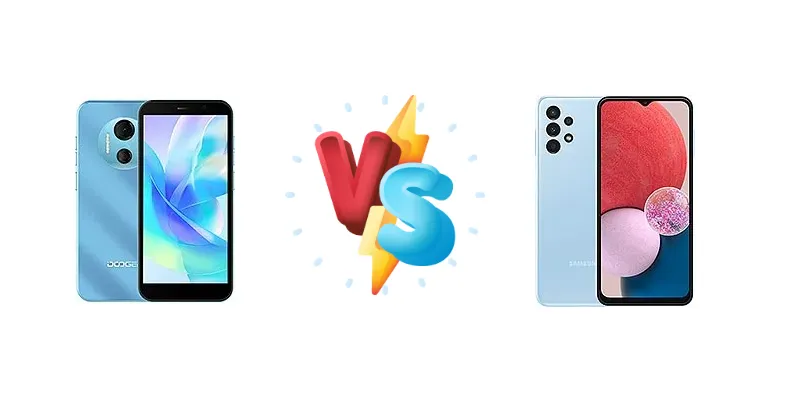
Doogee X97 Pro vs Samsung Galaxy A13: A Detailed Comparison for Budget Shoppers
| Phones Images | |||||
|---|---|---|---|---|---|
|
🏆 Quick Verdict
For most users, the Samsung Galaxy A13 is the better choice. While the Doogee X97 Pro offers a competitive price, the Galaxy A13’s Helio G80 chipset provides a noticeable performance advantage in everyday tasks and light gaming, making it a more future-proof option.
| PHONES | ||
|---|---|---|
| Phone Names | Doogee X97 Pro | Samsung Galaxy A13 (SM-A137) |
| Network | ||
|---|---|---|
| 2G bands | GSM 850 / 900 / 1800 / 1900 | GSM 850 / 900 / 1800 / 1900 |
| 3G bands | HSDPA 800 / 850 / 900 / 1700(AWS) / 1900 / 2100 | HSDPA 850 / 900 / 2100 |
| 4G bands | 1, 2, 3, 4, 5, 7, 8, 12, 13, 17, 18, 19, 20, 25, 26, 34, 38, 39, 40, 41, 66 | 1, 3, 5, 7, 8, 20, 28, 38, 40, 41 |
| Speed | HSPA, LTE | HSPA, LTE |
| Technology | GSM / HSPA / LTE | GSM / HSPA / LTE |
| Launch | ||
|---|---|---|
| Announced | 2022, June | 2022, June |
| Status | Available. Released 2022, July | Available. Released 2022, July |
| Body | ||
|---|---|---|
| Build | - | Glass front (Gorilla Glass 5), plastic frame, plastic back |
| Dimensions | 162 x 76.9 x 9.7 mm (6.38 x 3.03 x 0.38 in) | 165.1 x 76.4 x 8.8 mm (6.5 x 3.01 x 0.35 in) |
| SIM | Nano-SIM + Nano-SIM | · Nano-SIM· Nano-SIM + Nano-SIM |
| Weight | - | 195 g (6.88 oz) |
| Display | ||
|---|---|---|
| Protection | - | Corning Gorilla Glass 5 |
| Resolution | 720 x 1440 pixels, 18:9 ratio (~268 ppi density) | 1080 x 2408 pixels, 20:9 ratio (~400 ppi density) |
| Size | 6.0 inches, 92.9 cm2 (~74.6% screen-to-body ratio) | 6.6 inches, 104.9 cm2 (~83.2% screen-to-body ratio) |
| Type | IPS LCD | PLS LCD |
| Platform | ||
|---|---|---|
| CPU | Octa-core (4x2.0 GHz Cortex-A53 & 4x1.5 GHz Cortex-A53) | Octa-core (2x2.0 GHz Cortex-A75 & 6x1.8 GHz Cortex-A55) |
| Chipset | Mediatek MT6762G Helio G25 (12 nm) | Mediatek MT6769V/CU Helio G80 (12 nm) |
| GPU | PowerVR GE8320 | Mali-G52 MC2 |
| OS | Android 12 | Android 12, upgradable to Android 14, One UI 6.1 |
| Memory | ||
|---|---|---|
| Card slot | microSDXC (dedicated slot) | microSDXC (dedicated slot) |
| Internal | 64GB 4GB RAM | 32GB 3GB RAM, 32GB 4GB RAM, 64GB 4GB RAM, 128GB 4GB RAM |
| - | eMMC 5.1 | |
| Main Camera | ||
|---|---|---|
| Dual | 12 MP, f/1.8, (wide), PDAF Auxiliary lens | - |
| Features | Triple-LED flash | LED flash, panorama, HDR |
| Quad | - | 50 MP, f/1.8, (wide), PDAF 5 MP, f/2.2, 123˚ (ultrawide), 1/5.0", 1.12µm 2 MP (macro) Auxiliary lens |
| Single | - | 8 MP, f/2.2, (wide) |
| Video | 1080p | 1080p@30fps |
| Selfie camera | ||
|---|---|---|
| Single | 5 MP, f/2.2, (wide) | 8 MP, f/2.2, (wide) |
| Video | 720p | 1080p@30fps |
| Sound | ||
|---|---|---|
| 3.5mm jack | - | Yes |
| 35mm jack | Yes | Yes |
| Loudspeaker | Yes | Yes |
| Comms | ||
|---|---|---|
| Bluetooth | 5.0, A2DP, LE | 5.2, A2DP, LE |
| NFC | Yes | Yes |
| Positioning | GPS, GLONASS, BDS, GALILEO | GPS, GLONASS, GALILEO, BDS |
| Radio | FM radio | No |
| USB | USB Type-C 2.0, OTG | USB Type-C 2.0, OTG |
| WLAN | Wi-Fi 802.11 a/b/g/n/ac, dual-band | Wi-Fi 802.11 a/b/g/n/ac, dual-band, Wi-Fi Direct |
| Features | ||
|---|---|---|
| Sensors | Accelerometer, proximity, compass | Fingerprint (side-mounted), accelerometer, compass |
| - | Virtual proximity sensing | |
| Battery | ||
|---|---|---|
| Charging | - | 15W wired |
| Type | 4200 mAh | Li-Po 5000 mAh |
| Misc | ||
|---|---|---|
| Colors | Black, Blue, Green | Black, White, Blue |
| Models | - | SM-A137F, SM-A137F/DSN, SM-A137F/DS |
| Price | About 120 EUR | About 180 EUR |
| SAR EU | - | 0.35 W/kg (head) 1.22 W/kg (body) |
Doogee X97 Pro
- Potentially lower price point
- May offer slightly longer standby time (depending on battery capacity)
- Simple and straightforward user experience
- Significantly weaker performance compared to the A13
- Less future-proof due to the older chipset
- Likely limited software updates
Samsung Galaxy A13 (SM-A137)
- More powerful Helio G80 chipset
- Smoother multitasking and app performance
- Samsung’s software ecosystem and potential for longer updates
- 15W fast charging
- Slightly higher price point
- May not offer significantly better camera performance in all scenarios
- 15W charging is still relatively slow
Display Comparison
Neither device boasts a standout display. Both likely utilize LCD panels, a common cost-saving measure in this segment. Specifics like resolution and peak brightness are not provided, but we can infer similar performance. The focus here isn't on visual fidelity, but rather basic usability. Bezels are likely comparable, prioritizing screen real estate within a budget.
Camera Comparison
Without detailed sensor information, a direct camera comparison is difficult. However, the market segment suggests both phones will rely heavily on software processing. The presence of a 2MP macro camera on both devices is largely a marketing tactic, offering limited real-world benefit. The primary sensor’s size and aperture are crucial, but unspecified. The A13 likely benefits from Samsung’s image processing algorithms, potentially delivering more pleasing results in various lighting conditions. The G80’s ISP (Image Signal Processor) is also more capable than the G25’s, allowing for faster image processing and potentially better dynamic range.
Performance
The core difference lies in the chipsets. The Samsung Galaxy A13’s Mediatek Helio G80 is a significant step up from the Doogee X97 Pro’s Helio G25. The G80 features two Cortex-A75 cores clocked at 2.0 GHz alongside six Cortex-A55 cores at 1.8 GHz, offering a more powerful architecture than the X97 Pro’s four Cortex-A53 cores at 2.0 GHz and four at 1.5 GHz. This translates to faster app loading times, smoother scrolling, and improved multitasking on the A13. The G80’s architecture is more efficient, meaning better sustained performance under load. While both are 12nm chips, the architectural improvements of the G80 outweigh the node similarity.
Battery Life
Battery capacity is not specified for the Doogee X97 Pro, but typical budget phones in this class range from 4000-5000mAh. The Samsung Galaxy A13 supports 15W wired charging. While not fast charging by modern standards, it’s adequate for overnight top-ups. The actual battery life will depend on usage patterns, but the more efficient Helio G80 in the A13 will likely contribute to longer runtimes, even with a similar capacity battery. The G25 in the X97 Pro will likely require more frequent charging.
Buying Guide
Buy the Doogee X97 Pro if you prioritize absolute affordability and are primarily focused on basic communication tasks like calls, texts, and light social media use. Buy the Samsung Galaxy A13 (SM-A137) if you value smoother multitasking, a more responsive user experience, and the potential for playing more demanding mobile games, even at lower settings. The A13 also benefits from Samsung’s established software support.