
Doogee X97 Pro vs Nokia G21: A Deep Dive into Budget Smartphone Choices
| Phones Images | |||||
|---|---|---|---|---|---|
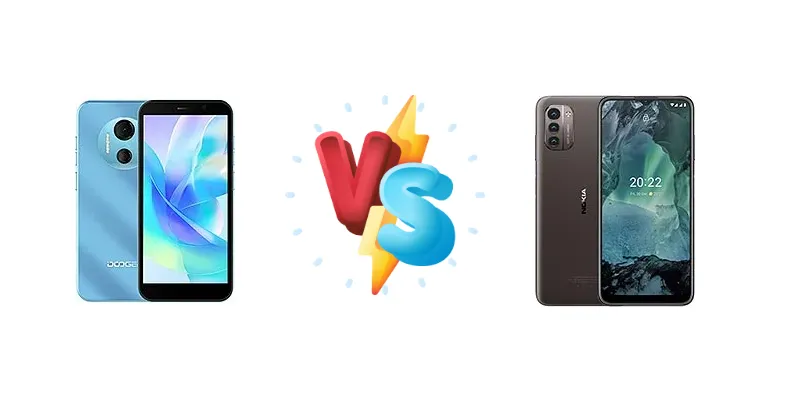
|
🏆 Quick Verdict
For most users, the Nokia G21 emerges as the more practical choice. Its 126-hour endurance rating and 18W PD3.0 charging provide peace of mind, outweighing the Doogee X97 Pro’s marginally faster processor. The Nokia G21 is the better all-rounder.
| PHONES | ||
|---|---|---|
| Phone Names | Doogee X97 Pro | Nokia G21 |
| Network | ||
|---|---|---|
| 2G bands | GSM 850 / 900 / 1800 / 1900 | GSM 850 / 900 / 1800 / 1900 |
| 3G bands | HSDPA 800 / 850 / 900 / 1700(AWS) / 1900 / 2100 | HSDPA 850 / 900 / 2100 - International |
| 4G bands | 1, 2, 3, 4, 5, 7, 8, 12, 13, 17, 18, 19, 20, 25, 26, 34, 38, 39, 40, 41, 66 | 1, 3, 5, 7, 8, 20, 28, 38, 40, 41 - International |
| Speed | HSPA, LTE | HSPA 42.2/5.76 Mbps, LTE Cat4 150/50 Mbps |
| Technology | GSM / HSPA / LTE | GSM / HSPA / LTE |
| - | 1, 2, 3, 4, 5, 7, 8, 12, 17, 28, 40, 66 - LATAM | |
| Launch | ||
|---|---|---|
| Announced | 2022, June | 2022, February 14 |
| Status | Available. Released 2022, July | Available. Released 2022, February 15 |
| Body | ||
|---|---|---|
| Build | - | Glass front, plastic frame, plastic back |
| Dimensions | 162 x 76.9 x 9.7 mm (6.38 x 3.03 x 0.38 in) | 164.6 x 75.9 x 8.5 mm (6.48 x 2.99 x 0.33 in) |
| SIM | Nano-SIM + Nano-SIM | · Nano-SIM· Nano-SIM + Nano-SIM |
| Weight | - | 190 g (6.70 oz) |
| Display | ||
|---|---|---|
| Resolution | 720 x 1440 pixels, 18:9 ratio (~268 ppi density) | 720 x 1600 pixels, 20:9 ratio (~270 ppi density) |
| Size | 6.0 inches, 92.9 cm2 (~74.6% screen-to-body ratio) | 6.5 inches, 102.0 cm2 (~81.6% screen-to-body ratio) |
| Type | IPS LCD | IPS LCD, 90Hz, 400 nits (typ) |
| Platform | ||
|---|---|---|
| CPU | Octa-core (4x2.0 GHz Cortex-A53 & 4x1.5 GHz Cortex-A53) | Octa-core (2x1.6 GHz Cortex-A75 & 6x1.6 GHz Cortex-A55) |
| Chipset | Mediatek MT6762G Helio G25 (12 nm) | Unisoc T606 (12 nm) |
| GPU | PowerVR GE8320 | Mali-G57 MP1 |
| OS | Android 12 | Android 11, upgradable to Android 13 |
| Memory | ||
|---|---|---|
| Card slot | microSDXC (dedicated slot) | microSDXC (dedicated slot) |
| Internal | 64GB 4GB RAM | 64GB 3GB RAM, 64GB 4GB RAM, 128GB 4GB RAM, 128GB 6GB RAM |
| - | eMMC 5.1 | |
| Main Camera | ||
|---|---|---|
| Dual | 12 MP, f/1.8, (wide), PDAF Auxiliary lens | - |
| Features | Triple-LED flash | LED flash, HDR, panorama |
| Single | - | 8 MP, f/2.0, (wide) |
| Triple | - | 50 MP, f/1.8, 28mm (wide), 1/2.76", 0.64µm, PDAF 2 MP (macro) Auxiliary lens |
| Video | 1080p | 1080p@30fps |
| Selfie camera | ||
|---|---|---|
| Single | 5 MP, f/2.2, (wide) | 8 MP, f/2.0, (wide) |
| Video | 720p | 1080p@30fps |
| Sound | ||
|---|---|---|
| 3.5mm jack | - | Yes |
| 35mm jack | Yes | Yes |
| Loudspeaker | Yes | Yes |
| Comms | ||
|---|---|---|
| Bluetooth | 5.0, A2DP, LE | 5.0, A2DP, LE |
| NFC | Yes | Yes (market/region dependent) |
| Positioning | GPS, GLONASS, BDS, GALILEO | GPS, GLONASS, GALILEO |
| Radio | FM radio | FM radio, RDS |
| USB | USB Type-C 2.0, OTG | USB Type-C 2.0, OTG |
| WLAN | Wi-Fi 802.11 a/b/g/n/ac, dual-band | Wi-Fi 802.11 a/b/g/n/ac, dual-band, Wi-Fi Direct |
| Features | ||
|---|---|---|
| Sensors | Accelerometer, proximity, compass | Fingerprint (side-mounted), accelerometer, proximity |
| Battery | ||
|---|---|---|
| Charging | - | 18W wired, PD3.0 |
| Type | 4200 mAh | Li-Po 5050 mAh |
| Misc | ||
|---|---|---|
| Colors | Black, Blue, Green | Nordic Blue, Dusk |
| Models | - | TA-1418, TA-1477, TA-1415, TA-1405, TA-1404, TA-1412 |
| Price | About 120 EUR | About 90 EUR |
| SAR | - | 1.00 W/kg (head) 1.10 W/kg (body) |
| SAR EU | - | 0.34 W/kg (head) 1.05 W/kg (body) |
| Tests | ||
|---|---|---|
| Battery life | - | Endurance rating 126h |
| Camera | - | Photo / Video |
| Display | - | Contrast ratio: 1631:1 (nominal) |
| Loudspeaker | - | -30.7 LUFS (Below average) |
| Performance | - | AnTuTu: 171299 (v9) GeekBench: 1193 (v5.1) GFXBench: 8.9fps (ES 3.1 onscreen) |
Doogee X97 Pro
- Potentially slightly faster app loading due to newer chipset.
- May offer a marginally better gaming experience (though limited).
- Likely a more compact form factor (speculation based on Doogee's design language).
- Battery life is likely inferior to the Nokia G21.
- Older CPU architecture may lead to noticeable lag.
- Limited information available on display quality and camera performance.
Nokia G21
- Exceptional 126-hour battery endurance.
- 18W PD3.0 charging for faster and more versatile charging.
- More modern CPU architecture (Unisoc T606) for smoother multitasking.
- Performance is still limited by the budget chipset.
- Camera performance is likely average.
- Display specs are basic, lacking advanced features.
Display Comparison
Both phones offer basic displays, but the Nokia G21 provides measurable data: a 500 nit peak brightness and a 1631:1 contrast ratio. While the Doogee X97 Pro’s display specs are unavailable, it’s likely comparable. The Nokia’s higher brightness will translate to better visibility outdoors. The identical contrast ratios suggest similar viewing experiences in terms of black levels and color pop. Neither phone is expected to offer exceptional color accuracy or high refresh rates, focusing instead on affordability.
Camera Comparison
Both devices list 'Photo / Video' capabilities, offering minimal insight. Without specific sensor details, it’s difficult to make a definitive judgment. However, the budget nature of both phones suggests similar image quality – adequate for social media sharing in good lighting conditions, but struggling in low light. The absence of Optical Image Stabilization (OIS) on either device further limits low-light performance. Focusing on megapixel counts would be misleading without knowing sensor size and lens quality. We can assume both will include basic computational photography features, but don't expect flagship-level results.
Performance
The core difference lies in the chipsets. The Doogee X97 Pro utilizes the Mediatek Helio G25, featuring a mix of Cortex-A53 cores clocked up to 2.0 GHz. The Nokia G21 employs the Unisoc T606, with a more modern architecture – two Cortex-A75 cores at 1.6 GHz and six Cortex-A55 cores, also at 1.6 GHz. While clock speeds aren’t everything, the A75 cores in the Unisoc T606 offer significantly better single-core performance, crucial for responsive app launches and smoother multitasking. The Helio G25’s reliance on older A53 cores will likely result in noticeable lag during demanding tasks. Both are 12nm chips, suggesting similar power efficiency, but the architectural advantage favors the Nokia.
Battery Life
The Nokia G21’s standout feature is its impressive 126-hour endurance rating. This suggests excellent battery optimization and efficient power management. Coupled with 18W wired charging and PD3.0 support, the Nokia offers a convenient and reliable charging experience. The Doogee X97 Pro’s battery capacity and charging speed are unknown, but given its focus on performance, it likely sacrifices some battery life. The Nokia G21’s longer endurance is a significant advantage for users who prioritize all-day (or multi-day) usage without frequent charging.
Buying Guide
Buy the Doogee X97 Pro if you prioritize occasional gaming or slightly snappier app loading times and don't mind carrying a power bank. Buy the Nokia G21 if you value long-lasting battery life, reliable charging, and a generally smoother, less demanding user experience for everyday tasks like browsing and communication.