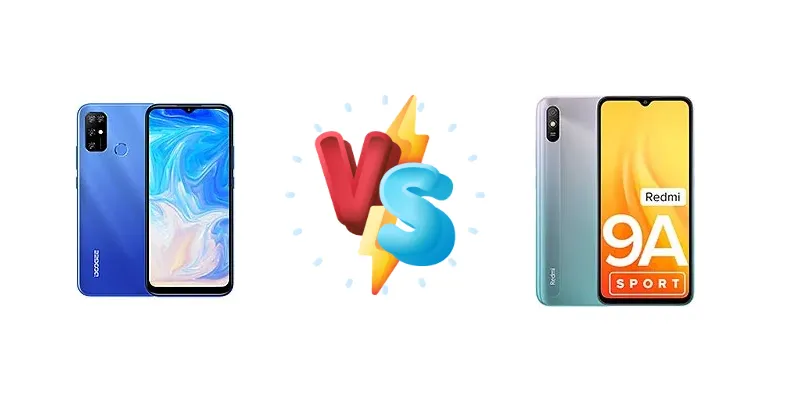
The Doogee X96 and Xiaomi Redmi 9A Sport represent the extreme end of the smartphone price spectrum. Both aim to deliver essential functionality at a minimal cost, but they achieve this through different approaches to chipset selection and core specifications. This comparison dissects their strengths and weaknesses to determine which offers the best value for users prioritizing affordability.
🏆 Quick Verdict
For the average user, the Xiaomi Redmi 9A Sport is the better choice. While both phones offer a basic experience, the Redmi 9A Sport’s 12nm Helio G25 chipset provides a noticeable performance advantage and improved efficiency over the Doogee X96’s 28nm Unisoc SC9863A, making it more responsive for everyday tasks.
| Network |
|---|
| 2G bands | GSM 850 / 900 / 1800 / 1900 | GSM 850 / 900 / 1800 / 1900 |
| 3G bands | HSDPA 850 / 900 / 1900 / 2100 | HSDPA 850 / 900 / 2100 |
| 4G bands | 1, 3, 5, 7, 8, 20, 40, 41 | 1, 3, 5, 8, 40, 41 |
| Speed | HSPA, LTE | HSPA, LTE |
| Technology | GSM / HSPA / LTE | GSM / HSPA / LTE |
| Launch |
|---|
| Announced | 2021, September 30 | 2021, September 28 |
| Status | Available. Released 2021, October 11 | Available. Released 2021, September 28 |
| Body |
|---|
| Dimensions | 165.2 x 76.7 x 9.7 mm (6.50 x 3.02 x 0.38 in) | 164.9 x 77.1 x 9 mm (6.49 x 3.04 x 0.35 in) |
| SIM | Nano-SIM + Nano-SIM | Nano-SIM + Nano-SIM |
| Weight | 198 g (6.98 oz) | 194 g (6.84 oz) |
| | - | Water-repellent coating |
| Display |
|---|
| Resolution | 720 x 1600 pixels, 20:9 ratio (~269 ppi density) | 720 x 1600 pixels, 20:9 ratio (~269 ppi density) |
| Size | 6.52 inches, 102.6 cm2 (~81.0% screen-to-body ratio) | 6.53 inches, 102.9 cm2 (~81.0% screen-to-body ratio) |
| Type | IPS LCD | IPS LCD, 400 nits (typ) |
| Platform |
|---|
| CPU | Octa-core (4x1.6 GHz Cortex-A55 & 4x1.2 GHz Cortex-A55) | Octa-core (4x2.0 GHz Cortex-A53 & 4x1.5 GHz Cortex-A53) |
| Chipset | Unisoc SC9863A (28 nm) | Mediatek MT6762G Helio G25 (12 nm) |
| GPU | IMG8322 | PowerVR GE8320 |
| OS | Android 11 (Go edition) | Android 10, MIUI 12 |
| Memory |
|---|
| Card slot | microSDXC (dedicated slot) | microSDXC (dedicated slot) |
| Internal | 32GB 2GB RAM | 32GB 2GB RAM, 32GB 3GB RAM |
| | - | eMMC 5.1 |
| Main Camera |
|---|
| Features | LED flash | LED flash, HDR |
| Quad | 8 MP, f/2.0, (wide)
2 MP (macro)
Auxiliary lenses | - |
| Single | - | 13 MP, f/2.2, 28mm (wide), 1.0µm, PDAF |
| Video | 1080p | 1080p@30/60fps |
| Selfie camera |
|---|
| Features | - | HDR |
| Single | 5 MP, f/2.2, (wide) | 5 MP, f/2.2, (wide), 1.12µm |
| Video | 720p | 1080p@30fps |
| Sound |
|---|
| 3.5mm jack | - | Yes |
| 35mm jack | Yes | Yes |
| Loudspeaker | Yes | Yes |
| Comms |
|---|
| Bluetooth | 4.2, A2DP | 5.0, A2DP, LE |
| NFC | No | No |
| Positioning | GPS, GLONASS, BDS | GPS, GLONASS, BDS |
| Radio | FM radio | FM radio |
| USB | microUSB 2.0 | microUSB 2.0, OTG |
| WLAN | Wi-Fi 802.11 b/g/n | Wi-Fi 802.11 a/b/g/n, Wi-Fi Direct |
| Features |
|---|
| Sensors | Fingerprint (rear-mounted), accelerometer, proximity | Accelerometer, proximity |
| Battery |
|---|
| Charging | 10W wired | 10W wired |
| Type | 5400 mAh | Li-Po 5000 mAh |
| Misc |
|---|
| Colors | Black, Blue, Green, Red | Carbon Black, Coral Green, Metallic Blue |
| Price | About 130 EUR | About 100 EUR |
Doogee X96
- Potentially lower price point
- Simple and straightforward user experience
- Acceptable for basic communication tasks
- Less efficient chipset (28nm)
- Slower performance compared to the Redmi 9A Sport
- Likely shorter battery life
Xiaomi Redmi 9A Sport
- More efficient chipset (12nm)
- Faster CPU clock speeds
- Better overall performance for everyday tasks
- Potentially longer battery life
- Slightly higher price
- Basic camera capabilities
- Still limited for demanding applications
Display Comparison
Neither device boasts a standout display. Both likely feature LCD panels, typical for this price point. The absence of detailed display specifications necessitates a focus on the chipset’s ability to drive the UI smoothly. The Redmi 9A Sport’s more powerful GPU, stemming from the Helio G25, will likely translate to slightly smoother scrolling and animations, even if the resolution and panel quality are similar.
Camera Comparison
Both phones likely feature basic camera setups focused on affordability. Without detailed sensor information, it’s safe to assume both will struggle in low-light conditions. The presence of a 2MP macro camera on both is largely a marketing tactic, offering limited practical benefit due to the low resolution. Image processing will likely be minimal on both devices, relying heavily on software algorithms to enhance photos. The Redmi 9A Sport’s slightly more powerful ISP (Image Signal Processor) within the Helio G25 might offer marginally better image quality, but the difference will be minimal.
Performance
The core difference lies in the chipsets. The Xiaomi Redmi 9A Sport’s MediaTek Helio G25, fabricated on a 12nm process, is significantly more efficient than the Doogee X96’s Unisoc SC9863A (28nm). This process node difference is crucial; a smaller node generally means lower power consumption and less heat generation for the same level of performance. The Helio G25’s CPU, with its 2.0 GHz Cortex-A53 cores, also boasts a higher clock speed than the X96’s 1.6 GHz Cortex-A55 cores, resulting in faster application loading and overall system responsiveness. While both use an octa-core configuration, the architectural differences and fabrication process give the Redmi 9A Sport a clear edge.
Battery Life
Both devices are equipped with 10W wired charging, indicating a similar charging experience – expect over 3 hours for a full charge. While battery capacity isn’t specified, the Redmi 9A Sport’s more efficient Helio G25 chipset will likely result in longer battery life during typical usage. The 12nm process allows the phone to perform tasks using less power, extending the time between charges. The Doogee X96’s less efficient 28nm chipset will drain the battery faster under similar workloads.
Buying Guide
Buy the Doogee X96 if you need a phone primarily for extremely light use – basic calling, texting, and occasional static app browsing – and are on the absolute tightest budget. Buy the Xiaomi Redmi 9A Sport if you prefer a slightly more responsive experience for social media, light gaming, and general multitasking, and are willing to spend a small premium for improved performance and efficiency.
Frequently Asked Questions
❓ Will the Helio G25 in the Redmi 9A Sport struggle with popular apps like Facebook or WhatsApp?
While not a powerhouse, the Helio G25 is generally sufficient for running common social media apps like Facebook and WhatsApp. You might experience occasional slowdowns with multiple apps open simultaneously, but for typical usage, it should provide an acceptable experience.
❓ Is the Unisoc SC9863A in the Doogee X96 capable of playing any mobile games?
The Unisoc SC9863A can handle very basic 2D games, but it will struggle with most modern 3D titles. Expect low frame rates and significant lag even on low graphics settings. It's not a gaming-focused device.
❓ How long will it take to fully charge both phones from 0%?
With both phones utilizing 10W charging, expect a full charge to take approximately 3 to 4 hours. The charging speed is quite slow by modern standards, so overnight charging is recommended.
❓ Are either of these phones likely to receive software updates?
Software update support is limited for phones in this price range. While both Doogee and Xiaomi provide updates, they are often infrequent and may not include the latest Android versions. Expect minimal long-term software support.