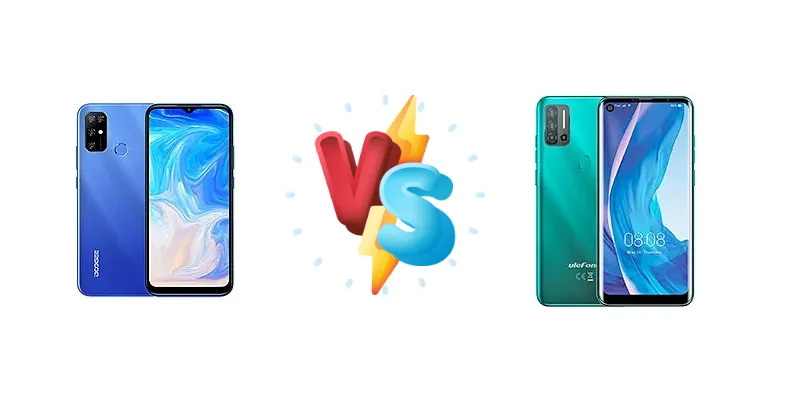
The Doogee X96 and Ulefone Note 11P represent the fiercely competitive sub-$150 smartphone market. Both aim to deliver essential functionality at an incredibly low price point, but they achieve this with significantly different chipsets. This comparison dissects the core differences between the Unisoc SC9863A in the Doogee X96 and the MediaTek Helio P60 in the Ulefone Note 11P, revealing which device offers the better user experience.
🏆 Quick Verdict
For the average user prioritizing responsiveness and smoother multitasking, the Ulefone Note 11P is the better choice. The Helio P60’s more powerful Cortex-A73 cores and 12nm process provide a noticeable performance advantage over the Doogee X96’s SC9863A, despite both phones sharing the same 10W charging.
| Network |
|---|
| 2G bands | GSM 850 / 900 / 1800 / 1900 | GSM 850 / 900 / 1800 / 1900 |
| 3G bands | HSDPA 850 / 900 / 1900 / 2100 | HSDPA 850 / 900 / 1700(AWS) / 1900 / 2100 |
| 4G bands | 1, 3, 5, 7, 8, 20, 40, 41 | 1, 2, 3, 4, 5, 7, 8, 12, 17, 19, 20, 28 |
| Speed | HSPA, LTE | HSPA, LTE |
| Technology | GSM / HSPA / LTE | GSM / HSPA / LTE |
| Launch |
|---|
| Announced | 2021, September 30 | 2021, January 09 |
| Status | Available. Released 2021, October 11 | Available. Released 2021, March 08 |
| Body |
|---|
| Build | - | Glass front, plastic back, plastic frame |
| Dimensions | 165.2 x 76.7 x 9.7 mm (6.50 x 3.02 x 0.38 in) | 166.9 x 77.2 x 10 mm (6.57 x 3.04 x 0.39 in) |
| SIM | Nano-SIM + Nano-SIM | Nano-SIM + Nano-SIM |
| Weight | 198 g (6.98 oz) | 184 g (6.49 oz) |
| Display |
|---|
| Resolution | 720 x 1600 pixels, 20:9 ratio (~269 ppi density) | 720 x 1600 pixels, 20:9 ratio (~268 ppi density) |
| Size | 6.52 inches, 102.6 cm2 (~81.0% screen-to-body ratio) | 6.55 inches, 103.6 cm2 (~80.4% screen-to-body ratio) |
| Type | IPS LCD | IPS LCD |
| Platform |
|---|
| CPU | Octa-core (4x1.6 GHz Cortex-A55 & 4x1.2 GHz Cortex-A55) | Octa-core (4x2.0 GHz Cortex-A73 & 4x2.0 GHz Cortex-A53) |
| Chipset | Unisoc SC9863A (28 nm) | Mediatek MT6771 Helio P60 (12 nm) |
| GPU | IMG8322 | Mali-G72 MP3 |
| OS | Android 11 (Go edition) | Android 11 |
| Memory |
|---|
| Card slot | microSDXC (dedicated slot) | microSDXC (dedicated slot) |
| Internal | 32GB 2GB RAM | 128GB 8GB RAM |
| Main Camera |
|---|
| Features | LED flash | Dual-LED flash |
| Quad | 8 MP, f/2.0, (wide)
2 MP (macro)
Auxiliary lenses | 48 MP, f/1.8, (wide), PDAF
8 MP, f/2.2, (ultrawide)
2 MP (macro)
Auxiliary lens |
| Single | - | 8 MP, f/1.8 |
| Video | 1080p | 1080p@30fps |
| Selfie camera |
|---|
| Single | 5 MP, f/2.2, (wide) | 8 MP, f/1.8 |
| Video | 720p | 1080p@30fps |
| Sound |
|---|
| 3.5mm jack | - | Yes |
| 35mm jack | Yes | Yes |
| Loudspeaker | Yes | Yes |
| Comms |
|---|
| Bluetooth | 4.2, A2DP | 5.0, A2DP, LE |
| NFC | No | No |
| Positioning | GPS, GLONASS, BDS | GPS, GLONASS, BDS, GALILEO |
| Radio | FM radio | FM radio |
| USB | microUSB 2.0 | USB Type-C 2.0, OTG |
| WLAN | Wi-Fi 802.11 b/g/n | Wi-Fi 802.11 a/b/g/n/ac, dual-band, Wi-Fi Direct |
| Features |
|---|
| Sensors | Fingerprint (rear-mounted), accelerometer, proximity | Fingerprint (rear-mounted), accelerometer, gyro, proximity, compass |
| | - | 24-bit/192kHz audio |
| Battery |
|---|
| Charging | 10W wired | 10W wired |
| Type | 5400 mAh | Li-Po 4500 mAh |
| Misc |
|---|
| Colors | Black, Blue, Green, Red | Black, Red, Green |
| Price | About 130 EUR | About 160 EUR |
Doogee X96
- Potentially lower price point
- Simple and straightforward user experience
- Acceptable for basic communication tasks
- Significantly slower performance
- Less efficient chipset
- Limited multitasking capabilities
Ulefone Note 11P
- Faster and more responsive performance
- More efficient chipset
- Better image processing capabilities
- May be slightly more expensive
- Still limited by budget components
- 10W charging is slow
Display Comparison
Neither Doogee nor Ulefone provide detailed display specifications beyond resolution. However, given the price point, both likely utilize IPS LCD panels. The key difference lies under the hood. The Ulefone Note 11P benefits from the Helio P60’s integrated image signal processor (ISP), potentially leading to slightly better image processing for photos taken with the same sensor. The lack of detailed display specs means we can't assess brightness, color accuracy, or viewing angles with certainty.
Camera Comparison
Without detailed sensor information, a direct camera comparison is difficult. Both phones likely feature a primary camera and several lower-resolution sensors for depth and macro photography. However, the Helio P60’s ISP in the Ulefone Note 11P provides a computational advantage. It can process images faster and more effectively, potentially improving dynamic range and noise reduction. The Doogee X96’s SC9863A lacks the same level of image processing capability, meaning photos may appear less detailed and more prone to noise, especially in low-light conditions. We can assume both phones will struggle with complex scenes.
Performance
This is where the Ulefone Note 11P pulls ahead significantly. The MediaTek Helio P60, built on a 12nm process, features four Cortex-A73 cores clocked at 2.0 GHz, alongside four Cortex-A53 cores. This contrasts sharply with the Doogee X96’s Unisoc SC9863A, which uses four Cortex-A55 cores at 1.6 GHz and another four at 1.2 GHz. The A73 cores in the Helio P60 are architecturally superior, offering substantially better single-core performance, crucial for app launch speeds and general responsiveness. The 12nm process also contributes to better power efficiency, potentially leading to slightly longer battery life under load. The SC9863A’s 28nm process is older and less efficient.
Battery Life
Both devices are equipped with 10W wired charging, indicating similar charging speeds. While battery capacity isn’t specified, the more efficient Helio P60 in the Ulefone Note 11P could translate to slightly longer real-world battery life, even with a similar capacity battery. The 12nm process reduces power consumption during operation, offsetting any potential capacity disadvantage. Users should expect roughly a full day of light use from either device, but the Note 11P may hold up better under moderate load.
Buying Guide
Buy the Doogee X96 if you need a phone primarily for very basic tasks like calls, texts, and light social media browsing, and are on an extremely tight budget. Buy the Ulefone Note 11P if you prefer a more responsive experience for everyday use, including moderate multitasking, streaming video, and casual gaming. The Note 11P’s chipset offers a tangible upgrade in performance for a minimal price increase.
Frequently Asked Questions
❓ Will the Helio P60 in the Ulefone Note 11P struggle with demanding games like PUBG Mobile?
While the Helio P60 can run PUBG Mobile, expect to play at lower graphics settings and frame rates to maintain a stable experience. It's not a gaming powerhouse, but it's significantly better suited for casual gaming than the Unisoc SC9863A in the Doogee X96.
❓ Is the 10W charging on either phone a significant drawback?
Yes, 10W charging is quite slow by modern standards. Expect a full charge to take several hours. Neither phone prioritizes fast charging, focusing instead on keeping costs down. It's best to charge overnight.
❓ How much of a difference will I notice in everyday tasks like browsing and social media?
You'll likely notice a substantial difference. The Ulefone Note 11P's Helio P60 will result in snappier app launches, smoother scrolling, and less lag when switching between applications compared to the Doogee X96.
❓ Does the Doogee X96 have any advantages over the Ulefone Note 11P besides potentially being cheaper?
The Doogee X96 might appeal to users who prioritize extreme simplicity and minimal software overhead. However, the performance trade-offs are significant, making it a less versatile option overall.