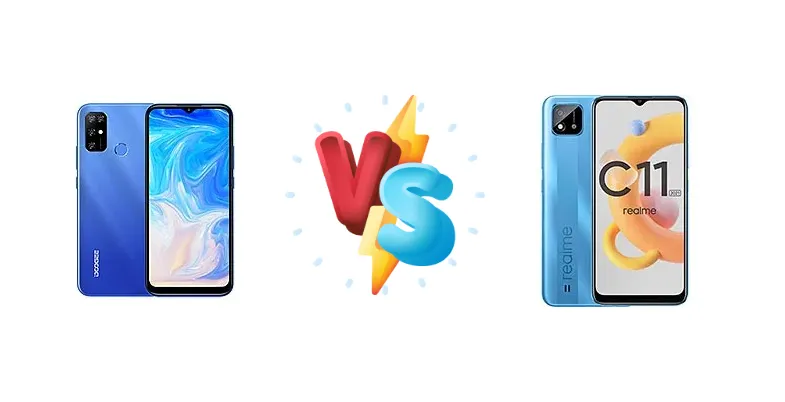
The ultra-budget smartphone segment is fiercely competitive. Both the Doogee X96 and the Realme C11 (2021) aim to deliver essential smartphone functionality at the lowest possible price. However, a closer look reveals a startling similarity: both devices are powered by the exact same Unisoc SC9863A chipset. This comparison dissects the nuances beyond the core hardware to determine which phone offers the better overall experience.
🏆 Quick Verdict
For the average user prioritizing a slightly more versatile feature set, the Realme C11 (2021) emerges as the winner. While performance is identical, the inclusion of reverse wired charging provides a practical benefit for users who frequently share power with friends or accessories, making it a marginally more useful device.
| Network |
|---|
| 2G bands | GSM 850 / 900 / 1800 / 1900 | GSM 850 / 900 / 1800 / 1900 |
| 3G bands | HSDPA 850 / 900 / 1900 / 2100 | HSDPA 850 / 900 / 1900 / 2100 |
| 4G bands | 1, 3, 5, 7, 8, 20, 40, 41 | 1, 3, 5, 8, 38, 40, 41 |
| Speed | HSPA, LTE | HSPA, LTE |
| Technology | GSM / HSPA / LTE | GSM / HSPA / LTE |
| Launch |
|---|
| Announced | 2021, September 30 | 2021, June 28 |
| Status | Available. Released 2021, October 11 | Available. Released 2021, June 28 |
| Body |
|---|
| Build | - | Glass front, plastic frame, plastic back |
| Dimensions | 165.2 x 76.7 x 9.7 mm (6.50 x 3.02 x 0.38 in) | 165.2 x 76.4 x 8.9 mm (6.50 x 3.01 x 0.35 in) |
| SIM | Nano-SIM + Nano-SIM | Nano-SIM + Nano-SIM |
| Weight | 198 g (6.98 oz) | 190 g (6.70 oz) |
| | - | Splash resistant design |
| Display |
|---|
| Resolution | 720 x 1600 pixels, 20:9 ratio (~269 ppi density) | 720 x 1600 pixels, 20:9 ratio (~269 ppi density) |
| Size | 6.52 inches, 102.6 cm2 (~81.0% screen-to-body ratio) | 6.52 inches, 102.6 cm2 (~81.3% screen-to-body ratio) |
| Type | IPS LCD | IPS LCD, 400 nits (typ) |
| Platform |
|---|
| CPU | Octa-core (4x1.6 GHz Cortex-A55 & 4x1.2 GHz Cortex-A55) | Octa-core (4x1.6 GHz Cortex-A55 & 4x1.2 GHz Cortex-A55) |
| Chipset | Unisoc SC9863A (28 nm) | Unisoc SC9863A (28 nm) |
| GPU | IMG8322 | IMG8322 |
| OS | Android 11 (Go edition) | Android 11, Realme Go UI |
| Memory |
|---|
| Card slot | microSDXC (dedicated slot) | microSDXC (dedicated slot) |
| Internal | 32GB 2GB RAM | 32GB 2GB RAM, 64GB 4GB RAM |
| | - | eMMC 5.1 |
| Main Camera |
|---|
| Features | LED flash | LED flash, HDR, panorama |
| Quad | 8 MP, f/2.0, (wide)
2 MP (macro)
Auxiliary lenses | - |
| Single | - | 8 MP, f/2.0, (wide), AF |
| Video | 1080p | 1080p@30fps |
| Selfie camera |
|---|
| Features | - | HDR, panorama |
| Single | 5 MP, f/2.2, (wide) | 5 MP, f/2.2, (wide) |
| Video | 720p | 1080p@30fps |
| Sound |
|---|
| 3.5mm jack | - | Yes |
| 35mm jack | Yes | Yes |
| Loudspeaker | Yes | Yes |
| Comms |
|---|
| Bluetooth | 4.2, A2DP | 4.2, A2DP |
| NFC | No | No |
| Positioning | GPS, GLONASS, BDS | GPS, GLONASS, GALILEO, BDS |
| Radio | FM radio | Unspecified |
| USB | microUSB 2.0 | microUSB 2.0, OTG |
| WLAN | Wi-Fi 802.11 b/g/n | Wi-Fi 802.11 b/g/n |
| Features |
|---|
| Sensors | Fingerprint (rear-mounted), accelerometer, proximity | Accelerometer, gyro, proximity, compass |
| Battery |
|---|
| Charging | 10W wired | 10W wired
Reverse wired |
| Type | 5400 mAh | 5000 mAh |
| Misc |
|---|
| Colors | Black, Blue, Green, Red | Cool Blue, Cool Grey |
| Models | - | RMX3231 |
| Price | About 130 EUR | About 80 EUR |
Doogee X96
- Potentially lower price point (depending on retailer)
- Simple and straightforward user experience
- Functional for basic smartphone tasks
- Lacks reverse charging functionality
- Limited brand recognition
- Potentially slower software updates
Realme C11 (2021)
- Reverse wired charging for power sharing
- Established brand reputation (Realme)
- Likely more frequent software updates
- Identical performance to Doogee X96
- May be slightly more expensive
- Still limited by the Unisoc SC9863A chipset
Display Comparison
Both the Doogee X96 and Realme C11 (2021) lack detailed display specifications in the provided data. Given their price point, it's safe to assume both utilize LCD panels with resolutions likely around 720p+. Expect similar color accuracy and viewing angles. The absence of higher refresh rates or advanced panel technologies like LTPO is standard for this segment. Bezels are likely to be substantial on both devices, maximizing screen real estate within a compact form factor.
Camera Comparison
Camera details are sparse. Both phones likely feature a multi-camera setup, but the provided data doesn't reveal sensor sizes or lens apertures. It's reasonable to expect a primary camera around 8-13MP, accompanied by lower-resolution sensors for depth sensing or macro photography. Image processing will be basic, prioritizing speed over detail. The absence of Optical Image Stabilization (OIS) is expected. The usefulness of any included 2MP macro camera is questionable, offering limited practical benefit due to its low resolution.
Performance
The core of both devices is the Unisoc SC9863A (28nm) chipset, featuring an octa-core CPU configuration with 4 cores clocked at 1.6 GHz and 4 cores at 1.2 GHz, all based on the Cortex-A55 architecture. This means performance will be virtually identical in day-to-day tasks like browsing, social media, and light app usage. The 28nm manufacturing process isn't particularly efficient, so sustained performance under heavy load may be limited. RAM capacity isn't specified, but both likely feature 2-3GB, which will impact multitasking capabilities. Thermal management will likely be passive, relying on the phone's chassis to dissipate heat.
Battery Life
Both devices support 10W wired charging. However, the Realme C11 (2021) adds reverse wired charging, a feature absent on the Doogee X96. While 10W charging is slow, it's adequate for overnight charging. Battery capacity isn't specified, but both likely house batteries in the 4000-5000 mAh range. The Realme C11's reverse charging capability allows it to act as a portable power bank for other devices, a significant advantage for users who frequently travel or rely on multiple gadgets.
Buying Guide
Buy the Doogee X96 if you need a basic, functional smartphone with no frills and are focused solely on core communication and light app usage. Buy the Realme C11 (2021) if you prefer the added convenience of reverse wired charging, allowing you to use your phone as a power bank for other devices, or if you favor Realme's established software ecosystem and brand reputation.
Frequently Asked Questions
❓ Is the Unisoc SC9863A chipset capable of running popular apps like WhatsApp and Facebook smoothly?
Yes, the Unisoc SC9863A is sufficient for running lightweight apps like WhatsApp and Facebook without significant lag. However, multitasking with several apps open simultaneously may result in slowdowns due to the limited RAM typically found in these devices.
❓ How long does it take to fully charge the Realme C11 (2021) with the 10W charger?
With the included 10W charger, expect a full charge from 0% to 100% to take approximately 3-4 hours. This is a relatively slow charging speed compared to modern smartphones, but it's typical for devices in this price range. Overnight charging is recommended.
❓ Can the Realme C11 (2021) be used to charge my wireless earbuds using the reverse charging feature?
The Realme C11 (2021) supports reverse *wired* charging, meaning you can connect another device via USB cable to transfer power. It does *not* support wireless reverse charging. Therefore, you can charge a wired-charging case for earbuds, but not directly wirelessly.