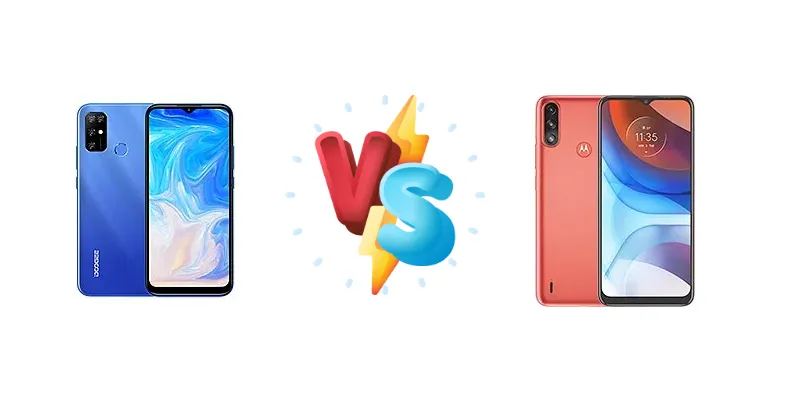
The Doogee X96 and Motorola Moto E7i Power represent the extreme end of the budget smartphone spectrum. Both devices are targeted at first-time smartphone buyers or those needing a reliable secondary device. However, a striking similarity in their core specifications – specifically the Unisoc SC9863A chipset – begs the question: where do they truly differ, and which offers the best value?
🏆 Quick Verdict
For the average user prioritizing brand recognition and potentially software support, the Motorola Moto E7i Power is the slightly better choice. However, the Doogee X96 may offer a more competitive price point, making it attractive to those solely focused on minimizing cost, despite the identical core hardware.
| Network |
|---|
| 2G bands | GSM 850 / 900 / 1800 / 1900 | GSM 850 / 900 / 1800 / 1900 |
| 3G bands | HSDPA 850 / 900 / 1900 / 2100 | HSDPA 850 / 900 / 1700(AWS) / 1900 / 2100 |
| 4G bands | 1, 3, 5, 7, 8, 20, 40, 41 | LTE |
| Speed | HSPA, LTE | HSPA, LTE |
| Technology | GSM / HSPA / LTE | GSM / HSPA / LTE |
| Launch |
|---|
| Announced | 2021, September 30 | 2021, February 23 |
| Status | Available. Released 2021, October 11 | Available. Released 2021, March 15 |
| Body |
|---|
| Build | - | Glass front, plastic back, plastic frame |
| Dimensions | 165.2 x 76.7 x 9.7 mm (6.50 x 3.02 x 0.38 in) | 165.1 x 75.9 x 9.2 mm (6.5 x 2.99 x 0.36 in) |
| SIM | Nano-SIM + Nano-SIM | Nano-SIM + Nano-SIM |
| Weight | 198 g (6.98 oz) | 200 g (7.05 oz) |
| | - | Water-repellent design |
| Display |
|---|
| Resolution | 720 x 1600 pixels, 20:9 ratio (~269 ppi density) | 720 x 1600 pixels, 20:9 ratio (~270 ppi density) |
| Size | 6.52 inches, 102.6 cm2 (~81.0% screen-to-body ratio) | 6.51 inches, 102.3 cm2 (~81.7% screen-to-body ratio) |
| Type | IPS LCD | IPS LCD, 380 nits (typ) |
| Platform |
|---|
| CPU | Octa-core (4x1.6 GHz Cortex-A55 & 4x1.2 GHz Cortex-A55) | Octa-core (4x1.6 GHz Cortex-A55 & 4x1.2 GHz Cortex-A55) |
| Chipset | Unisoc SC9863A (28 nm) | Unisoc SC9863A (28 nm) |
| GPU | IMG8322 | IMG8322 |
| OS | Android 11 (Go edition) | Android 10 (Go edition) |
| Memory |
|---|
| Card slot | microSDXC (dedicated slot) | microSDXC (uses shared SIM slot) |
| Internal | 32GB 2GB RAM | 32GB 2GB RAM |
| | - | eMMC 5.1 |
| Main Camera |
|---|
| Dual | - | 13 MP, f/2.0, 26mm (wide), 1/3.1", 1.12µm, PDAF
2 MP (macro) |
| Features | LED flash | LED flash, HDR, panorama |
| Quad | 8 MP, f/2.0, (wide)
2 MP (macro)
Auxiliary lenses | - |
| Video | 1080p | 1080p@30fps |
| Selfie camera |
|---|
| Features | - | HDR |
| Single | 5 MP, f/2.2, (wide) | 5 MP, f/2.2, 27mm (wide), 1.12µm |
| Video | 720p | 1080p@30fps |
| Sound |
|---|
| 3.5mm jack | - | Yes |
| 35mm jack | Yes | Yes |
| Loudspeaker | Yes | Yes |
| Comms |
|---|
| Bluetooth | 4.2, A2DP | 4.2, A2DP |
| NFC | No | No |
| Positioning | GPS, GLONASS, BDS | GPS, GLONASS, GALILEO |
| Radio | FM radio | Unspecified |
| USB | microUSB 2.0 | USB Type-C 2.0 |
| WLAN | Wi-Fi 802.11 b/g/n | Wi-Fi 802.11 b/g/n |
| Features |
|---|
| Sensors | Fingerprint (rear-mounted), accelerometer, proximity | Fingerprint (rear-mounted), accelerometer, proximity |
| Battery |
|---|
| Charging | 10W wired | 10W wired |
| Type | 5400 mAh | Li-Ion 5000 mAh |
| Misc |
|---|
| Colors | Black, Blue, Green, Red | Tahiti Blue, Coral Red |
| Models | - | XT2097-13 |
| Price | About 130 EUR | About 120 EUR |
Doogee X96
- Potentially lower price point
- Identical performance to Moto E7i Power
- May offer unique software features
- Less established brand reputation
- Potentially limited software support
Motorola Moto E7i Power
- Trusted Motorola brand
- Potentially better software support
- Wider availability of accessories
- Likely higher price than Doogee X96
- Identical performance to Doogee X96
Display Comparison
Both the Doogee X96 and Motorola Moto E7i Power utilize displays that are likely of similar quality, given their shared market segment. While specific details like panel type (IPS vs. TFT) and resolution are not provided, we can assume both offer basic viewing experiences suitable for everyday tasks. The absence of information regarding peak brightness or color gamut suggests neither device is geared towards media consumption or outdoor visibility. Bezels are likely to be substantial on both, contributing to a larger overall footprint.
Camera Comparison
Camera performance is likely to be a weak point on both devices. While details are scarce, the shared budget positioning suggests similar sensor quality and image processing capabilities. The inclusion of a 2MP macro camera on either device is largely a marketing gimmick, offering limited practical benefit due to the low resolution and lack of optical image stabilization. Expect acceptable results in well-lit conditions, but significant noise and lack of detail in low-light scenarios. The primary sensor resolution is not specified, but is unlikely to exceed 13MP.
Performance
The heart of both the Doogee X96 and Motorola Moto E7i Power is the Unisoc SC9863A chipset, fabricated on a 28nm process. This chipset features an octa-core configuration with four cores clocked at 1.6 GHz (Cortex-A55) and four at 1.2 GHz (Cortex-A55). This means performance will be virtually identical between the two devices. The 28nm node is relatively inefficient, suggesting neither phone will excel in sustained performance or thermal management. Expect smooth operation for basic tasks like calling, texting, and light web browsing, but potential slowdowns with more demanding applications. RAM capacity is not specified, but likely sits around 2-3GB, further limiting multitasking capabilities.
Battery Life
Both the Doogee X96 and Motorola Moto E7i Power support 10W wired charging, a slow standard by today's metrics. Battery capacity is not specified, but given the target market, it's likely to be in the 4000-5000 mAh range. Expect a full charge to take several hours. Real-world battery life will depend heavily on usage patterns, but both devices should be capable of lasting a full day with moderate use, prioritizing power saving features.
Buying Guide
Buy the Doogee X96 if you need the absolute lowest possible price and are comfortable with a less established brand. You'll get the same performance as the Moto E7i Power for potentially less money. Buy the Motorola Moto E7i Power if you prefer the reliability of a well-known brand like Motorola, and value the potential for more consistent software updates and a wider support network, even if it comes at a slight price premium.
Frequently Asked Questions
❓ Will the Unisoc SC9863A chipset struggle with popular apps like Facebook or WhatsApp?
While the Unisoc SC9863A is an entry-level chipset, it should be sufficient for running basic apps like Facebook and WhatsApp. However, expect some lag or slowdowns when multitasking or using more demanding features within these apps. Optimizing app settings and limiting background processes can help improve performance.
❓ How long will it take to fully charge the Doogee X96 or Motorola Moto E7i Power with the 10W charger?
With the 10W charging standard, a full charge from 0% to 100% will likely take between 3 to 5 hours. This is a relatively slow charging speed compared to modern smartphones, so it's best to charge overnight or during periods of inactivity.
❓ Are software updates guaranteed for either the Doogee X96 or Motorola Moto E7i Power?
Software update support is less certain for both devices. Motorola generally provides at least one major Android update for its budget phones, but the Doogee X96's update schedule is less predictable. Expect security patches to be infrequent, if at all.