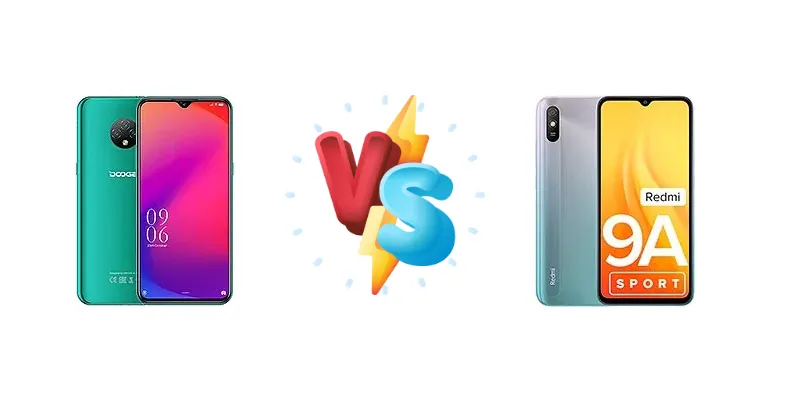
The Doogee X95 and Xiaomi Redmi 9A Sport represent the ultra-budget end of the smartphone spectrum. Both aim to deliver essential functionality at the lowest possible price point, but they differ significantly in their internal hardware. This comparison dissects those differences, focusing on how the chipset choices impact real-world performance and user experience.
🏆 Quick Verdict
For most users, the Xiaomi Redmi 9A Sport is the better choice. Its Helio G25 chipset, with its octa-core configuration, provides a noticeable performance uplift over the Doogee X95’s quad-core Helio A22, making it more responsive for everyday tasks and light gaming. While both offer similar battery and charging capabilities, the Redmi 9A Sport’s processing power justifies the slight price difference.
| Network |
|---|
| 2G bands | GSM 850 / 900 / 1800 / 1900 | GSM 850 / 900 / 1800 / 1900 |
| 3G bands | HSDPA 900 / 2100 | HSDPA 850 / 900 / 2100 |
| 4G bands | 1, 3, 7, 8, 20 | 1, 3, 5, 8, 40, 41 |
| Speed | HSPA, LTE | HSPA, LTE |
| Technology | GSM / HSPA / LTE | GSM / HSPA / LTE |
| Launch |
|---|
| Announced | 2020, April 23. Released 2020, May | 2021, September 28 |
| Status | Discontinued | Available. Released 2021, September 28 |
| Body |
|---|
| Dimensions | 167 x 77.4 x 8.9 mm (6.57 x 3.05 x 0.35 in) | 164.9 x 77.1 x 9 mm (6.49 x 3.04 x 0.35 in) |
| SIM | Nano-SIM + Nano-SIM | Nano-SIM + Nano-SIM |
| Weight | - | 194 g (6.84 oz) |
| | - | Water-repellent coating |
| Display |
|---|
| Resolution | 540 x 1200 pixels, 20:9 ratio (~202 ppi density) | 720 x 1600 pixels, 20:9 ratio (~269 ppi density) |
| Size | 6.52 inches, 102.6 cm2 (~79.4% screen-to-body ratio) | 6.53 inches, 102.9 cm2 (~81.0% screen-to-body ratio) |
| Type | IPS LCD, 450 nits | IPS LCD, 400 nits (typ) |
| Platform |
|---|
| CPU | Quad-core 1.8 GHz Cortex-A53 | Octa-core (4x2.0 GHz Cortex-A53 & 4x1.5 GHz Cortex-A53) |
| Chipset | Mediatek MT6761V Helio A22 (12 nm) | Mediatek MT6762G Helio G25 (12 nm) |
| GPU | PowerVR GE8300 | PowerVR GE8320 |
| OS | Android 10 | Android 10, MIUI 12 |
| Memory |
|---|
| Card slot | microSDXC (uses shared SIM slot) | microSDXC (dedicated slot) |
| Internal | 16GB 3GB RAM | 32GB 2GB RAM, 32GB 3GB RAM |
| | - | eMMC 5.1 |
| Main Camera |
|---|
| Features | LED flash | LED flash, HDR |
| Single | - | 13 MP, f/2.2, 28mm (wide), 1.0µm, PDAF |
| Triple | 13 MP, (wide)
2 MP, (telephoto)
Auxiliary lens | - |
| Video | 1080p | 1080p@30/60fps |
| Selfie camera |
|---|
| Features | - | HDR |
| Single | 5 MP, f/2.2, (wide) | 5 MP, f/2.2, (wide), 1.12µm |
| Video | 720p | 1080p@30fps |
| Sound |
|---|
| 3.5mm jack | - | Yes |
| 35mm jack | Yes | Yes |
| Loudspeaker | Yes | Yes |
| Comms |
|---|
| Bluetooth | 5.2, A2DP, LE | 5.0, A2DP, LE |
| NFC | No | No |
| Positioning | GPS, GLONASS, BDS | GPS, GLONASS, BDS |
| Radio | FM radio | FM radio |
| USB | microUSB 2.0, OTG | microUSB 2.0, OTG |
| WLAN | Wi-Fi 802.11 b/g/n | Wi-Fi 802.11 a/b/g/n, Wi-Fi Direct |
| Features |
|---|
| Sensors | Accelerometer, proximity | Accelerometer, proximity |
| Battery |
|---|
| Charging | 10W wired | 10W wired |
| Type | 4350 mAh | Li-Po 5000 mAh |
| Misc |
|---|
| Colors | Black, Blue, Green | Carbon Black, Coral Green, Metallic Blue |
| Price | About 110 EUR | About 100 EUR |
Doogee X95
- Potentially lower price point
- Simple and straightforward user experience
- Compact and lightweight design
- Significantly slower performance
- Limited multitasking capabilities
- Struggles with demanding apps
Xiaomi Redmi 9A Sport
- Faster and more responsive performance
- Better for multitasking and light gaming
- More future-proof chipset
- Slightly higher price
- May have more pre-installed bloatware
- Camera quality likely similar to Doogee X95
Display Comparison
Neither device boasts a particularly impressive display. Both likely utilize LCD panels, common in this price bracket. Specifics like resolution and brightness are not provided, but we can assume they are similar – likely 720p+ resolution. The focus here isn’t on visual fidelity, but on basic readability. Bezels are expected to be substantial on both, maximizing screen real estate within a compact form factor.
Camera Comparison
Camera performance on both devices will be limited. Without specific sensor details, it’s safe to assume both feature basic camera setups. The presence of a 2MP macro camera on the Redmi 9A Sport is unlikely to deliver meaningful results; these sensors often lack the detail and clarity to produce usable macro shots. The primary sensor’s quality will be the determining factor, and without knowing the megapixel count or aperture, it’s difficult to declare a clear winner. Image processing will likely be minimal on both, resulting in images that are acceptable in good lighting conditions but suffer in low light.
Performance
The core difference lies in the chipsets. The Xiaomi Redmi 9A Sport’s Mediatek Helio G25 is a significant step up from the Doogee X95’s Helio A22. The G25’s octa-core CPU (4x2.0 GHz Cortex-A53 & 4x1.5 GHz Cortex-A53) provides substantially more processing power than the X95’s quad-core 1.8 GHz Cortex-A53. This translates to faster app loading times, smoother multitasking, and a more fluid user interface. While neither is a gaming powerhouse, the G25 will handle less demanding titles with greater ease. The Helio G25 also includes a slightly more capable GPU, further enhancing its gaming potential. The A22 is geared towards basic functionality, and will struggle with anything beyond simple tasks.
Battery Life
Both the Doogee X95 and Xiaomi Redmi 9A Sport feature 10W wired charging, indicating similar charging speeds. While battery capacity isn’t specified, typical capacities for phones in this segment range from 4000mAh to 5000mAh. The difference in chipset efficiency is likely to have a minor impact on battery life, with the Redmi 9A Sport potentially consuming slightly more power due to its higher performance. However, both should comfortably last a full day with moderate usage.
Buying Guide
Buy the Doogee X95 if your primary need is a very basic smartphone for calls, texts, and extremely light app usage, and you are prioritizing the absolute lowest possible cost. Buy the Xiaomi Redmi 9A Sport if you want a more responsive experience for social media, browsing, and occasional gaming, and are willing to spend a little more for improved performance. The Redmi 9A Sport is the better all-rounder.
Frequently Asked Questions
❓ Will the Redmi 9A Sport be able to run popular social media apps like TikTok and Instagram smoothly?
Yes, the Helio G25 chipset in the Redmi 9A Sport is capable of running social media apps like TikTok and Instagram without significant lag. The octa-core processor and improved GPU provide a smoother experience compared to the Doogee X95’s Helio A22, especially when scrolling through feeds or recording videos.
❓ Is the Doogee X95 a good option for someone who primarily uses their phone for calls and texts?
Yes, the Doogee X95 is a suitable option for basic communication. Its Helio A22 chipset is sufficient for making calls, sending texts, and using simple apps. However, if you anticipate using your phone for anything beyond these core functions, the Redmi 9A Sport offers a more versatile experience.
❓ Can I play games like PUBG Mobile on either of these phones?
While technically possible, playing PUBG Mobile on either the Doogee X95 or Redmi 9A Sport will likely be a compromised experience. The Helio G25 in the Redmi 9A Sport will allow for lower graphics settings and frame rates, but expect stuttering and lag. The Helio A22 in the Doogee X95 will struggle significantly, making the game largely unplayable.
❓ How much storage do these phones typically come with, and can it be expanded?
Both phones typically come with 32GB of internal storage, which can be expanded via a microSD card slot. This is crucial, as the operating system and pre-installed apps will consume a significant portion of the available storage. A microSD card is highly recommended for storing photos, videos, and other files.