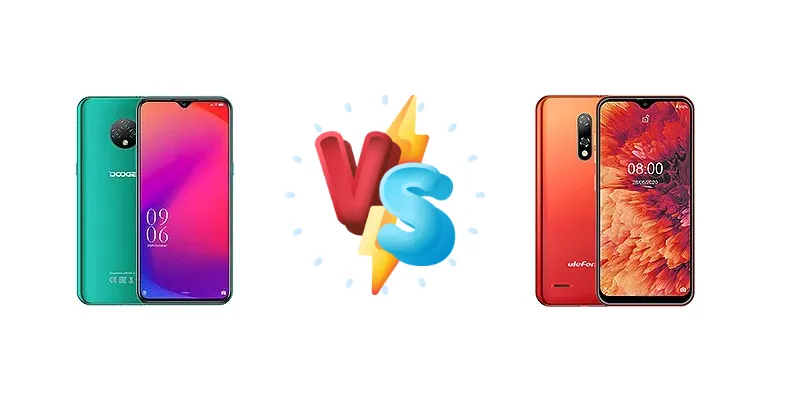
The Doogee X95 and Ulefone Note 8P represent the extreme end of the budget smartphone market, targeting users prioritizing affordability above all else. Both devices aim to deliver basic smartphone functionality, but significant differences in their underlying chipsets dictate their performance capabilities. This comparison dissects those differences to determine which phone offers the best value.
🏆 Quick Verdict
For the average user seeking a functional, albeit basic, smartphone experience, the Doogee X95 is the better choice. Its newer Mediatek MT6761V Helio A22 chipset, built on a 12nm process, provides a noticeable performance advantage and improved efficiency compared to the Ulefone Note 8P’s older, 28nm MT6737.
| Network |
|---|
| 2G bands | GSM 850 / 900 / 1800 / 1900 | GSM 850 / 900 / 1800 / 1900 |
| 3G bands | HSDPA 900 / 2100 | HSDPA 850 / 900 / 1900 / 2100 |
| 4G bands | 1, 3, 7, 8, 20 | 1, 3, 7, 8, 20 |
| Speed | HSPA, LTE | HSPA 21.1/5.76 Mbps, LTE Cat4 150/50 Mbps |
| Technology | GSM / HSPA / LTE | GSM / HSPA / LTE |
| Launch |
|---|
| Announced | 2020, April 23. Released 2020, May | 2020, June 08. Released 2020, June 08 |
| Status | Discontinued | Discontinued |
| Body |
|---|
| Dimensions | 167 x 77.4 x 8.9 mm (6.57 x 3.05 x 0.35 in) | 141.7 x 66.5 x 12 mm (5.58 x 2.62 x 0.47 in) |
| SIM | Nano-SIM + Nano-SIM | Nano-SIM + Micro-SIM |
| Weight | - | 153 g (5.40 oz) |
| Display |
|---|
| Resolution | 540 x 1200 pixels, 20:9 ratio (~202 ppi density) | 442 x 960 pixels, 19.5:9 ratio (~192 ppi density) |
| Size | 6.52 inches, 102.6 cm2 (~79.4% screen-to-body ratio) | 5.5 inches, 74.1 cm2 (~78.7% screen-to-body ratio) |
| Type | IPS LCD, 450 nits | IPS LCD |
| Platform |
|---|
| CPU | Quad-core 1.8 GHz Cortex-A53 | Quad-core 1.3 GHz Cortex-A53 |
| Chipset | Mediatek MT6761V Helio A22 (12 nm) | Mediatek MT6737 (28 nm) |
| GPU | PowerVR GE8300 | Mali-T720MP1 |
| OS | Android 10 | Android 10 (Go edition) |
| Memory |
|---|
| Card slot | microSDXC (uses shared SIM slot) | microSDXC (dedicated slot) |
| Internal | 16GB 3GB RAM | 16GB 2GB RAM |
| | - | eMMC 5.1 |
| Main Camera |
|---|
| Dual | - | 8 MP, f/2.0, AF
2 MP |
| Features | LED flash | LED flash, HDR |
| Triple | 13 MP, (wide)
2 MP, (telephoto)
Auxiliary lens | - |
| Video | 1080p | 720p@30fps |
| Selfie camera |
|---|
| Single | 5 MP, f/2.2, (wide) | 5 MP, f/2.2 |
| Video | 720p | 720p@30fps |
| Sound |
|---|
| 3.5mm jack | - | Yes |
| 35mm jack | Yes | Yes |
| Loudspeaker | Yes | Yes |
| Comms |
|---|
| Bluetooth | 5.2, A2DP, LE | 4.2, A2DP, LE |
| NFC | No | No |
| Positioning | GPS, GLONASS, BDS | GPS |
| Radio | FM radio | Stereo FM radio, RDS, recording |
| USB | microUSB 2.0, OTG | microUSB 2.0 |
| WLAN | Wi-Fi 802.11 b/g/n | Wi-Fi 802.11 a/b/g/n, Wi-Fi Direct |
| Features |
|---|
| Sensors | Accelerometer, proximity | Accelerometer |
| Battery |
|---|
| Charging | 10W wired | - |
| Type | 4350 mAh | Li-Ion 2700 mAh |
| Misc |
|---|
| Colors | Black, Blue, Green | Black, Amber Sunrise, Midnight Green |
| Price | About 110 EUR | About 70 EUR |
| SAR | - | 1.11 W/kg (head) 1.11 W/kg (body) |
Doogee X95
- More powerful and efficient chipset (MT6761V)
- Likely better battery life due to chipset efficiency
- More responsive user experience
- Limited detailed specifications available
- 10W charging is slow
Ulefone Note 8P
- Lowest possible price point
- Functional for basic tasks
- May have slightly larger battery capacity (unconfirmed)
- Older, less efficient chipset (MT6737)
- Slower performance and responsiveness
- Likely shorter battery life
Display Comparison
Neither Doogee nor Ulefone provide detailed display specifications. Given their price points, both likely utilize IPS LCD panels with 720p+ resolutions. However, the lack of information prevents a meaningful comparison of brightness, color accuracy, or viewing angles. We can assume both displays are adequate for indoor use but may struggle in direct sunlight. The absence of features like high refresh rates or Gorilla Glass is expected in this segment.
Camera Comparison
Detailed camera specifications are unavailable for either device. However, given the market segment, it’s safe to assume both phones feature basic camera setups with limited capabilities. Image quality will likely be acceptable in good lighting conditions but will suffer in low light. The absence of optical image stabilization (OIS) is almost certain. Focusing on megapixel counts alone is misleading; sensor size and image processing algorithms are far more critical, and data on these is absent. Any 'macro' cameras included are likely to be low-resolution and offer minimal benefit.
Performance
The core difference lies in the chipsets. The Doogee X95’s Mediatek MT6761V Helio A22 (12nm) boasts a quad-core 1.8 GHz Cortex-A53 CPU, while the Ulefone Note 8P utilizes the older Mediatek MT6737 (28nm) with a quad-core 1.3 GHz Cortex-A53 CPU. The 12nm fabrication process of the Helio A22 is significantly more efficient than the 28nm process of the MT6737, resulting in lower power consumption and potentially less heat generation. The higher clock speed of the A22 also translates to faster processing speeds, making the X95 noticeably more responsive for app loading and multitasking. While both CPUs use the same Cortex-A53 architecture, the newer process and higher clock speed give the Doogee X95 a clear advantage.
Battery Life
Both devices likely feature batteries in the 3000-4000 mAh range, though specific capacities are unconfirmed. The Doogee X95’s more efficient MT6761V chipset will translate to longer battery life despite potentially having a similar capacity to the Ulefone Note 8P. Both phones support 10W wired charging, which is slow by modern standards. Expect several hours to fully charge from 0-100%. The efficiency gains of the Helio A22 will be more noticeable in daily usage than the charging speed.
Buying Guide
Buy the Doogee X95 if you need a slightly more responsive user experience for everyday tasks like browsing, social media, and light messaging. Its newer chipset will handle these tasks with less lag. Buy the Ulefone Note 8P if your primary concern is absolute minimal cost and you only require the most basic smartphone functionality – calls, texts, and very occasional light app use. The Note 8P represents a trade-off for the lowest possible price point.
Frequently Asked Questions
❓ Will the Doogee X95 handle popular social media apps like Facebook and WhatsApp smoothly?
Yes, the Doogee X95’s Mediatek MT6761V Helio A22 chipset is sufficient to run social media apps like Facebook and WhatsApp without significant lag. While it won’t offer a blazing-fast experience, it will provide a usable and responsive experience for these common tasks. The Ulefone Note 8P may struggle with smoother operation, especially with multiple apps open.
❓ Is the Ulefone Note 8P suitable for someone who primarily uses their phone for calls and texts?
Yes, the Ulefone Note 8P is perfectly adequate for basic communication – calls and texts. Its older chipset is sufficient for these core functions, and its lower price point makes it a viable option for users with minimal smartphone needs. However, expect slower performance if you attempt to use more demanding apps.
❓ Can either of these phones run modern mobile games?
Neither the Doogee X95 nor the Ulefone Note 8P are suitable for playing modern, graphically demanding mobile games. While simple 2D games may be playable at low settings, the chipsets lack the processing power and graphics capabilities to handle popular titles like PUBG or Call of Duty Mobile. Expect significant lag and low frame rates.