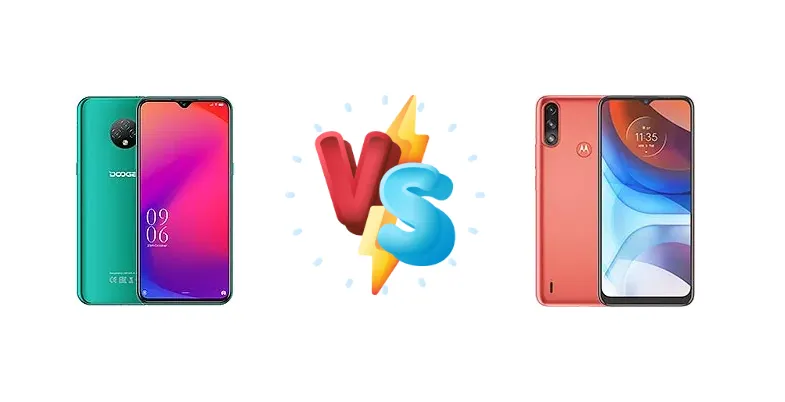
The ultra-budget smartphone segment is fiercely competitive. The Doogee X95 and Motorola Moto E7i Power both aim to deliver essential smartphone functionality at the lowest possible price point. However, they take different approaches to achieving this, with the Doogee leveraging a slightly older, but established, Mediatek chipset, while the Motorola opts for a newer Unisoc solution. This comparison will dissect the key differences to determine which device offers the best value.
🏆 Quick Verdict
For the average user prioritizing multi-tasking and a smoother overall experience, the Motorola Moto E7i Power is the better choice. Its octa-core Unisoc SC9863A processor, despite being built on a larger node, offers a significant performance advantage over the Doogee X95’s quad-core Helio A22, making it more responsive for everyday tasks.
| Network |
|---|
| 2G bands | GSM 850 / 900 / 1800 / 1900 | GSM 850 / 900 / 1800 / 1900 |
| 3G bands | HSDPA 900 / 2100 | HSDPA 850 / 900 / 1700(AWS) / 1900 / 2100 |
| 4G bands | 1, 3, 7, 8, 20 | LTE |
| Speed | HSPA, LTE | HSPA, LTE |
| Technology | GSM / HSPA / LTE | GSM / HSPA / LTE |
| Launch |
|---|
| Announced | 2020, April 23. Released 2020, May | 2021, February 23 |
| Status | Discontinued | Available. Released 2021, March 15 |
| Body |
|---|
| Build | - | Glass front, plastic back, plastic frame |
| Dimensions | 167 x 77.4 x 8.9 mm (6.57 x 3.05 x 0.35 in) | 165.1 x 75.9 x 9.2 mm (6.5 x 2.99 x 0.36 in) |
| SIM | Nano-SIM + Nano-SIM | Nano-SIM + Nano-SIM |
| Weight | - | 200 g (7.05 oz) |
| | - | Water-repellent design |
| Display |
|---|
| Resolution | 540 x 1200 pixels, 20:9 ratio (~202 ppi density) | 720 x 1600 pixels, 20:9 ratio (~270 ppi density) |
| Size | 6.52 inches, 102.6 cm2 (~79.4% screen-to-body ratio) | 6.51 inches, 102.3 cm2 (~81.7% screen-to-body ratio) |
| Type | IPS LCD, 450 nits | IPS LCD, 380 nits (typ) |
| Platform |
|---|
| CPU | Quad-core 1.8 GHz Cortex-A53 | Octa-core (4x1.6 GHz Cortex-A55 & 4x1.2 GHz Cortex-A55) |
| Chipset | Mediatek MT6761V Helio A22 (12 nm) | Unisoc SC9863A (28 nm) |
| GPU | PowerVR GE8300 | IMG8322 |
| OS | Android 10 | Android 10 (Go edition) |
| Memory |
|---|
| Card slot | microSDXC (uses shared SIM slot) | microSDXC (uses shared SIM slot) |
| Internal | 16GB 3GB RAM | 32GB 2GB RAM |
| | - | eMMC 5.1 |
| Main Camera |
|---|
| Dual | - | 13 MP, f/2.0, 26mm (wide), 1/3.1", 1.12µm, PDAF
2 MP (macro) |
| Features | LED flash | LED flash, HDR, panorama |
| Triple | 13 MP, (wide)
2 MP, (telephoto)
Auxiliary lens | - |
| Video | 1080p | 1080p@30fps |
| Selfie camera |
|---|
| Features | - | HDR |
| Single | 5 MP, f/2.2, (wide) | 5 MP, f/2.2, 27mm (wide), 1.12µm |
| Video | 720p | 1080p@30fps |
| Sound |
|---|
| 3.5mm jack | - | Yes |
| 35mm jack | Yes | Yes |
| Loudspeaker | Yes | Yes |
| Comms |
|---|
| Bluetooth | 5.2, A2DP, LE | 4.2, A2DP |
| NFC | No | No |
| Positioning | GPS, GLONASS, BDS | GPS, GLONASS, GALILEO |
| Radio | FM radio | Unspecified |
| USB | microUSB 2.0, OTG | USB Type-C 2.0 |
| WLAN | Wi-Fi 802.11 b/g/n | Wi-Fi 802.11 b/g/n |
| Features |
|---|
| Sensors | Accelerometer, proximity | Fingerprint (rear-mounted), accelerometer, proximity |
| Battery |
|---|
| Charging | 10W wired | 10W wired |
| Type | 4350 mAh | Li-Ion 5000 mAh |
| Misc |
|---|
| Colors | Black, Blue, Green | Tahiti Blue, Coral Red |
| Models | - | XT2097-13 |
| Price | About 110 EUR | About 120 EUR |
Doogee X95
- Potentially slightly better battery life under very light use due to the 12nm process.
- Lowest possible price point.
- Functional for basic communication.
- Significantly slower performance compared to the Moto E7i Power.
- Struggles with multitasking and demanding apps.
- Likely limited software support.
Motorola Moto E7i Power
- Octa-core processor delivers a smoother and more responsive user experience.
- Better performance for multitasking and app loading.
- More capable ISP for potentially better image processing.
- Less efficient 28nm process may impact battery life.
- May be slightly more expensive than the Doogee X95.
- Still a budget device with limitations in camera quality and overall features.
Display Comparison
Neither device boasts a standout display. Both are likely to feature LCD panels, typical for this price range. The key difference lies under the hood. While specific display specs are unavailable, the focus here is on the chipset's ability to drive the display smoothly. The Unisoc SC9863A’s more powerful GPU will likely result in slightly smoother scrolling and animations on the Moto E7i Power, even if the resolution and panel quality are similar.
Camera Comparison
Both phones are expected to feature basic camera setups. Given the price point, image quality will be heavily reliant on software processing. Without specific sensor details, it’s difficult to make a definitive judgment. However, the Unisoc SC9863A’s slightly more capable ISP (Image Signal Processor) may offer a marginal improvement in image processing speed and quality on the Moto E7i Power. Expect both to struggle in low-light conditions, and any 'macro' lenses will likely be of very limited utility.
Performance
This is where the most significant difference emerges. The Doogee X95’s Mediatek MT6761V Helio A22 is a quad-core processor built on a 12nm process. The Motorola Moto E7i Power, however, utilizes the Unisoc SC9863A, an octa-core chip (4x1.6 GHz Cortex-A55 & 4x1.2 GHz Cortex-A55) fabricated on a larger 28nm node. While the 28nm process is less efficient, the sheer number of cores and the newer Cortex-A55 architecture give the Unisoc chip a clear advantage in multi-threaded tasks. This translates to faster app loading times, smoother multitasking, and a more responsive user interface on the Moto E7i Power. The Helio A22 will struggle with anything beyond basic app usage.
Battery Life
Both devices feature 10W wired charging, indicating a similar charging experience. Battery capacity is not specified, but given the focus on 'Power' in the Moto E7i Power’s name, it likely has a slightly larger battery. However, the Unisoc SC9863A’s less efficient 28nm process will consume more power than the Helio A22’s 12nm process. This means the Doogee X95 *could* potentially offer slightly longer battery life under light usage, but the Moto E7i Power’s larger battery (if present) and optimized software could offset this difference, especially with moderate use.
Buying Guide
Buy the Doogee X95 if you absolutely need the lowest possible price and your usage is limited to basic tasks like calls, texts, and light social media. It’s a functional device for those with minimal smartphone requirements. Buy the Motorola Moto E7i Power if you prefer a more responsive user experience, occasionally browse the web with multiple tabs, or want a phone that can handle slightly more demanding apps without significant lag. The E7i Power offers a better balance of performance and affordability.
Frequently Asked Questions
❓ Will the Unisoc SC9863A in the Moto E7i Power overheat during prolonged use?
While the 28nm process is less efficient, the Unisoc SC9863A is designed for entry-level smartphones and isn't a high-performance chip. Overheating is unlikely during typical usage scenarios like browsing, social media, and light gaming. However, demanding games or prolonged video recording could lead to some thermal throttling.
❓ Is the Doogee X95 suitable for playing games like PUBG Mobile or Call of Duty Mobile?
The Doogee X95’s Mediatek Helio A22 is not powerful enough to provide a playable experience in demanding games like PUBG Mobile or Call of Duty Mobile. You may be able to run them at the lowest settings, but expect significant lag and frame rate drops. The Moto E7i Power would offer a slightly better experience, but still isn't ideal for serious gaming.
❓ How much storage does each phone offer, and is it expandable?
Storage capacity is not specified in the provided data. However, both phones are likely to offer a base storage of 32GB or 64GB. Given the target market, both are highly likely to include a microSD card slot for expandable storage, allowing users to add more space for photos, videos, and apps.
❓ What version of Android do these phones run?
The provided data does not specify the Android version. However, given their budget nature, both are likely to run a relatively older version of Android, potentially Android 11 or 12, with limited updates expected. Motorola generally offers a cleaner Android experience with fewer pre-installed apps.