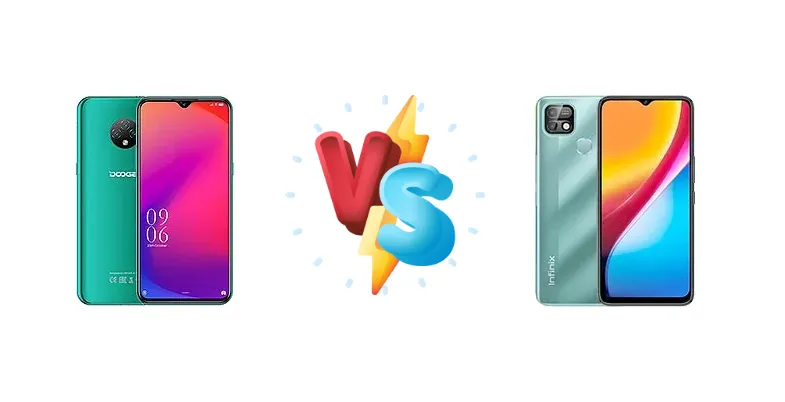
The sub-$150 smartphone market is fiercely competitive. Both the Doogee X95 and Infinix Smart 5 Pro aim to deliver essential smartphone functionality at an incredibly affordable price. However, they take different approaches to achieving this, primarily through their chipset choices. This comparison dissects those choices and reveals which phone offers the best value for your money.
🏆 Quick Verdict
For the average user prioritizing multitasking and a slightly smoother experience, the Infinix Smart 5 Pro is the better choice. Its octa-core Unisoc SC9863A, despite being built on a larger process node, offers a performance advantage over the Doogee X95’s quad-core Helio A22, making it more capable for everyday tasks.
| Network |
|---|
| 2G bands | GSM 850 / 900 / 1800 / 1900 | GSM 850 / 900 / 1800 / 1900 |
| 3G bands | HSDPA 900 / 2100 | HSDPA 850 / 900 / 2100 |
| 4G bands | 1, 3, 7, 8, 20 | 1, 3, 5, 8, 38, 40, 41 |
| Speed | HSPA, LTE | HSPA 21.1/5.76 Mbps, LTE Cat4 150/50 Mbps |
| Technology | GSM / HSPA / LTE | GSM / HSPA / LTE |
| | - | 1, 2, 3, 4, 5, 7, 8, 20, 28, 38, 41, 40, 66 |
| Launch |
|---|
| Announced | 2020, April 23. Released 2020, May | 2021, November 17 |
| Status | Discontinued | Available. Released 2021, November 17 |
| Body |
|---|
| Build | - | Glass front, plastic back, plastic frame |
| Dimensions | 167 x 77.4 x 8.9 mm (6.57 x 3.05 x 0.35 in) | 164.4 x 75.6 x 9.5 mm (6.47 x 2.98 x 0.37 in) |
| SIM | Nano-SIM + Nano-SIM | Nano-SIM + Nano-SIM |
| Weight | - | - |
| Display |
|---|
| Resolution | 540 x 1200 pixels, 20:9 ratio (~202 ppi density) | 720 x 1600 pixels, 20:9 ratio (~269 ppi density) |
| Size | 6.52 inches, 102.6 cm2 (~79.4% screen-to-body ratio) | 6.52 inches, 102.6 cm2 (~82.6% screen-to-body ratio) |
| Type | IPS LCD, 450 nits | IPS LCD, 500 nits (peak) |
| Platform |
|---|
| CPU | Quad-core 1.8 GHz Cortex-A53 | Octa-core (4x1.6 GHz Cortex-A55 & 4x1.2 GHz Cortex-A55) |
| Chipset | Mediatek MT6761V Helio A22 (12 nm) | Unisoc SC9863A (28 nm) |
| GPU | PowerVR GE8300 | IMG8322 |
| OS | Android 10 | Android 11 (Go edition), XOS 7.6 |
| Memory |
|---|
| Card slot | microSDXC (uses shared SIM slot) | microSDXC (dedicated slot) |
| Internal | 16GB 3GB RAM | 32GB 2GB RAM |
| | - | eMMC 5.1 |
| Main Camera |
|---|
| Dual | - | 13 MP, f/1.8, AF
Auxiliary lens |
| Features | LED flash | Quad-LED flash |
| Single | - | 8 MP |
| Triple | 13 MP, (wide)
2 MP, (telephoto)
Auxiliary lens | - |
| Video | 1080p | 1440p@30fps |
| Selfie camera |
|---|
| Features | - | Dual-LED flash |
| Single | 5 MP, f/2.2, (wide) | 8 MP |
| Video | 720p | 1080p@30fps |
| Sound |
|---|
| 3.5mm jack | - | Yes |
| 35mm jack | Yes | Yes |
| Loudspeaker | Yes | Yes |
| Comms |
|---|
| Bluetooth | 5.2, A2DP, LE | 4.2, A2DP |
| NFC | No | No |
| Positioning | GPS, GLONASS, BDS | GPS |
| Radio | FM radio | FM radio |
| USB | microUSB 2.0, OTG | microUSB 2.0 |
| WLAN | Wi-Fi 802.11 b/g/n | Wi-Fi 802.11 b/g/n |
| Features |
|---|
| Sensors | Accelerometer, proximity | Fingerprint (rear-mounted), accelerometer, proximity |
| Battery |
|---|
| Charging | 10W wired | 10W wired |
| Type | 4350 mAh | 6000 mAh |
| Misc |
|---|
| Colors | Black, Blue, Green | Morandi Green, Heart of Ocean |
| Price | About 110 EUR | About 70 EUR |
Doogee X95
- Potentially better battery life due to more efficient chipset.
- Doogee's reputation for durable devices.
- Simpler user experience for basic tasks.
- Significantly slower performance compared to the Infinix Smart 5 Pro.
- Limited multitasking capabilities.
- Outdated processor architecture.
Infinix Smart 5 Pro
- Octa-core processor offers smoother performance.
- More responsive user interface.
- Better suited for multitasking and app switching.
- Less efficient chipset may result in shorter battery life.
- Larger process node (28nm) increases power consumption.
- Potential for shorter software support.
Display Comparison
Neither device boasts a standout display. Both likely feature basic LCD panels, and detailed specifications like brightness and color accuracy are unavailable. However, the focus here is on the chipset's ability to drive the display smoothly. The more powerful CPU in the Infinix Smart 5 Pro will likely translate to slightly faster UI rendering and smoother scrolling, even if the panel itself is similar.
Camera Comparison
Camera performance is likely to be similar on both devices, relying heavily on software processing. Detailed sensor information is missing, but both are likely to feature basic camera setups. The absence of Optical Image Stabilization (OIS) on either device means low-light photography will be challenging. Focusing on the chipset, the Infinix Smart 5 Pro’s slightly more capable processor could offer faster image processing times, but the overall image quality will be limited by the sensor and lens quality.
Performance
The core difference lies in the chipsets. The Doogee X95 utilizes the Mediatek MT6761V Helio A22, a quad-core processor built on a 12nm process. The Infinix Smart 5 Pro, conversely, features the Unisoc SC9863A, an octa-core chip fabricated on a larger 28nm node. While the 28nm process is less efficient, the eight cores (four Cortex-A55 at 1.6GHz and four at 1.2GHz) provide a significant advantage in multi-threaded tasks. The Cortex-A55 architecture is also more modern and efficient per core than the A53 found in the Helio A22. This means the Infinix Smart 5 Pro will handle app switching and multitasking more effectively, though both will struggle with graphically intensive games.
Battery Life
Both phones feature 10W wired charging, indicating similar charging speeds. While battery capacity isn't specified, the less efficient Unisoc SC9863A in the Infinix Smart 5 Pro will likely result in slightly shorter battery life compared to the Doogee X95’s Helio A22, despite the performance gains. The 28nm process inherently consumes more power, meaning users may need to charge the Infinix Smart 5 Pro more frequently with similar usage patterns.
Buying Guide
Buy the Doogee X95 if you need a simple, reliable device for basic communication – calls, texts, and light app usage – and prioritize a potentially longer software support lifespan from a brand known for rugged devices. Buy the Infinix Smart 5 Pro if you prefer a phone capable of handling more demanding apps, light multitasking, and enjoy a slightly more responsive user experience, even if it means potentially shorter software updates.
Frequently Asked Questions
❓ Will the Infinix Smart 5 Pro struggle with popular apps like WhatsApp and Facebook?
While the Infinix Smart 5 Pro won't offer a flagship-level experience, its octa-core processor should handle apps like WhatsApp and Facebook without significant issues. However, running multiple apps simultaneously or using resource-intensive features within these apps may lead to slowdowns.
❓ Is the Unisoc SC9863A chipset known for overheating?
The Unisoc SC9863A is a low-power chipset and generally doesn't exhibit significant overheating issues. However, prolonged use of demanding apps or gaming could lead to some thermal throttling, reducing performance slightly to manage temperatures.
❓ Can either of these phones handle basic mobile gaming?
Both phones can handle very basic 2D games. However, graphically demanding 3D games will likely be unplayable or experience extremely low frame rates. The Infinix Smart 5 Pro will offer a slightly better experience due to its more powerful processor, but don't expect a smooth gaming experience.
❓ How long will software updates be supported on the Doogee X95?
Doogee's software update policy for entry-level devices is often limited. While a specific timeframe isn't available, users should expect a maximum of one major Android update and potentially limited security patches. The Infinix Smart 5 Pro may have a similar or slightly shorter support lifespan.