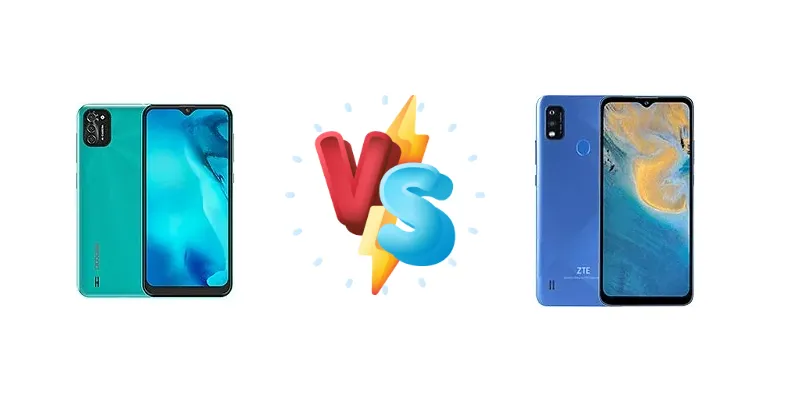
The Doogee X93 and ZTE Blade A51 represent the extreme end of the smartphone price spectrum. Both aim to deliver essential functionality at a minimal cost, but they achieve this with significantly different hardware. This comparison dissects their core components to determine which offers the best value for users prioritizing affordability.
🏆 Quick Verdict
For the average user, the ZTE Blade A51 emerges as the better choice. Its octa-core Unisoc SC9863A processor provides a noticeable performance advantage over the Doogee X93’s quad-core Mediatek MT6580, translating to smoother multitasking and app loading, despite both phones sharing a 28nm process.
| Network |
|---|
| 2G bands | GSM 850 / 900 / 1800 / 1900 | GSM 850 / 900 / 1800 / 1900 |
| 3G bands | HSDPA 900 / 2100 | HSDPA 850 / 900 / 1900 / 2100 |
| 4G bands | - | 1, 3, 5, 7, 8, 20, 28, 38, 40, 41 |
| Speed | HSPA 42.2/5.76 Mbps | HSPA, LTE |
| Technology | GSM / HSPA | GSM / HSPA / LTE |
| Launch |
|---|
| Announced | 2021, August | 2021, May 08 |
| Status | Available. Released 2021, August | Available. Released 2021, May 08 |
| Body |
|---|
| Dimensions | 156 x 73.8 x 9.8 mm (6.14 x 2.91 x 0.39 in) | 166.5 x 75.6 x 8.5 mm (6.56 x 2.98 x 0.33 in) |
| SIM | Nano-SIM + Nano-SIM | Nano-SIM + Nano-SIM |
| Weight | - | 173.7 g (6.14 oz) |
| Display |
|---|
| Resolution | 600 x 1280 pixels (~232 ppi density) | 720 x 1600 pixels, 20:9 ratio (~269 ppi density) |
| Size | 6.1 inches, 92.3 cm2 (~80.1% screen-to-body ratio) | 6.52 inches, 102.6 cm2 (~81.5% screen-to-body ratio) |
| Type | IPS LCD | IPS LCD |
| Platform |
|---|
| CPU | Quad-core 1.3 GHz Cortex-A7 | Octa-core (4x1.6 GHz Cortex-A55 & 4x1.2 GHz Cortex-A55) |
| Chipset | Mediatek MT6580 (28 nm) | Unisoc SC9863A (28 nm) |
| GPU | Mali-400MP2 | IMG8322 |
| OS | Android 10 (Go edition) | Android 11 (Go edition) |
| Memory |
|---|
| Card slot | microSDXC (dedicated slot) | microSDXC |
| Internal | 16GB 2GB RAM | 32GB 2GB RAM, 64GB 2GB RAM |
| | - | eMMC 5.1 |
| Main Camera |
|---|
| Dual | - | 13 MP, AF
2 MP |
| Features | LED flash | LED flash, HDR |
| Triple | 8 MP, f/2.2, (wide)
Auxiliary lenses | - |
| Video | 1080p | 1080p@30fps |
| Selfie camera |
|---|
| Single | 5 MP, f/2.2, (wide) | 5 MP |
| Video | 720p | - |
| Sound |
|---|
| 3.5mm jack | - | Yes |
| 35mm jack | Yes | Yes |
| Loudspeaker | Yes | Yes |
| Comms |
|---|
| Bluetooth | 4.2, A2DP | 4.2, A2DP, LE |
| NFC | No | Yes |
| Positioning | GPS, GLONASS, BDS | GPS, GLONASS |
| Radio | FM radio | FM radio |
| USB | microUSB 2.0, OTG | USB Type-C 2.0, OTG |
| WLAN | Wi-Fi 802.11 a/b/g/n/ac, dual-band | Wi-Fi 802.11 b/g/n |
| Features |
|---|
| Sensors | Accelerometer, proximity | Fingerprint (rear-mounted), accelerometer, proximity |
| Battery |
|---|
| Charging | 10W wired | - |
| Type | 4350 mAh | Li-Ion 3200 mAh |
| Misc |
|---|
| Colors | Black, Blue, Green | Blue, Gray |
| Price | About 90 EUR | - |
Doogee X93
- Potentially lower price point
- Simple and straightforward user experience
- Reliable for basic communication
- Outdated processor
- Limited multitasking capabilities
- Poor performance with demanding apps
ZTE Blade A51
- Octa-core processor for smoother performance
- More efficient processor architecture
- Better suited for social media and web browsing
- May be slightly more expensive
- 10W charging is slow
- Camera quality likely limited
Display Comparison
Neither Doogee nor ZTE provide display specifications beyond the basic panel size. Given the price point, both likely utilize IPS LCD panels. The absence of details like resolution, brightness, or refresh rate suggests a focus on cost reduction. Expect similar viewing experiences – adequate for basic tasks but lacking vibrancy or sharpness compared to higher-end displays. Bezels are likely to be substantial on both devices.
Camera Comparison
Detailed camera specifications are unavailable for either device. However, given the market segment, it’s safe to assume both feature basic camera setups. Expect a primary sensor, potentially accompanied by a secondary depth or macro lens (likely 2MP). Image quality will be heavily reliant on software processing and will likely struggle in low-light conditions. The aperture size and sensor size are critical factors, but without that data, it’s difficult to definitively say which phone has the better camera. The Unisoc’s ISP (Image Signal Processor) *may* offer slightly better processing capabilities, but this is speculative.
Performance
The core difference lies in the chipset. The Doogee X93’s Mediatek MT6580, a quad-core processor based on the Cortex-A7 architecture, is a significantly older design. The ZTE Blade A51’s Unisoc SC9863A, featuring an octa-core configuration (4x1.6 GHz Cortex-A55 & 4x1.2 GHz Cortex-A55), offers a substantial leap in processing power. The Cortex-A55 cores are more efficient and capable than the A7, resulting in faster app launches and smoother multitasking. While both are built on a 28nm process, the increased core count and newer architecture of the Unisoc chip provide a clear advantage. The A51 will handle more demanding apps and light gaming with greater ease.
Battery Life
Both devices feature 10W wired charging, indicating a similar charging experience – slow by modern standards. Battery capacity is not specified, but given the target market, expect capacities around 3000-4000 mAh. The Unisoc SC9863A’s improved efficiency *could* translate to slightly better battery life on the ZTE Blade A51, offsetting any potential capacity differences. Expect a full charge to take over 2 hours in both cases.
Buying Guide
Buy the Doogee X93 if you need a phone for extremely basic tasks – calls, texts, and light app usage – and prioritize simplicity. Its lower price point might be attractive for first-time smartphone users or as a temporary device. Buy the ZTE Blade A51 if you prefer a more responsive experience, even with budget constraints. The octa-core processor makes it better suited for social media, web browsing, and occasional gaming.
Frequently Asked Questions
❓ Will the ZTE Blade A51 be able to run popular social media apps like Facebook and Instagram smoothly?
Yes, the ZTE Blade A51’s octa-core Unisoc SC9863A processor is significantly more capable of handling the demands of social media apps compared to the Doogee X93’s quad-core Mediatek MT6580. You should experience smoother scrolling and faster loading times within these applications.
❓ Is the Doogee X93 a good option for someone who primarily uses their phone for calls and texts?
Yes, the Doogee X93 is a suitable option for basic communication. Its Mediatek MT6580 processor is sufficient for making calls, sending texts, and using simple contact apps. However, if you anticipate using any other apps, even basic ones, the ZTE Blade A51 will provide a more responsive experience.
❓ Can either of these phones handle basic mobile games like Candy Crush or Subway Surfers?
Both phones *can* run basic mobile games, but the ZTE Blade A51 will offer a noticeably better experience. The Unisoc SC9863A’s increased processing power will result in fewer frame drops and smoother gameplay, especially in more visually demanding titles. The Doogee X93 may struggle with even simple games.