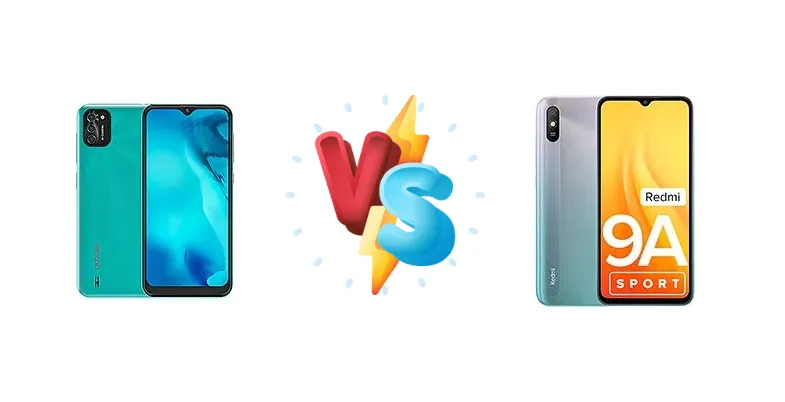
The Doogee X93 and Xiaomi Redmi 9A Sport represent the extreme end of the smartphone price spectrum. Both aim to deliver essential functionality at a minimal cost, but they take different approaches to achieving this. This comparison dissects their core components to determine which device offers the best value for users prioritizing affordability.
🏆 Quick Verdict
For the average user, the Xiaomi Redmi 9A Sport is the better choice. Its Helio G25 chipset, built on a more efficient 12nm process, provides a significantly more responsive experience than the Doogee X93’s older MT6580. While both offer basic functionality, the Redmi 9A Sport’s performance edge justifies the potentially slight price difference.
| Network |
|---|
| 2G bands | GSM 850 / 900 / 1800 / 1900 | GSM 850 / 900 / 1800 / 1900 |
| 3G bands | HSDPA 900 / 2100 | HSDPA 850 / 900 / 2100 |
| 4G bands | - | 1, 3, 5, 8, 40, 41 |
| Speed | HSPA 42.2/5.76 Mbps | HSPA, LTE |
| Technology | GSM / HSPA | GSM / HSPA / LTE |
| Launch |
|---|
| Announced | 2021, August | 2021, September 28 |
| Status | Available. Released 2021, August | Available. Released 2021, September 28 |
| Body |
|---|
| Dimensions | 156 x 73.8 x 9.8 mm (6.14 x 2.91 x 0.39 in) | 164.9 x 77.1 x 9 mm (6.49 x 3.04 x 0.35 in) |
| SIM | Nano-SIM + Nano-SIM | Nano-SIM + Nano-SIM |
| Weight | - | 194 g (6.84 oz) |
| | - | Water-repellent coating |
| Display |
|---|
| Resolution | 600 x 1280 pixels (~232 ppi density) | 720 x 1600 pixels, 20:9 ratio (~269 ppi density) |
| Size | 6.1 inches, 92.3 cm2 (~80.1% screen-to-body ratio) | 6.53 inches, 102.9 cm2 (~81.0% screen-to-body ratio) |
| Type | IPS LCD | IPS LCD, 400 nits (typ) |
| Platform |
|---|
| CPU | Quad-core 1.3 GHz Cortex-A7 | Octa-core (4x2.0 GHz Cortex-A53 & 4x1.5 GHz Cortex-A53) |
| Chipset | Mediatek MT6580 (28 nm) | Mediatek MT6762G Helio G25 (12 nm) |
| GPU | Mali-400MP2 | PowerVR GE8320 |
| OS | Android 10 (Go edition) | Android 10, MIUI 12 |
| Memory |
|---|
| Card slot | microSDXC (dedicated slot) | microSDXC (dedicated slot) |
| Internal | 16GB 2GB RAM | 32GB 2GB RAM, 32GB 3GB RAM |
| | - | eMMC 5.1 |
| Main Camera |
|---|
| Features | LED flash | LED flash, HDR |
| Single | - | 13 MP, f/2.2, 28mm (wide), 1.0µm, PDAF |
| Triple | 8 MP, f/2.2, (wide)
Auxiliary lenses | - |
| Video | 1080p | 1080p@30/60fps |
| Selfie camera |
|---|
| Features | - | HDR |
| Single | 5 MP, f/2.2, (wide) | 5 MP, f/2.2, (wide), 1.12µm |
| Video | 720p | 1080p@30fps |
| Sound |
|---|
| 3.5mm jack | - | Yes |
| 35mm jack | Yes | Yes |
| Loudspeaker | Yes | Yes |
| Comms |
|---|
| Bluetooth | 4.2, A2DP | 5.0, A2DP, LE |
| NFC | No | No |
| Positioning | GPS, GLONASS, BDS | GPS, GLONASS, BDS |
| Radio | FM radio | FM radio |
| USB | microUSB 2.0, OTG | microUSB 2.0, OTG |
| WLAN | Wi-Fi 802.11 a/b/g/n/ac, dual-band | Wi-Fi 802.11 a/b/g/n, Wi-Fi Direct |
| Features |
|---|
| Sensors | Accelerometer, proximity | Accelerometer, proximity |
| Battery |
|---|
| Charging | 10W wired | 10W wired |
| Type | 4350 mAh | Li-Po 5000 mAh |
| Misc |
|---|
| Colors | Black, Blue, Green | Carbon Black, Coral Green, Metallic Blue |
| Price | About 90 EUR | About 100 EUR |
Doogee X93
- Potentially lower price point
- Simple and straightforward user experience
- Suitable for basic communication tasks
- Significantly weaker performance
- Outdated chipset architecture
- Limited multitasking capabilities
Xiaomi Redmi 9A Sport
- More powerful and efficient chipset
- Smoother user experience
- Better multitasking performance
- May be slightly more expensive
- Still limited camera capabilities
- Basic display quality
Display Comparison
Neither device boasts a standout display. Both likely utilize LCD panels, typical for this price range. However, the lack of detailed display specifications prevents a direct comparison of brightness or color accuracy. The focus here is on functionality, not visual fidelity. Bezels are expected to be substantial on both models, maximizing screen real estate within their budget constraints.
Camera Comparison
Both phones likely feature basic camera setups. Given the price point, image quality will be limited. Detailed sensor information is unavailable, but it’s safe to assume both rely on relatively small sensors. The Redmi 9A Sport may have a slight advantage due to its more modern chipset potentially offering better image signal processing (ISP) capabilities. However, don't expect flagship-level photography from either device. Any 2MP macro or depth sensors on either phone are likely to offer minimal practical benefit.
Performance
The performance gap is the most significant differentiator. The Xiaomi Redmi 9A Sport’s MediaTek Helio G25, fabricated on a 12nm process, is a substantial upgrade over the Doogee X93’s 28nm MediaTek MT6580. The Helio G25’s octa-core configuration (4x2.0 GHz Cortex-A53 & 4x1.5 GHz Cortex-A53) provides significantly more processing power than the X93’s quad-core 1.3 GHz Cortex-A7. This translates to faster app loading times, smoother multitasking, and a more responsive user interface. The 12nm process also contributes to better thermal efficiency, potentially reducing throttling during sustained use. The X93 will struggle with anything beyond the most basic applications.
Battery Life
Both devices feature 10W wired charging, indicating similar charging speeds. While battery capacity isn't specified, both likely house batteries in the 4000-5000 mAh range, common for this segment. The Redmi 9A Sport’s more efficient chipset could translate to slightly better battery life, as it consumes less power during operation. However, the difference is unlikely to be dramatic, and both phones should provide a full day of use with moderate usage.
Buying Guide
Buy the Doogee X93 if you absolutely need a phone for the most basic tasks – calls, texts, and light app usage – and are on the tightest of budgets. Its simplicity and lower price point might appeal to first-time smartphone users or those needing a secondary device. Buy the Xiaomi Redmi 9A Sport if you prioritize a smoother, more responsive user experience, even for light multitasking and occasional gaming. The Helio G25 chipset offers a noticeable performance boost for everyday tasks.
Frequently Asked Questions
❓ Will the Helio G25 in the Redmi 9A Sport handle popular games like PUBG Mobile?
While the Helio G25 isn't a gaming powerhouse, it can run PUBG Mobile at lower settings. Expect frame rate drops and occasional stuttering, but it's playable for casual gaming. The Doogee X93's MT6580 would struggle significantly with this title.
❓ Is the difference in chipset architecture (28nm vs 12nm) really that noticeable in everyday use?
Yes, the difference is substantial. The 12nm process used in the Helio G25 is significantly more efficient, meaning it consumes less power for the same level of performance. This translates to a smoother user experience, better battery life, and less heat generation compared to the older 28nm MT6580.
❓ Are software updates likely to be provided for either of these devices?
Software update support is limited for phones in this price range. Expect minimal updates, primarily security patches. Neither Doogee nor Xiaomi prioritize long-term software support for their entry-level models.