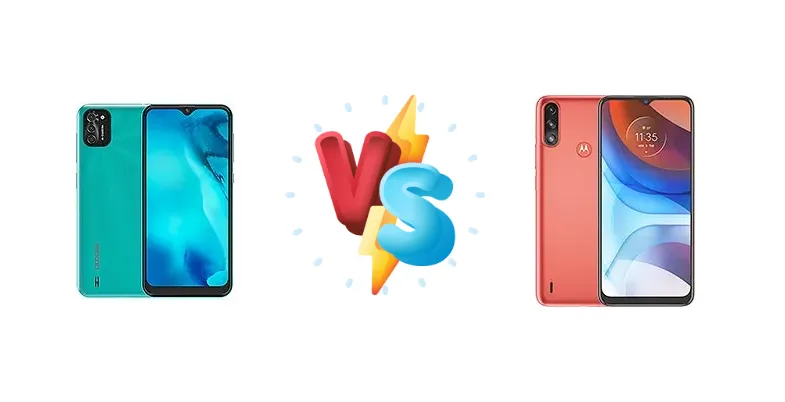
The Doogee X93 and Motorola Moto E7i Power represent the extreme end of the budget smartphone spectrum. Both aim to deliver essential smartphone functionality at the lowest possible price point, but they take different approaches to achieving this. This comparison focuses on the core hardware differences – specifically the chipsets – and how those translate into real-world user experience.
🏆 Quick Verdict
For the average user prioritizing responsiveness and multitasking, the Motorola Moto E7i Power is the better choice. Its Unisoc SC9863A octa-core processor provides a significant performance uplift over the Doogee X93’s quad-core Mediatek MT6580, making everyday tasks smoother and more enjoyable. While both offer similar battery and charging capabilities, the E7i Power’s CPU advantage is decisive.
| Network |
|---|
| 2G bands | GSM 850 / 900 / 1800 / 1900 | GSM 850 / 900 / 1800 / 1900 |
| 3G bands | HSDPA 900 / 2100 | HSDPA 850 / 900 / 1700(AWS) / 1900 / 2100 |
| 4G bands | - | LTE |
| Speed | HSPA 42.2/5.76 Mbps | HSPA, LTE |
| Technology | GSM / HSPA | GSM / HSPA / LTE |
| Launch |
|---|
| Announced | 2021, August | 2021, February 23 |
| Status | Available. Released 2021, August | Available. Released 2021, March 15 |
| Body |
|---|
| Build | - | Glass front, plastic back, plastic frame |
| Dimensions | 156 x 73.8 x 9.8 mm (6.14 x 2.91 x 0.39 in) | 165.1 x 75.9 x 9.2 mm (6.5 x 2.99 x 0.36 in) |
| SIM | Nano-SIM + Nano-SIM | Nano-SIM + Nano-SIM |
| Weight | - | 200 g (7.05 oz) |
| | - | Water-repellent design |
| Display |
|---|
| Resolution | 600 x 1280 pixels (~232 ppi density) | 720 x 1600 pixels, 20:9 ratio (~270 ppi density) |
| Size | 6.1 inches, 92.3 cm2 (~80.1% screen-to-body ratio) | 6.51 inches, 102.3 cm2 (~81.7% screen-to-body ratio) |
| Type | IPS LCD | IPS LCD, 380 nits (typ) |
| Platform |
|---|
| CPU | Quad-core 1.3 GHz Cortex-A7 | Octa-core (4x1.6 GHz Cortex-A55 & 4x1.2 GHz Cortex-A55) |
| Chipset | Mediatek MT6580 (28 nm) | Unisoc SC9863A (28 nm) |
| GPU | Mali-400MP2 | IMG8322 |
| OS | Android 10 (Go edition) | Android 10 (Go edition) |
| Memory |
|---|
| Card slot | microSDXC (dedicated slot) | microSDXC (uses shared SIM slot) |
| Internal | 16GB 2GB RAM | 32GB 2GB RAM |
| | - | eMMC 5.1 |
| Main Camera |
|---|
| Dual | - | 13 MP, f/2.0, 26mm (wide), 1/3.1", 1.12µm, PDAF
2 MP (macro) |
| Features | LED flash | LED flash, HDR, panorama |
| Triple | 8 MP, f/2.2, (wide)
Auxiliary lenses | - |
| Video | 1080p | 1080p@30fps |
| Selfie camera |
|---|
| Features | - | HDR |
| Single | 5 MP, f/2.2, (wide) | 5 MP, f/2.2, 27mm (wide), 1.12µm |
| Video | 720p | 1080p@30fps |
| Sound |
|---|
| 3.5mm jack | - | Yes |
| 35mm jack | Yes | Yes |
| Loudspeaker | Yes | Yes |
| Comms |
|---|
| Bluetooth | 4.2, A2DP | 4.2, A2DP |
| NFC | No | No |
| Positioning | GPS, GLONASS, BDS | GPS, GLONASS, GALILEO |
| Radio | FM radio | Unspecified |
| USB | microUSB 2.0, OTG | USB Type-C 2.0 |
| WLAN | Wi-Fi 802.11 a/b/g/n/ac, dual-band | Wi-Fi 802.11 b/g/n |
| Features |
|---|
| Sensors | Accelerometer, proximity | Fingerprint (rear-mounted), accelerometer, proximity |
| Battery |
|---|
| Charging | 10W wired | 10W wired |
| Type | 4350 mAh | Li-Ion 5000 mAh |
| Misc |
|---|
| Colors | Black, Blue, Green | Tahiti Blue, Coral Red |
| Models | - | XT2097-13 |
| Price | About 90 EUR | About 120 EUR |
Doogee X93
- Lowest possible price point
- Functional for basic tasks
- Simple and straightforward Android experience
- Slow performance with the MT6580 chipset
- Limited multitasking capabilities
- Outdated CPU architecture
Motorola Moto E7i Power
- Significantly better performance with the Unisoc SC9863A
- Improved multitasking and responsiveness
- More modern CPU architecture
- Still a budget device with limitations
- 10W charging is slow
- Camera quality likely limited
Display Comparison
Neither Doogee nor Motorola provide detailed display specifications for these models. Given their price point, it’s safe to assume both utilize LCD panels with 720p+ resolutions. Expect similar levels of color accuracy and brightness. The focus here isn’t on display quality, but on core performance.
Camera Comparison
Both phones likely feature basic camera setups. Detailed sensor information is scarce, but it’s reasonable to assume both include a primary camera and potentially a secondary depth or macro sensor. Given the price bracket, image quality will be limited, particularly in low-light conditions. Focusing on the chipset difference, the E7i Power’s more capable CPU could potentially offer slightly faster image processing, but the sensor itself will be the primary limiting factor.
Performance
The core difference lies in the chipsets. The Doogee X93’s Mediatek MT6580, built on a 28nm process, features a quad-core Cortex-A7 CPU clocked at 1.3 GHz. This is an older architecture designed for basic functionality. Conversely, the Motorola Moto E7i Power utilizes the Unisoc SC9863A, also on 28nm, but with an octa-core configuration – four Cortex-A55 cores at 1.6 GHz and four at 1.2 GHz. The Cortex-A55 is a more modern and efficient architecture than the A7, and the eight cores provide significantly improved multitasking capabilities. While both are 28nm, the architectural improvements and core count give the E7i Power a clear advantage in CPU-bound tasks. Expect noticeable lag on the X93 when switching between apps or loading complex web pages.
Battery Life
Both the Doogee X93 and Motorola Moto E7i Power feature 10W wired charging. Battery capacity is not specified in the provided data, but typical capacities for phones in this segment range from 3000mAh to 4000mAh. With the less efficient MT6580, the Doogee X93 might see slightly faster battery drain under load, but in typical usage, the difference will be minimal. The 10W charging speed will result in relatively slow charging times for both devices – expect several hours to reach a full charge.
Buying Guide
Buy the Doogee X93 if you absolutely need the lowest possible price and your smartphone usage is limited to basic calling, texting, and very light app use. It’s a functional device for those with minimal demands. Buy the Motorola Moto E7i Power if you want a more responsive experience for social media, web browsing, and occasional light gaming. The E7i Power offers a noticeable performance improvement for a small price premium, making it a more versatile option.
Frequently Asked Questions
❓ Will the Unisoc SC9863A in the Moto E7i Power handle popular apps like WhatsApp and Facebook smoothly?
Yes, the octa-core processor and more modern architecture of the Unisoc SC9863A are well-suited for running common social media apps like WhatsApp and Facebook. You should experience a smoother and more responsive experience compared to the Doogee X93’s Mediatek MT6580.
❓ Is the Doogee X93 suitable for playing mobile games?
The Doogee X93 is not ideal for gaming. The Mediatek MT6580’s limited processing power and older GPU will struggle with most modern mobile games, even at low settings. Expect significant lag and frame rate drops. The Moto E7i Power will offer a slightly better experience, but it’s still not a gaming-focused device.
❓ Does either phone support VoLTE or Wi-Fi calling?
Support for VoLTE and Wi-Fi calling depends on the carrier and region. Neither Doogee nor Motorola explicitly state support for these features on these specific models. It’s crucial to check with your mobile carrier to confirm compatibility before purchasing.
❓ What Android version do these phones ship with, and will they receive updates?
Both phones likely ship with Android Go Edition, a lightweight version of Android designed for devices with limited resources. Software update support is typically limited on phones in this price range. Expect minimal or no major Android version updates.