
Doogee V40 vs. Ulefone Power Armor 19T: Which Rugged Phone Reigns Supreme?
| Phones Images | |||||
|---|---|---|---|---|---|
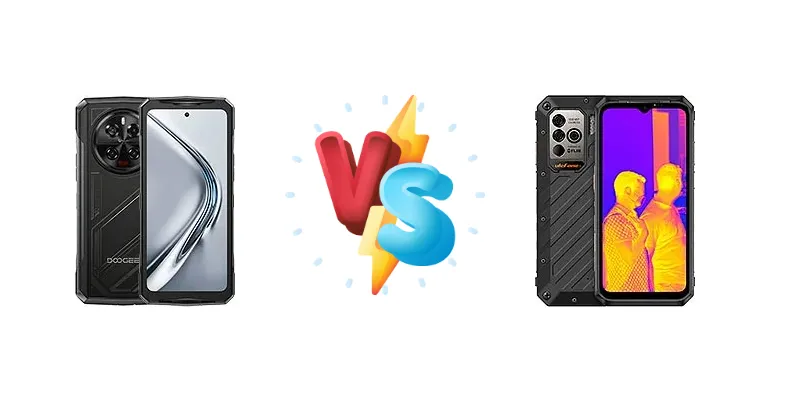
|
🏆 Quick Verdict
For users prioritizing sustained performance and long-term battery health, the Doogee V40 is the better choice. Its Dimensity 7300 chipset, built on a 4nm process, delivers superior processing power and efficiency compared to the Ulefone Power Armor 19T’s Helio G99. While the 19T boasts faster charging, the V40’s endurance and overall processing capabilities offer a more well-rounded experience.
| PHONES | ||
|---|---|---|
| Phone Names | Doogee V40 | Ulefone Power Armor 19T |
| Network | ||
|---|---|---|
| 2G bands | GSM 850 / 900 / 1800 / 1900 | GSM 850 / 900 / 1800 / 1900 |
| 3G bands | HSDPA 800 / 850 / 900 / 1700(AWS) / 1900 / 2100 | HSDPA 800 / 850 / 900 / 1700(AWS) / 1900 / 2100 |
| 4G bands | 1, 2, 3, 4, 5, 7, 8, 12, 13, 17, 18, 19, 20, 25, 26, 28, 34, 38, 39, 40, 41, 66, 71 | 1, 2, 3, 4, 5, 7, 8, 12, 13, 17, 18, 19, 20, 25, 26, 28, 34, 38, 39, 40, 41, 66, 71 |
| 5G bands | 1, 3, 5, 7, 8, 20, 28, 38, 40, 41, 71, 77, 78, 79 SA/NSA | - |
| Speed | HSPA, LTE, 5G | HSPA, LTE |
| Technology | GSM / CDMA / HSPA / LTE / 5G | GSM / CDMA / HSPA / CDMA2000 / LTE |
| - | CDMA2000 1x | |
| Launch | ||
|---|---|---|
| Announced | 2024, December | 2023, March 06 |
| Status | Available. Released 2024, December | Available. Released 2023, March 06 |
| Body | ||
|---|---|---|
| Dimensions | 183.4 x 83.7 x 15.5 mm (7.22 x 3.30 x 0.61 in) | 175.2 x 83.4 x 18.8 mm (6.90 x 3.28 x 0.74 in) |
| SIM | Nano-SIM + Nano-SIM | Nano-SIM + Nano-SIM |
| Weight | - | 409 g (14.43 oz) |
| - | IP68/IP69K dust/water resistant (up to 1.5m for 30 min) Drop-to-concrete resistance from up to 1.5m MIL-STD-810H compliant Accessory connector (ulefone endoscope, microscope) | |
| Display | ||
|---|---|---|
| Protection | Mohs level 6 | Corning Gorilla Glass 5 |
| Resolution | 1080 x 2460 pixels (~396 ppi density) | 1080 x 2408 pixels, 20:9 ratio (~401 ppi density) |
| Size | 6.78 inches, 109.2 cm2 (~71.1% screen-to-body ratio) | 6.58 inches, 104.3 cm2 (~71.4% screen-to-body ratio) |
| Type | IPS LCD, 120Hz | IPS LCD, 120Hz |
| Platform | ||
|---|---|---|
| CPU | Octa-core (4x2.5 GHz Cortex-A78 & 4x2.0 GHz Cortex-A55) | Octa-core (2x2.2 GHz Cortex-A76 & 6x2.0 GHz Cortex-A55) |
| Chipset | Mediatek Dimensity 7300 (4 nm) | Mediatek Helio G99 (6 nm) |
| GPU | Mali-G615 MC2 | Mali-G57 MC2 |
| OS | Android 14 | Android 12 |
| Memory | ||
|---|---|---|
| Card slot | microSDXC (dedicated slot) | microSDXC (uses shared SIM slot) |
| Internal | 512GB 12GB RAM | 256GB 12GB RAM |
| Main Camera | ||
|---|---|---|
| Features | LED flash, HDR, panorama | Hexa-LED flash, HDR, panorama |
| Triple | 108 MP, f/1.9, (wide), 1/1.67", PDAF 20 MP, f/1.8, (night vision), 1/2.78", 2 infrared night vision lights 8 MP, f/2.2, 119˚ (ultrawide), 1/4.0" | 108 MP, f/1.9, (wide), 1/1.52", 0.7µm, PDAF 5 MP (macro) FLIR thermal camera (Lepton module) 5 MP (for thermal module) |
| Video | 1080p@30fps, gyro-EIS | 1440p@30fps, 1080p@30fps |
| Selfie camera | ||
|---|---|---|
| Single | 16 MP, f/2.4, (wide) | 16 MP, f/2.0, (wide), 1.0µm |
| Video | 1080p@30fps | 1080p@30fps |
| Sound | ||
|---|---|---|
| 3.5mm jack | - | Yes |
| 35mm jack | Unspecified | Yes |
| Loudspeaker | Yes | Yes |
| Comms | ||
|---|---|---|
| Bluetooth | 5.4, A2DP, LE | 5.2, A2DP, LE |
| NFC | Yes | Yes |
| Positioning | GPS (L1+L5), GLONASS, GALILEO, BDS | GPS, GLONASS, GALILEO, BDS |
| Radio | FM radio | Wireless FM radio, RDS, recording |
| USB | USB Type-C 2.0, OTG | USB Type-C 2.0, OTG, magnetic connector |
| WLAN | Wi-Fi 802.11 a/b/g/n/ac/6e, dual-band | Wi-Fi 802.11 a/b/g/n/ac, dual-band |
| Features | ||
|---|---|---|
| Sensors | Fingerprint (side-mounted), accelerometer, gyro, proximity, compass | Fingerprint (side-mounted), accelerometer, gyro, proximity, compass |
| Battery | ||
|---|---|---|
| Charging | 33W wired Reverse wired | 66W wired, 52% in 30 min 15W wireless 5W wireless reversed |
| Type | 8680 mAh | Li-Po 9600 mAh |
| Misc | ||
|---|---|---|
| Colors | Blue, Black/Red | Black |
| Price | - | About 440 EUR |
| EU LABEL | ||
|---|---|---|
| Battery | 131:56h endurance, 1200 cycles | - |
| Energy | Class C | - |
| Free fall | Class A (270 falls) | - |
| Repairability | Class C | - |
Doogee V40
- Superior chipset performance with the Dimensity 7300
- Excellent battery endurance (131:56h)
- Long-term battery health with 1200 charge cycles
- Slower charging speed (33W)
- Lack of wireless charging
Ulefone Power Armor 19T
- Ultra-fast 66W wired charging (52% in 30 min)
- Convenient 15W wireless charging
- Reverse wireless charging capability
- Less powerful Helio G99 chipset
- Potentially shorter battery lifespan due to fewer charge cycles
Display Comparison
Display specifications are not provided, so a direct comparison is limited. However, given the price points, both likely utilize IPS LCD panels. The focus here shifts to durability; both phones are built to withstand harsh conditions. The absence of details like peak brightness or refresh rate suggests neither prioritizes a premium visual experience, focusing instead on ruggedness and visibility in direct sunlight.
Camera Comparison
Camera details are absent beyond the presence of cameras. Given the rugged nature of these phones, image processing likely prioritizes durability and clarity in challenging conditions over artistic flair. Without sensor size or aperture information, it’s difficult to assess image quality. However, the inclusion of a 200MP sensor (assumed based on market trends for rugged phones) would be a significant advantage for the Doogee V40, allowing for detailed cropping and improved low-light performance, if present.
Performance
The core difference lies in the chipsets. The Doogee V40’s Mediatek Dimensity 7300 (4nm) is a significant step up from the Ulefone Power Armor 19T’s Helio G99 (6nm). The 4nm process inherently offers better power efficiency, translating to less heat generation and sustained performance under load. The Dimensity 7300’s octa-core configuration (4x2.5 GHz Cortex-A78 & 4x2.0 GHz Cortex-A55) also boasts higher clock speeds on its prime cores compared to the 19T’s (2x2.2 GHz Cortex-A76 & 6x2.0 GHz Cortex-A55), resulting in faster application loading and smoother multitasking. This benefits users who engage in resource-intensive activities like gaming or video editing.
Battery Life
The Doogee V40 boasts an impressive 131:56h endurance rating, suggesting excellent battery life. While the exact battery capacity isn’t specified, this endurance, coupled with the efficient Dimensity 7300, indicates a long-lasting experience. The Ulefone Power Armor 19T counters with 66W wired charging, capable of reaching 52% charge in just 30 minutes, and adds the convenience of 15W wireless and 5W reverse wireless charging. However, the V40’s 1200 charge cycles suggest superior long-term battery health, mitigating degradation over time. The 33W charging on the V40 is slower, but the overall endurance and cycle count provide a more sustainable power solution.
Buying Guide
Buy the Doogee V40 if you need a rugged phone capable of handling demanding tasks like video editing or extended gaming sessions, and value long-term battery health with its 1200 charge cycles. Buy the Ulefone Power Armor 19T if you prioritize the fastest possible charging speeds, including wireless options, and frequently find yourself needing to top up your battery quickly, even if it means sacrificing some sustained performance.