
Doogee V40 vs Oukitel WP210: A Deep Dive into Rugged Smartphone Performance
| Phones Images | |||||
|---|---|---|---|---|---|
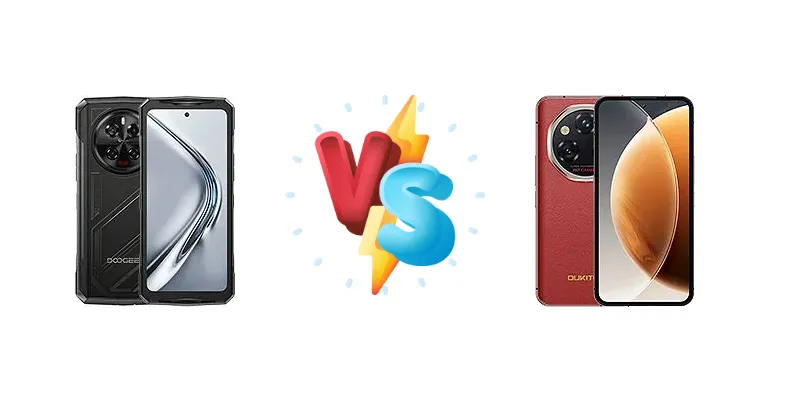
|
🏆 Quick Verdict
For the average user prioritizing longevity and consistent performance, the Doogee V40 emerges as the winner. Its significantly superior 131:56h battery endurance and efficient Dimensity 7300 chipset provide a more reliable experience, even if it means sacrificing some peak processing power compared to the Oukitel WP210.
| PHONES | ||
|---|---|---|
| Phone Names | Doogee V40 | Oukitel WP210 |
| Network | ||
|---|---|---|
| 2G bands | GSM 850 / 900 / 1800 / 1900 | GSM 850 / 900 / 1800 / 1900 |
| 3G bands | HSDPA 800 / 850 / 900 / 1700(AWS) / 1900 / 2100 | HSDPA 800 / 850 / 900 / 1700(AWS) / 1900 / 2100 |
| 4G bands | 1, 2, 3, 4, 5, 7, 8, 12, 13, 17, 18, 19, 20, 25, 26, 28, 34, 38, 39, 40, 41, 66, 71 | 1, 2, 3, 4, 5, 7, 8, 12, 13, 17, 18, 19, 20, 25, 26, 28, 34, 38, 39, 40, 41, 66, 71 |
| 5G bands | 1, 3, 5, 7, 8, 20, 28, 38, 40, 41, 71, 77, 78, 79 SA/NSA | 1, 2, 3, 5, 7, 8, 12, 20, 25, 28, 34, 38, 39, 40, 41, 48, 66, 71, 77, 78 SA/NSA |
| Speed | HSPA, LTE, 5G | HSPA, LTE, 5G |
| Technology | GSM / CDMA / HSPA / LTE / 5G | GSM / HSPA / LTE / 5G |
| Launch | ||
|---|---|---|
| Announced | 2024, December | 2025, July |
| Status | Available. Released 2024, December | Available. Released 2025, July 15 |
| Body | ||
|---|---|---|
| Dimensions | 183.4 x 83.7 x 15.5 mm (7.22 x 3.30 x 0.61 in) | 163.6 x 77.9 x 13.7 mm (6.44 x 3.07 x 0.54 in) |
| SIM | Nano-SIM + Nano-SIM | Nano-SIM + Nano-SIM |
| Weight | - | 311 g (10.97 oz) |
| Display | ||
|---|---|---|
| Protection | Mohs level 6 | Corning Gorilla Glass 5, Mohs level 5 |
| Resolution | 1080 x 2460 pixels (~396 ppi density) | 1080 x 2408 pixels, 20:9 ratio (~394 ppi density) |
| Size | 6.78 inches, 109.2 cm2 (~71.1% screen-to-body ratio) | 6.7 inches, 108.1 cm2 (~84.9% screen-to-body ratio) |
| Type | IPS LCD, 120Hz | IPS LCD, 120Hz, 500 nits |
| Platform | ||
|---|---|---|
| CPU | Octa-core (4x2.5 GHz Cortex-A78 & 4x2.0 GHz Cortex-A55) | Octa-core (1x3.1 GHz Cortex-A78 & 3x3.0 GHz Cortex-A78 & 4x2.0 GHz Cortex-A55) |
| Chipset | Mediatek Dimensity 7300 (4 nm) | Mediatek Dimensity 8200 (4 nm) |
| GPU | Mali-G615 MC2 | Mali-G610 MC6 |
| OS | Android 14 | Android 15 |
| Memory | ||
|---|---|---|
| Card slot | microSDXC (dedicated slot) | microSDXC (uses shared SIM slot) |
| Internal | 512GB 12GB RAM | 512GB 12GB RAM |
| Main Camera | ||
|---|---|---|
| Features | LED flash, HDR, panorama | LED flash, HDR, panorama |
| Triple | 108 MP, f/1.9, (wide), 1/1.67", PDAF 20 MP, f/1.8, (night vision), 1/2.78", 2 infrared night vision lights 8 MP, f/2.2, 119˚ (ultrawide), 1/4.0" | 108 MP, f/1.9, (wide), 1/1.8", PDAF 2 MP (macro) Auxiliary lens |
| Video | 1080p@30fps, gyro-EIS | 4K@30fps |
| Selfie camera | ||
|---|---|---|
| Single | 16 MP, f/2.4, (wide) | 32 MP, f/2.2, (wide), 1/2.74" |
| Video | 1080p@30fps | 1080p@30fps |
| Sound | ||
|---|---|---|
| 35mm jack | Unspecified | No |
| Loudspeaker | Yes | Yes |
| Comms | ||
|---|---|---|
| Bluetooth | 5.4, A2DP, LE | 5.3, A2DP, LE |
| NFC | Yes | Yes |
| Positioning | GPS (L1+L5), GLONASS, GALILEO, BDS | GPS (L1+L5), GLONASS, GALILEO, BDS |
| Radio | FM radio | FM radio |
| USB | USB Type-C 2.0, OTG | USB Type-C 2.0 |
| WLAN | Wi-Fi 802.11 a/b/g/n/ac/6e, dual-band | Wi-Fi 802.11 a/b/g/n/ac/6, dual-band |
| Features | ||
|---|---|---|
| Sensors | Fingerprint (side-mounted), accelerometer, gyro, proximity, compass | Fingerprint (side-mounted), accelerometer, gyro, proximity, compass |
| Battery | ||
|---|---|---|
| Charging | 33W wired Reverse wired | 45W wired |
| Type | 8680 mAh | Li-Po 8800 mAh |
| Misc | ||
|---|---|---|
| Colors | Blue, Black/Red | Gray, Black, Red |
| EU LABEL | ||
|---|---|---|
| Battery | 131:56h endurance, 1200 cycles | 86:17h endurance, 1000 cycles |
| Energy | Class C | Class B |
| Free fall | Class A (270 falls) | Class A (270 falls) |
| Repairability | Class C | Class C |
Doogee V40
- Exceptional battery life (131:56h endurance)
- Longer battery lifespan (1200 cycles)
- Balanced CPU architecture for sustained performance
- Less powerful CPU compared to the Oukitel WP210
- Slower charging speed (33W)
Oukitel WP210
- More powerful CPU (Dimensity 8200)
- Faster charging speed (45W)
- Potentially smoother display performance
- Significantly shorter battery life (86:17h endurance)
- Fewer battery cycles (1000 cycles)
- Potential for thermal throttling under sustained load
Display Comparison
While display specifications aren't provided, both phones likely utilize IPS LCD panels common in the rugged segment. The focus here is on durability rather than cutting-edge display tech. However, the chipset differences *could* impact display responsiveness; the more powerful Dimensity 8200 in the Oukitel WP210 may translate to smoother scrolling and animations, assuming both phones have similar refresh rates (which is not specified).
Camera Comparison
Camera details are absent, making a direct comparison impossible. However, given the market segment, both phones likely prioritize practicality over photographic excellence. Expect decent main sensors for daylight photography, but image quality will likely suffer in low-light conditions. The inclusion of a 2MP macro lens on either device is largely a marketing gimmick and shouldn't be a deciding factor.
Performance
The Oukitel WP210 holds a clear advantage in raw processing power with its Dimensity 8200 (4nm) chipset, featuring a 3.1 GHz Cortex-A78 prime core alongside three additional Cortex-A78 cores. This contrasts with the Doogee V40’s Dimensity 7300 (4nm) which has a 2.5 GHz Cortex-A78 prime core. While both are 4nm chips offering good efficiency, the WP210’s core configuration suggests superior multi-core performance. However, the Doogee V40’s architecture, while slightly slower on paper, benefits from a more balanced core arrangement (4x A78, 4x A55) which may lead to more sustained performance under load. The WP210's 3x A78 configuration could lead to thermal throttling in prolonged intensive tasks.
Battery Life
The Doogee V40’s 131:56h endurance is a standout feature, significantly exceeding the Oukitel WP210’s 86:17h. This translates to days of use on a single charge for the V40, while the WP210 will likely require daily charging. While the WP210 compensates with 45W wired charging, potentially offering a faster 0-100% time than the V40’s 33W, the sheer longevity of the V40’s battery is a more compelling advantage for users prioritizing uptime. The V40 also boasts 1200 battery cycles, suggesting a longer lifespan before significant capacity degradation compared to the WP210’s 1000 cycles.
Buying Guide
Buy the Doogee V40 if you need a phone that can genuinely last for days on a single charge, and you value consistent performance over raw benchmark scores. This is ideal for outdoor enthusiasts, field workers, or anyone who frequently finds themselves away from a power outlet. Buy the Oukitel WP210 if you prioritize faster processing speeds for demanding tasks like gaming or video editing, and you don't mind charging your phone more frequently. The 45W charging also offers a quicker top-up when you do need power.