
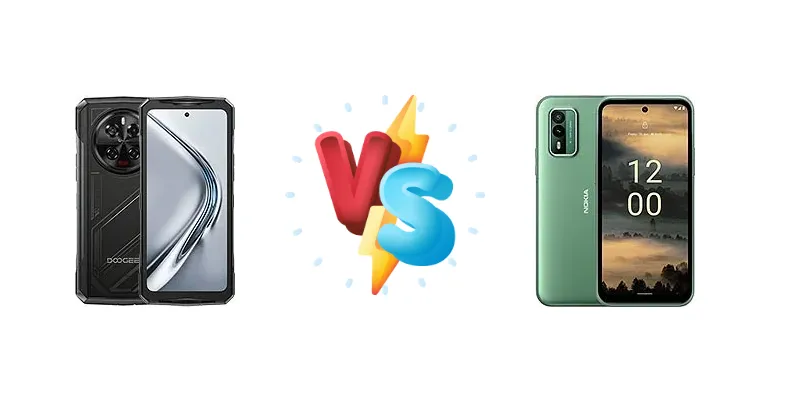
Doogee V40 vs Nokia XR21: A Deep Dive into Rugged Smartphone Performance
| Phones Images | |||||
|---|---|---|---|---|---|
|
🏆 Quick Verdict
For users prioritizing performance and extended battery life, the Doogee V40 emerges as the stronger choice. Its Dimensity 7300 chipset and impressive 131:56h endurance significantly outperform the Nokia XR21's Snapdragon 695. However, the XR21 offers a more established brand reputation and potentially wider software support.
| PHONES | ||
|---|---|---|
| Phone Names | Doogee V40 | Nokia XR21 |
| Network | ||
|---|---|---|
| 2G bands | GSM 850 / 900 / 1800 / 1900 | GSM 850 / 900 / 1800 / 1900 |
| 3G bands | HSDPA 800 / 850 / 900 / 1700(AWS) / 1900 / 2100 | HSDPA 850 / 900 / 1700(AWS) / 1900 / 2100 |
| 4G bands | 1, 2, 3, 4, 5, 7, 8, 12, 13, 17, 18, 19, 20, 25, 26, 28, 34, 38, 39, 40, 41, 66, 71 | 1, 2, 3, 4, 5, 7, 8, 12, 13, 17, 20, 25, 26, 28, 32, 38, 39, 40, 41, 42, 43, 48, 66, 71 |
| 5G bands | 1, 3, 5, 7, 8, 20, 28, 38, 40, 41, 71, 77, 78, 79 SA/NSA | 1, 2, 3, 5, 7, 20, 25, 28, 40, 41, 66, 71, 77, 78, 79 SA/NSA |
| Speed | HSPA, LTE, 5G | HSPA, LTE, 5G |
| Technology | GSM / CDMA / HSPA / LTE / 5G | GSM / HSPA / LTE / 5G |
| Launch | ||
|---|---|---|
| Announced | 2024, December | 2023, May 03 |
| Status | Available. Released 2024, December | Available. Released 2023, June 11 |
| Body | ||
|---|---|---|
| Build | - | Glass front (Gorilla Glass Victus), plastic back, plastic frame |
| Dimensions | 183.4 x 83.7 x 15.5 mm (7.22 x 3.30 x 0.61 in) | 168 x 78.6 x 10.5 mm (6.61 x 3.09 x 0.41 in) |
| SIM | Nano-SIM + Nano-SIM | Nano-SIM + Nano-SIM + eSIM (max 2 at a time) |
| Weight | - | 231 g (8.15 oz) |
| - | IP68/IP69K dust/water resistant (up to 1.5m for 60 min) Drop-to-concrete resistance from up to 1.8m MIL-STD-810H compliant | |
| Display | ||
|---|---|---|
| Protection | Mohs level 6 | Corning Gorilla Glass Victus |
| Resolution | 1080 x 2460 pixels (~396 ppi density) | 1080 x 2400 pixels, 20:9 ratio (~406 ppi density) |
| Size | 6.78 inches, 109.2 cm2 (~71.1% screen-to-body ratio) | 6.49 inches, 101.7 cm2 (~77.0% screen-to-body ratio) |
| Type | IPS LCD, 120Hz | IPS LCD, 120Hz, 450 nits (typ), 550 nits (HBM) |
| Platform | ||
|---|---|---|
| CPU | Octa-core (4x2.5 GHz Cortex-A78 & 4x2.0 GHz Cortex-A55) | Octa-core (2x2.2 GHz Kryo 660 Gold & 6x1.7 GHz Kryo 660 Silver) |
| Chipset | Mediatek Dimensity 7300 (4 nm) | Qualcomm SM6375 Snapdragon 695 5G (6 nm) |
| GPU | Mali-G615 MC2 | Adreno 619 |
| OS | Android 14 | Android 12 |
| Memory | ||
|---|---|---|
| Card slot | microSDXC (dedicated slot) | Unspecified |
| Internal | 512GB 12GB RAM | 128GB 6GB RAM |
| Main Camera | ||
|---|---|---|
| Dual | - | 64 MP, f/1.8, (wide), 1/2.0", PDAF 8 MP, f/2.2, (ultrawide), 1/4.0", 1.12µm |
| Features | LED flash, HDR, panorama | Dual-LED dual-tone flash, second LED flash, HDR, panorama |
| Triple | 108 MP, f/1.9, (wide), 1/1.67", PDAF 20 MP, f/1.8, (night vision), 1/2.78", 2 infrared night vision lights 8 MP, f/2.2, 119˚ (ultrawide), 1/4.0" | - |
| Video | 1080p@30fps, gyro-EIS | 1080p@30fps |
| Selfie camera | ||
|---|---|---|
| Single | 16 MP, f/2.4, (wide) | 16 MP, f/2.4 (wide) |
| Video | 1080p@30fps | 1080p@30fps |
| Sound | ||
|---|---|---|
| 3.5mm jack | - | Yes |
| 35mm jack | Unspecified | Yes |
| Loudspeaker | Yes | Yes, with stereo speakers |
| Comms | ||
|---|---|---|
| Bluetooth | 5.4, A2DP, LE | 5.1, A2DP, LE, aptX Adaptive |
| NFC | Yes | Yes (market/region dependent) |
| Positioning | GPS (L1+L5), GLONASS, GALILEO, BDS | GPS (L1+L5), GLONASS (G1), BDS (B1I+B1c+B2a), GALILEO (E1+E5a), QZSS (L1+L5), NavIC (L5) |
| Radio | FM radio | Unspecified |
| USB | USB Type-C 2.0, OTG | USB Type-C 2.0, OTG |
| WLAN | Wi-Fi 802.11 a/b/g/n/ac/6e, dual-band | Wi-Fi 802.11 a/b/g/n/ac/6, dual-band |
| Features | ||
|---|---|---|
| Sensors | Fingerprint (side-mounted), accelerometer, gyro, proximity, compass | Fingerprint (side-mounted), accelerometer, gyro, proximity, compass, barometer |
| Battery | ||
|---|---|---|
| Charging | 33W wired Reverse wired | 33W wired, PD2.0, QC3 |
| Type | 8680 mAh | Li-Po 4800 mAh |
| Misc | ||
|---|---|---|
| Colors | Blue, Black/Red | Midnight Black, Pine Green |
| Price | - | About 570 EUR |
| EU LABEL | ||
|---|---|---|
| Battery | 131:56h endurance, 1200 cycles | - |
| Energy | Class C | - |
| Free fall | Class A (270 falls) | - |
| Repairability | Class C | - |
Doogee V40
- Superior processing power with the Dimensity 7300
- Exceptional battery endurance (131:56h)
- High charge cycle count (1200 cycles) for long-term reliability
- Brand recognition is lower than Nokia
- Software update support may be less consistent
Nokia XR21
- Established brand reputation and trust
- Potential for faster charging with PD2.0/QC3
- Likely more consistent software updates
- Significantly less powerful chipset (Snapdragon 695)
- Lower battery endurance compared to the Doogee V40
- May struggle with demanding applications
Display Comparison
Display specifications are absent from the provided data, but considering the market segment, both likely feature durable, protected displays. The key difference will likely be in panel technology and brightness. We anticipate the Doogee V40, targeting a more performance-oriented user, may have a higher peak brightness for outdoor visibility. Nokia typically prioritizes color accuracy, so the XR21 might offer more natural color reproduction. Bezels are likely comparable given the rugged design constraints.
Camera Comparison
Camera details are limited. However, given the rugged nature of both phones, we can assume a focus on durability rather than cutting-edge camera technology. The absence of sensor details makes a direct comparison difficult. The presence of a larger main sensor (if present on the V40) would be a significant advantage. Image processing will likely differ, with Doogee potentially favoring vibrant colors and Nokia aiming for more realistic tones. The usefulness of any 2MP macro lenses on either device is questionable.
Performance
The core difference lies in the chipsets. The Doogee V40’s Mediatek Dimensity 7300 (4nm) is a significant step up from the Nokia XR21’s Qualcomm Snapdragon 695 (6nm). The 4nm process node of the Dimensity 7300 translates to better power efficiency and thermal performance, allowing for sustained peak performance. The Dimensity 7300’s octa-core configuration (4x2.5 GHz Cortex-A78 & 4x2.0 GHz Cortex-A55) provides a substantial CPU performance advantage over the XR21’s (2x2.2 GHz Kryo 660 Gold & 6x1.7 GHz Kryo 660 Silver). This will be noticeable in demanding applications and multitasking. The XR21’s Snapdragon 695 is adequate for everyday tasks, but will struggle with graphically intensive games or complex applications.
Battery Life
The Doogee V40 boasts an impressive 131:56h endurance rating, indicating exceptional battery life. While the capacity isn't specified, this endurance, coupled with 1200 charge cycles, suggests a large battery and optimized power management. Both phones offer 33W wired charging, but the XR21 adds PD2.0 and QC3 support, potentially allowing for slightly faster charging with compatible chargers. However, the V40’s significantly longer endurance will likely offset any minor charging speed differences.
Buying Guide
Buy the Doogee V40 if you need a rugged phone for demanding tasks like mobile gaming, video editing, or extended outdoor use where battery life is critical. Its superior chipset and endurance will keep you going. Buy the Nokia XR21 if you prefer a more balanced device with a focus on reliable performance for everyday tasks, a trusted brand, and potentially faster software updates, even if it means sacrificing some raw power and battery longevity.