
Doogee V40 vs Blackview BV9200: A Deep Dive into Rugged Smartphone Performance
| Phones Images | |||||
|---|---|---|---|---|---|
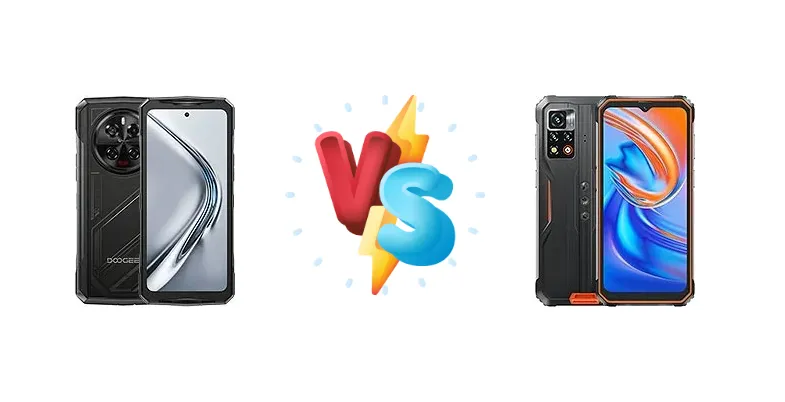
|
🏆 Quick Verdict
For users prioritizing sustained performance and long-term battery health, the Doogee V40 is the clear winner. Its Dimensity 7300 chipset offers a significant performance advantage over the Blackview BV9200’s Helio G96, and its impressive 131:56h endurance rating speaks volumes. While the BV9200’s 66W charging is faster, the V40’s efficiency and longevity make it the better choice for most.
| PHONES | ||
|---|---|---|
| Phone Names | Doogee V40 | Blackview BV9200 |
| Network | ||
|---|---|---|
| 2G bands | GSM 850 / 900 / 1800 / 1900 | GSM 850 / 900 / 1800 / 1900 |
| 3G bands | HSDPA 800 / 850 / 900 / 1700(AWS) / 1900 / 2100 | HSDPA 850 / 900 / 1700(AWS) / 1900 / 2100 |
| 4G bands | 1, 2, 3, 4, 5, 7, 8, 12, 13, 17, 18, 19, 20, 25, 26, 28, 34, 38, 39, 40, 41, 66, 71 | 1, 2, 3, 4, 5, 7, 8, 12, 13, 17, 18, 19, 20, 25, 26, 28, 34, 38, 39, 40, 41, 66 |
| 5G bands | 1, 3, 5, 7, 8, 20, 28, 38, 40, 41, 71, 77, 78, 79 SA/NSA | - |
| Speed | HSPA, LTE, 5G | HSPA, LTE |
| Technology | GSM / CDMA / HSPA / LTE / 5G | GSM / CDMA / HSPA / LTE |
| - | CDMA 800 / 1900 | |
| Launch | ||
|---|---|---|
| Announced | 2024, December | 2022, December 28 |
| Status | Available. Released 2024, December | Available. Released 2023, January 09 |
| Body | ||
|---|---|---|
| Dimensions | 183.4 x 83.7 x 15.5 mm (7.22 x 3.30 x 0.61 in) | 174.5 x 81.8 x 13.6 mm (6.87 x 3.22 x 0.54 in) |
| SIM | Nano-SIM + Nano-SIM | Nano-SIM + Nano-SIM |
| Weight | - | 310 g (10.93 oz) |
| - | IP68/IP69K dust/water resistant (up to 1.5m for 30 min) Drop-to-concrete resistance from up to 1.8m MIL-STD-810H compliant | |
| Display | ||
|---|---|---|
| Protection | Mohs level 6 | Corning Gorilla Glass 5 |
| Resolution | 1080 x 2460 pixels (~396 ppi density) | 1080 x 2408 pixels, 20:9 ratio (~400 ppi density) |
| Size | 6.78 inches, 109.2 cm2 (~71.1% screen-to-body ratio) | 6.6 inches, 104.9 cm2 (~73.5% screen-to-body ratio) |
| Type | IPS LCD, 120Hz | IPS LCD, 120Hz |
| Platform | ||
|---|---|---|
| CPU | Octa-core (4x2.5 GHz Cortex-A78 & 4x2.0 GHz Cortex-A55) | Octa-core (2x2.05 GHz Cortex-A76 & 6x2.0 GHz Cortex-A55) |
| Chipset | Mediatek Dimensity 7300 (4 nm) | Mediatek MT6781 Helio G96 (12 nm) |
| GPU | Mali-G615 MC2 | Mali-G52 MC2 |
| OS | Android 14 | Android 12, Doke-OS 3.1 |
| Memory | ||
|---|---|---|
| Card slot | microSDXC (dedicated slot) | microSDXC (dedicated slot) |
| Internal | 512GB 12GB RAM | 256GB 8GB RAM |
| - | UFS 2.1 | |
| Main Camera | ||
|---|---|---|
| Features | LED flash, HDR, panorama | LED flash, HDR, panorama |
| Single | - | 16 MP, (wide), 1/3", 1.0µm |
| Triple | 108 MP, f/1.9, (wide), 1/1.67", PDAF 20 MP, f/1.8, (night vision), 1/2.78", 2 infrared night vision lights 8 MP, f/2.2, 119˚ (ultrawide), 1/4.0" | 50 MP, f/1.8, (wide), 1/2.76", 0.64µm, PDAF 8 MP, f/1.8, 120˚, (ultrawide), AF Auxiliary lens |
| Video | 1080p@30fps, gyro-EIS | 1440p@30fps, 1080p@30fps |
| Selfie camera | ||
|---|---|---|
| Single | 16 MP, f/2.4, (wide) | 16 MP, f/2.0, (wide), 1/3", 1.0µm |
| Video | 1080p@30fps | 1080p |
| Sound | ||
|---|---|---|
| 3.5mm jack | - | No |
| 35mm jack | Unspecified | No |
| Loudspeaker | Yes | Yes, with dual speakers |
| Comms | ||
|---|---|---|
| Bluetooth | 5.4, A2DP, LE | 5.2, A2DP, LE |
| NFC | Yes | Yes |
| Positioning | GPS (L1+L5), GLONASS, GALILEO, BDS | GPS, GLONASS, GALILEO, BDS |
| Radio | FM radio | FM radio |
| USB | USB Type-C 2.0, OTG | USB Type-C, OTG |
| WLAN | Wi-Fi 802.11 a/b/g/n/ac/6e, dual-band | Wi-Fi 802.11 a/b/g/n/ac, dual-band |
| Features | ||
|---|---|---|
| Sensors | Fingerprint (side-mounted), accelerometer, gyro, proximity, compass | Fingerprint (side-mounted), accelerometer, gyro, proximity, compass, barometer |
| Battery | ||
|---|---|---|
| Charging | 33W wired Reverse wired | 66W wired 30W wireless |
| Type | 8680 mAh | 5000 mAh |
| Misc | ||
|---|---|---|
| Colors | Blue, Black/Red | Black, Orange, Green |
| Price | - | About 200 EUR |
| EU LABEL | ||
|---|---|---|
| Battery | 131:56h endurance, 1200 cycles | - |
| Energy | Class C | - |
| Free fall | Class A (270 falls) | - |
| Repairability | Class C | - |
Doogee V40
- Superior chipset performance with Dimensity 7300
- Exceptional battery endurance (131:56h)
- Long battery lifespan (1200 cycles)
- Slower charging speed (33W)
- Display specifications are unknown
Blackview BV9200
- Faster charging speeds (66W wired, 30W wireless)
- Brighter display (481 nits)
- High contrast ratio (1423:1)
- Less powerful chipset (Helio G96)
- Likely lower battery endurance
Display Comparison
The Blackview BV9200 distinguishes itself with a measured peak brightness of 481 nits and a 1423:1 contrast ratio, suggesting superior outdoor visibility and image pop compared to the Doogee V40 (display specs unavailable). While the V40’s display details are missing, the BV9200’s specifications indicate a focus on visual clarity in bright conditions. However, without knowing the V40’s panel type or refresh rate, it’s difficult to assess its overall quality beyond brightness and contrast. The BV9200’s contrast ratio suggests a VA panel, potentially offering deeper blacks, but at the expense of viewing angles.
Camera Comparison
Camera details beyond sensor resolution are absent for both devices, making a direct comparison challenging. However, the absence of any mention of advanced features like OIS on either phone suggests a focus on basic photography capabilities. Without knowing aperture sizes or sensor sizes, it’s difficult to assess image quality. The inclusion of a 2MP macro camera on the BV9200 is a common, but often underwhelming, feature in this price segment. The larger sensor (if present) on the main camera will be the most important factor in determining image quality, but this information is currently unavailable.
Performance
The performance gap between these two devices is substantial. The Doogee V40’s Mediatek Dimensity 7300 (4nm) is a significant leap forward from the Blackview BV9200’s Mediatek MT6781 Helio G96 (12nm). The Dimensity 7300’s newer architecture (4x2.5 GHz Cortex-A78 & 4x2.0 GHz Cortex-A55) and smaller fabrication node translate to greater processing power and improved power efficiency. The G96’s (2x2.05 GHz Cortex-A76 & 6x2.0 GHz Cortex-A55) older design will struggle with demanding applications and multitasking. This difference is particularly crucial for gamers and users who frequently edit photos or videos. The 4nm process of the Dimensity 7300 also means less heat generation, reducing the likelihood of performance throttling during extended use.
Battery Life
The Doogee V40 boasts an impressive 131:56h endurance rating, indicating exceptional battery life. While the Blackview BV9200’s battery capacity is unknown, its 66W wired and 30W wireless charging capabilities offer significantly faster charging speeds than the V40’s 33W wired charging (and reverse wired charging). However, the V40’s superior efficiency, thanks to the Dimensity 7300’s 4nm process, likely offsets the charging speed advantage. The V40 also claims 1200 battery cycles, suggesting a longer lifespan before significant degradation. The BV9200’s faster charging is beneficial for quick top-ups, but the V40’s longevity and overall endurance are more valuable in the long run.
Buying Guide
Buy the Doogee V40 if you need a phone that can handle demanding tasks like gaming or video editing without significant throttling, and if long-term battery health is a concern. Its more modern chipset and impressive endurance rating make it ideal for power users. Buy the Blackview BV9200 if you prioritize quick top-ups and a brighter screen for outdoor visibility, and your usage primarily revolves around everyday tasks and less intensive applications.