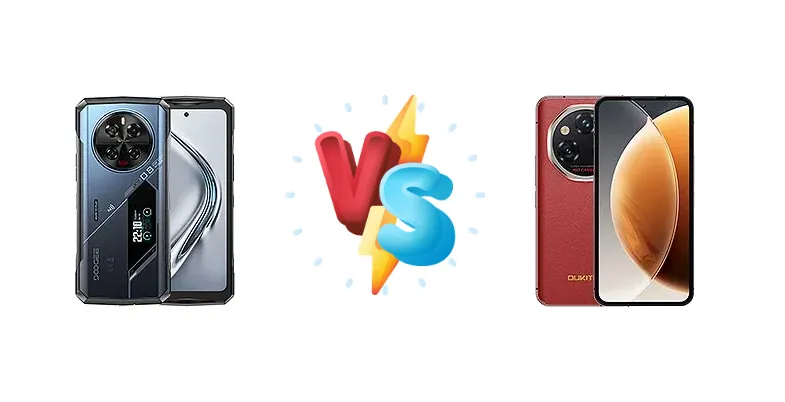
The rugged smartphone market is heating up, with both Doogee and Oukitel offering compelling options. We pit the Doogee V40 Pro, known for its exceptional battery endurance, against the Oukitel WP210, which prioritizes raw processing power and faster charging. This comparison will dissect their key specifications to determine which device best suits your needs.
🏆 Quick Verdict
For the average user prioritizing longevity and consistent performance, the Doogee V40 Pro emerges as the winner. Its significantly superior battery endurance (131:56h vs 86:17h) and respectable Dimensity 7300 chipset provide a balanced experience. However, power users demanding the fastest possible performance will lean towards the Oukitel WP210.
| Network |
|---|
| 2G bands | GSM 850 / 900 / 1800 / 1900 | GSM 850 / 900 / 1800 / 1900 |
| 3G bands | HSDPA 800 / 850 / 900 / 1700(AWS) / 1900 / 2100 | HSDPA 800 / 850 / 900 / 1700(AWS) / 1900 / 2100 |
| 4G bands | LTE | 1, 2, 3, 4, 5, 7, 8, 12, 13, 17, 18, 19, 20, 25, 26, 28, 34, 38, 39, 40, 41, 66, 71 |
| 5G bands | SA/NSA | 1, 2, 3, 5, 7, 8, 12, 20, 25, 28, 34, 38, 39, 40, 41, 48, 66, 71, 77, 78 SA/NSA |
| Speed | HSPA, LTE, 5G | HSPA, LTE, 5G |
| Technology | GSM / CDMA / HSPA / LTE / 5G | GSM / HSPA / LTE / 5G |
| Launch |
|---|
| Announced | 2024, October 07 | 2025, July |
| Status | Available. Released 2024, October 25 | Available. Released 2025, July 15 |
| Body |
|---|
| Dimensions | - | 163.6 x 77.9 x 13.7 mm (6.44 x 3.07 x 0.54 in) |
| SIM | Nano-SIM + Nano-SIM | Nano-SIM + Nano-SIM |
| Weight | - | 311 g (10.97 oz) |
| Display |
|---|
| Protection | Corning Gorilla Glass, Mohs level 6 | Corning Gorilla Glass 5, Mohs level 5 |
| Resolution | 1080 x 2460 pixels* (~396 ppi density) | 1080 x 2408 pixels, 20:9 ratio (~394 ppi density) |
| Size | 6.78 inches, 109.2 cm2 | 6.7 inches, 108.1 cm2 (~84.9% screen-to-body ratio) |
| Type | IPS LCD, 120Hz | IPS LCD, 120Hz, 500 nits |
| Platform |
|---|
| CPU | Octa-core (4x2.5 GHz Cortex-A78 & 4x2.0 GHz Cortex-A55) | Octa-core (1x3.1 GHz Cortex-A78 & 3x3.0 GHz Cortex-A78 & 4x2.0 GHz Cortex-A55) |
| Chipset | Mediatek Dimensity 7300 (4 nm) | Mediatek Dimensity 8200 (4 nm) |
| GPU | Mali-G615 MC2 | Mali-G610 MC6 |
| OS | Android 14 | Android 15 |
| Memory |
|---|
| Card slot | microSDXC (dedicated slot) | microSDXC (uses shared SIM slot) |
| Internal | 512GB 16GB RAM | 512GB 12GB RAM |
| Main Camera |
|---|
| Features | Dual-LED flash, HDR, panorama | LED flash, HDR, panorama |
| Quad | 200 MP, f/2.0, (wide), 1/1.47", PDAF
8 MP, f/2.4, 80mm (telephoto), 1/4.4"
20 MP, f/1.8, (night vision), 1/2.78", 2 infrared night vision lights
8 MP, f/2.2, 119˚ (ultrawide), 1/4.0" | - |
| Triple | - | 108 MP, f/1.9, (wide), 1/1.8", PDAF
2 MP (macro)
Auxiliary lens |
| Video | 4K@30fps, 1080p@30fps, gyro-EIS | 4K@30fps |
| Selfie camera |
|---|
| Single | 32 MP, f/1.8, (wide), 1/2.7" | 32 MP, f/2.2, (wide), 1/2.74" |
| Video | 1080p@30fps | 1080p@30fps |
| Sound |
|---|
| 35mm jack | Unspecified | No |
| Loudspeaker | Yes | Yes |
| Comms |
|---|
| Bluetooth | 5.2, A2DP, LE | 5.3, A2DP, LE |
| NFC | Yes | Yes |
| Positioning | GPS (L1+L5), GLONASS, GALILEO, BDS | GPS (L1+L5), GLONASS, GALILEO, BDS |
| Radio | Unspecified | FM radio |
| USB | USB Type-C 2.0, OTG | USB Type-C 2.0 |
| WLAN | Wi-Fi 802.11 a/b/g/n/ac/6, dual-band | Wi-Fi 802.11 a/b/g/n/ac/6, dual-band |
| Features |
|---|
| Sensors | Fingerprint (side-mounted), accelerometer, gyro, proximity, compass | Fingerprint (side-mounted), accelerometer, gyro, proximity, compass |
| Battery |
|---|
| Charging | 33W wired
Reverse wired | 45W wired |
| Type | 8680 mAh | Li-Po 8800 mAh |
| Misc |
|---|
| Colors | Blue, Silver | Gray, Black, Red |
| Price | About 510 EUR | - |
| EU LABEL |
|---|
| Battery | 131:56h endurance, 1200 cycles | 86:17h endurance, 1000 cycles |
| Energy | Class C | Class B |
| Free fall | Class A (270 falls) | Class A (270 falls) |
| Repairability | Class C | Class C |
Doogee V40 Pro
- Exceptional battery life (131:56h endurance)
- Longer battery lifespan (1200 cycles)
- Balanced performance from Dimensity 7300
- Slower charging speed (33W)
- Less powerful chipset compared to the WP210
Oukitel WP210
- Faster charging (45W)
- More powerful Dimensity 8200 chipset
- Potentially better image processing
- Significantly shorter battery life (86:17h endurance)
- Fewer battery cycles (1000 cycles)
Display Comparison
While both devices likely feature durable displays befitting their rugged nature, the context data doesn't provide specifics. However, the chipset differences suggest the Oukitel WP210, with its more powerful Dimensity 8200, is more likely to support higher refresh rate panels for smoother visuals. The lack of display specs necessitates assuming both utilize IPS LCD technology common in this segment, prioritizing durability over OLED's vibrant colors.
Camera Comparison
Without detailed camera specifications, a direct comparison is difficult. However, the chipset’s image signal processor (ISP) plays a crucial role. The Dimensity 8200 in the Oukitel WP210 generally offers more advanced ISP capabilities, potentially leading to better image processing, noise reduction, and dynamic range. It's reasonable to assume Oukitel would leverage this advantage. Both phones likely feature multiple cameras, but the quality of the main sensor and software optimization will be the deciding factors, information not provided in the context data.
Performance
The Oukitel WP210 takes a clear lead in processing power, utilizing the Mediatek Dimensity 8200. This chipset features a 3.1 GHz Cortex-A78 prime core, alongside three additional Cortex-A78 cores clocked at 3.0 GHz, offering a substantial advantage over the Doogee V40 Pro’s Dimensity 7300 (2.5 GHz Cortex-A78). The Dimensity 8200’s superior core configuration translates to faster app loading times, smoother multitasking, and improved gaming performance. However, the 4nm fabrication process is shared by both, mitigating some thermal concerns. The Doogee V40 Pro’s Dimensity 7300 remains a capable performer, but will show its limitations in demanding scenarios.
Battery Life
The Doogee V40 Pro dominates in battery endurance, boasting a remarkable 131:56h rating compared to the Oukitel WP210’s 86:17h. This translates to significantly longer usage between charges. While the Oukitel WP210 compensates with 45W wired charging, potentially achieving a full charge faster than the Doogee V40 Pro’s 33W, the sheer longevity of the V40 Pro’s battery is a major advantage for users who prioritize minimizing charging frequency. The Doogee V40 Pro also claims 1200 battery cycles, suggesting a longer lifespan before significant capacity degradation compared to the Oukitel's 1000 cycles.
Buying Guide
Buy the Doogee V40 Pro if you need a phone that can reliably last for days on a single charge, are frequently outdoors or in demanding environments, and value a consistent, smooth user experience over peak performance. Buy the Oukitel WP210 if you prioritize gaming, video editing, or other resource-intensive tasks, and appreciate the convenience of 45W fast charging, even if it means sacrificing some battery life.
Frequently Asked Questions
❓ Will the Oukitel WP210’s Dimensity 8200 experience significant thermal throttling during extended gaming sessions?
While the Dimensity 8200 is a powerful chipset, sustained high performance in a rugged phone chassis can lead to thermal throttling. The effectiveness of the WP210’s cooling system (not specified in the data) will be crucial. Expect some performance reduction after prolonged gaming, but it should still outperform the V40 Pro in peak loads.
❓ How much faster is the 45W charging on the Oukitel WP210 compared to the Doogee V40 Pro’s 33W charging?
The 45W charging on the Oukitel WP210 will likely result in a noticeably faster 0-100% charge time. While exact figures aren't available, expect a difference of at least 30-45 minutes, potentially more, depending on battery temperature and charging protocols. However, this speed comes at the cost of overall battery endurance.
❓ Is the difference in battery cycle counts (1200 vs 1000) between the Doogee V40 Pro and Oukitel WP210 significant for long-term use?
Yes, the 200-cycle difference is meaningful. It suggests the Doogee V40 Pro’s battery will retain a higher percentage of its original capacity after a similar number of charge cycles, potentially extending its usable lifespan by a year or more, depending on usage patterns.