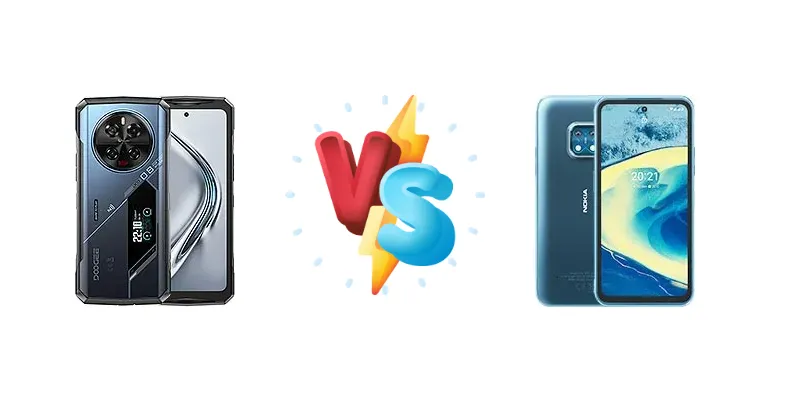
The rugged smartphone market caters to a specific need: durability. Both the Doogee V40 Pro and Nokia XR20 aim to deliver on that promise, but they take drastically different approaches to performance and features. The V40 Pro prioritizes raw power with a modern chipset, while the XR20 focuses on a balanced experience with a more established brand reputation for software support and build quality. This comparison will dissect their key differences to help you choose the right tool for your demanding lifestyle.
🏆 Quick Verdict
For users prioritizing performance and extended battery life, the Doogee V40 Pro emerges as the winner. Its Dimensity 7300 chipset offers a significant performance leap over the XR20’s Snapdragon 480, making it better suited for demanding tasks and future-proofing. However, the Nokia XR20 remains a solid choice for those valuing brand trust and a more streamlined software experience.
| Network |
|---|
| 2G bands | GSM 850 / 900 / 1800 / 1900 | GSM 850 / 900 / 1800 / 1900 |
| 3G bands | HSDPA 800 / 850 / 900 / 1700(AWS) / 1900 / 2100 | HSDPA 850 / 900 / 1700(AWS) / 1900 / 2100 |
| 4G bands | LTE | 1, 2, 3, 4, 5, 7, 8, 12, 13, 14, 20, 25, 26, 28, 30, 38, 40, 41, 48, 66, 71 |
| 5G bands | SA/NSA | 2, 5, 25, 38, 41, 48, 66, 77, 78 SA/NSA |
| Speed | HSPA, LTE, 5G | HSPA, LTE, 5G |
| Technology | GSM / CDMA / HSPA / LTE / 5G | GSM / CDMA / HSPA / EVDO / LTE / 5G |
| | - | CDMA2000 1xEV-DO |
| Launch |
|---|
| Announced | 2024, October 07 | 2021, July 27 |
| Status | Available. Released 2024, October 25 | Available. Released 2021, August 04 |
| Body |
|---|
| Dimensions | - | 171.6 x 81.5 x 10.6 mm (6.76 x 3.21 x 0.42 in) |
| SIM | Nano-SIM + Nano-SIM | · Nano-SIM· Nano-SIM + Nano-SIM |
| Weight | - | 248 g (8.75 oz) |
| | - | IP68 dust/water resistant (up to 1.5m for 60 min)
Drop-to-concrete resistance from up to 1.8m
MIL-STD-810H compliant |
| Display |
|---|
| Protection | Corning Gorilla Glass, Mohs level 6 | Corning Gorilla Glass Victus |
| Resolution | 1080 x 2460 pixels* (~396 ppi density) | 1080 x 2400 pixels, 20:9 ratio (~395 ppi density) |
| Size | 6.78 inches, 109.2 cm2 | 6.67 inches, 107.4 cm2 (~76.8% screen-to-body ratio) |
| Type | IPS LCD, 120Hz | IPS LCD, 550 nits |
| Platform |
|---|
| CPU | Octa-core (4x2.5 GHz Cortex-A78 & 4x2.0 GHz Cortex-A55) | Octa-core (2x2.0 GHz Kryo 460 & 6x1.8 GHz Kryo 460) |
| Chipset | Mediatek Dimensity 7300 (4 nm) | Qualcomm SM4350 Snapdragon 480 5G (8 nm) |
| GPU | Mali-G615 MC2 | Adreno 619 |
| OS | Android 14 | Android 11, upgradable to Android 13 |
| Memory |
|---|
| Card slot | microSDXC (dedicated slot) | microSDXC (uses shared SIM slot) |
| Internal | 512GB 16GB RAM | 64GB 4GB RAM, 128GB 6GB RAM |
| Main Camera |
|---|
| Dual | - | 48 MP, f/1.8, (wide), 1/2.25", 0.8µm, PDAF
13 MP, f/2.4, 123˚ (ultrawide), 1/3.0", 1.12µm |
| Features | Dual-LED flash, HDR, panorama | Zeiss optics, Dual-LED dual-tone flash, second LED flash, HDR, panorama |
| Quad | 200 MP, f/2.0, (wide), 1/1.47", PDAF
8 MP, f/2.4, 80mm (telephoto), 1/4.4"
20 MP, f/1.8, (night vision), 1/2.78", 2 infrared night vision lights
8 MP, f/2.2, 119˚ (ultrawide), 1/4.0" | - |
| Single | - | 8 MP, f/2.0 (wide), 1/4.0", 1.12µm |
| Video | 4K@30fps, 1080p@30fps, gyro-EIS | 1080p@30fps |
| Selfie camera |
|---|
| Single | 32 MP, f/1.8, (wide), 1/2.7" | 8 MP, f/2.0 (wide), 1/4.0", 1.12µm |
| Video | 1080p@30fps | 1080p@30fps |
| Sound |
|---|
| 3.5mm jack | - | Yes |
| 35mm jack | Unspecified | Yes |
| Loudspeaker | Yes | Yes, with stereo speakers |
| Comms |
|---|
| Bluetooth | 5.2, A2DP, LE | 5.1, A2DP, LE, aptX Adaptive |
| NFC | Yes | Yes |
| Positioning | GPS (L1+L5), GLONASS, GALILEO, BDS | GPS (L1+L5), GLONASS, BDS, GALILEO, QZSS, NavIC |
| Radio | Unspecified | Unspecified |
| USB | USB Type-C 2.0, OTG | USB Type-C 3.0 |
| WLAN | Wi-Fi 802.11 a/b/g/n/ac/6, dual-band | Wi-Fi 802.11 a/b/g/n/ac/6, dual-band, Wi-Fi Direct |
| Features |
|---|
| Sensors | Fingerprint (side-mounted), accelerometer, gyro, proximity, compass | Fingerprint (side-mounted), accelerometer, gyro, proximity, compass, barometer |
| Battery |
|---|
| Charging | 33W wired
Reverse wired | 18W wired
15W wireless |
| Type | 8680 mAh | Li-Po 4630 mAh |
| Misc |
|---|
| Colors | Blue, Silver | Ultra Blue, Granite Gray |
| Models | - | TA-1368, TA-1362 |
| Price | About 510 EUR | About 270 EUR |
| SAR EU | - | 1.13 W/kg (head) 1.43 W/kg (body) |
| EU LABEL |
|---|
| Battery | 131:56h endurance, 1200 cycles | - |
| Energy | Class C | - |
| Free fall | Class A (270 falls) | - |
| Repairability | Class C | - |
Doogee V40 Pro
- Significantly faster processor for demanding tasks
- Exceptional battery life (131:56h endurance)
- Faster 33W wired charging
- Potentially better image processing due to chipset
- Brand recognition is lower than Nokia
- Software update commitment may be less extensive
Nokia XR20
- Strong brand reputation for reliability and software support
- Wireless charging capability
- Balanced performance for everyday tasks
- Potentially more refined software experience
- Significantly slower processor
- Slower charging speeds
- Likely shorter battery life
- Less future-proofed
Display Comparison
While both phones are built for rugged use, display details are limited in the provided data. However, the chipset difference suggests the Doogee V40 Pro likely benefits from a more advanced display controller, potentially offering higher refresh rates and better color accuracy. The XR20, with its less powerful chipset, likely utilizes a more standard panel to conserve power. Bezels are likely similar given the rugged design focus, prioritizing protection over minimizing screen borders.
Camera Comparison
Camera specifications are not detailed enough for a comprehensive comparison. However, the chipset difference suggests the Doogee V40 Pro benefits from a more capable image signal processor (ISP) within the Dimensity 7300, potentially leading to better image processing, noise reduction, and dynamic range. Without sensor size or aperture information, it’s difficult to definitively say which phone captures better images, but the V40 Pro’s superior processing power gives it an edge. The XR20 likely focuses on reliable, consistent image quality rather than pushing for cutting-edge features.
Performance
The performance gap between these two devices is substantial. The Doogee V40 Pro’s Mediatek Dimensity 7300 (4nm) is a significantly more powerful chipset than the Nokia XR20’s Qualcomm Snapdragon 480 5G (8nm). The Dimensity 7300’s octa-core configuration (4x2.5 GHz Cortex-A78 & 4x2.0 GHz Cortex-A55) provides a noticeable advantage in CPU-intensive tasks compared to the XR20’s (2x2.0 GHz Kryo 460 & 6x1.8 GHz Kryo 460). The 4nm process node of the Dimensity 7300 also translates to improved thermal efficiency, reducing the likelihood of performance throttling during sustained workloads. This means the V40 Pro will handle gaming and multitasking far more smoothly.
Battery Life
The Doogee V40 Pro boasts an impressive 131:56h endurance rating, indicating exceptional battery life. While the Nokia XR20’s battery capacity isn’t specified, its less powerful chipset and 18W wired/15W wireless charging suggest a more modest endurance. The V40 Pro’s 33W wired charging is also faster than the XR20’s 18W wired charging, allowing for quicker top-ups. The V40 Pro’s stated 1200 charge cycles also suggest a longer lifespan for the battery itself.
Buying Guide
Buy the Doogee V40 Pro if you need a rugged phone capable of handling demanding applications like mobile gaming, video editing, or running multiple apps simultaneously. Its superior chipset and impressive 131:56h battery endurance make it ideal for professionals working in the field or anyone who heavily relies on their phone throughout the day. Buy the Nokia XR20 if you prefer a more reliable software experience with guaranteed updates, and prioritize a balanced, efficient device for everyday tasks like communication, navigation, and basic photography. It’s a strong choice for users who value simplicity and long-term support over raw power.
Frequently Asked Questions
❓ Does the Mediatek Dimensity 7300 in the Doogee V40 Pro generate excessive heat during prolonged gaming sessions?
The Dimensity 7300’s 4nm process node is designed for improved thermal efficiency. While some heat generation is inevitable during intensive gaming, the V40 Pro’s thermal management system, combined with the efficient chipset, should prevent significant throttling and maintain stable performance for extended periods. This is a marked improvement over the 8nm Snapdragon 480 in the XR20, which is more prone to throttling.
❓ How does Nokia’s software update policy compare to Doogee’s, and how long can I expect security updates for the XR20?
Nokia is renowned for its commitment to software updates, typically providing 3 years of major Android updates and 4 years of security patches for its XR series. Doogee’s update policy is less clearly defined, and while they do provide updates, the frequency and duration are generally shorter. The XR20 is the safer bet for long-term software support.
❓ Is the 15W wireless charging on the Nokia XR20 a practical feature, or is it too slow to be useful?
While 15W wireless charging isn't the fastest available, it offers a convenient way to top up the XR20’s battery without needing a cable. It’s best suited for overnight charging or occasional boosts, rather than rapid replenishment. The Doogee V40 Pro lacks wireless charging, making it reliant on its faster 33W wired charging.