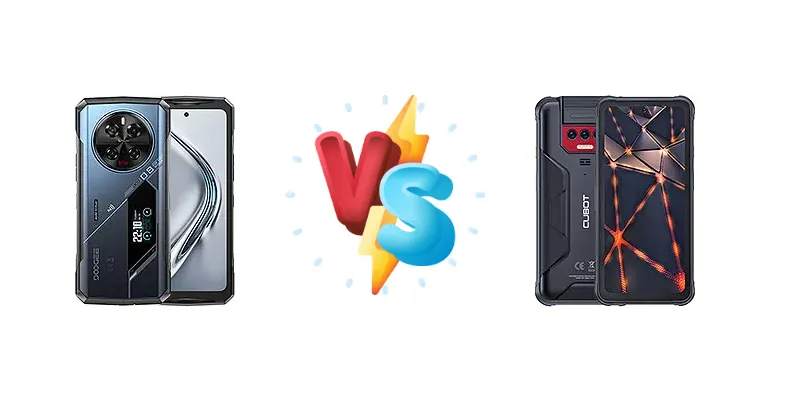
The rugged smartphone market is heating up, offering durable devices for outdoor enthusiasts and demanding work environments. The Doogee V40 Pro and Cubot KingKong 8 both aim to deliver on this promise, but they take significantly different approaches to performance and efficiency. This comparison dissects their core components to determine which phone offers the best value for your needs.
🏆 Quick Verdict
For users prioritizing performance and longevity, the Doogee V40 Pro is the clear winner. Its Mediatek Dimensity 7300 chipset, built on a 4nm process, provides a substantial performance advantage and superior power efficiency compared to the Cubot KingKong 8’s older 12nm MT8788V. While the KingKong 8 offers a more budget-friendly entry point, the V40 Pro’s endurance and processing power justify the price difference.
| Network |
|---|
| 2G bands | GSM 850 / 900 / 1800 / 1900 | GSM 850 / 900 / 1800 / 1900 |
| 3G bands | HSDPA 800 / 850 / 900 / 1700(AWS) / 1900 / 2100 | HSDPA 850 / 900 / 1700(AWS) / 1900 / 2100 |
| 4G bands | LTE | 1, 2, 3, 4, 5, 7, 8, 12, 17, 20, 28, 41 |
| 5G bands | SA/NSA | - |
| Speed | HSPA, LTE, 5G | HSPA, LTE |
| Technology | GSM / CDMA / HSPA / LTE / 5G | GSM / HSPA / LTE |
| Launch |
|---|
| Announced | 2024, October 07 | 2023, October 23 |
| Status | Available. Released 2024, October 25 | Available. Released 2023, October 23 |
| Body |
|---|
| Dimensions | - | 169.9 x 80.2 x 20 mm (6.69 x 3.16 x 0.79 in) |
| SIM | Nano-SIM + Nano-SIM | Nano-SIM + Nano-SIM |
| Weight | - | 382 g (13.47 oz) |
| Display |
|---|
| Protection | Corning Gorilla Glass, Mohs level 6 | - |
| Resolution | 1080 x 2460 pixels* (~396 ppi density) | 720 x 1612 pixels, 20:9 ratio (~270 ppi density) |
| Size | 6.78 inches, 109.2 cm2 | 6.53 inches, 102.4 cm2 (~75.2% screen-to-body ratio) |
| Type | IPS LCD, 120Hz | IPS LCD |
| Platform |
|---|
| CPU | Octa-core (4x2.5 GHz Cortex-A78 & 4x2.0 GHz Cortex-A55) | Octa-core (4x2.0 GHz Cortex-A73 & 4x2.0 GHz Cortex-A53) |
| Chipset | Mediatek Dimensity 7300 (4 nm) | Mediatek MT8788V/WA (12 nm) |
| GPU | Mali-G615 MC2 | - |
| OS | Android 14 | Android 13 |
| Memory |
|---|
| Card slot | microSDXC (dedicated slot) | microSDXC (uses shared SIM slot) |
| Internal | 512GB 16GB RAM | 256GB 12GB RAM |
| Main Camera |
|---|
| Features | Dual-LED flash, HDR, panorama | LED flash |
| Quad | 200 MP, f/2.0, (wide), 1/1.47", PDAF
8 MP, f/2.4, 80mm (telephoto), 1/4.4"
20 MP, f/1.8, (night vision), 1/2.78", 2 infrared night vision lights
8 MP, f/2.2, 119˚ (ultrawide), 1/4.0" | - |
| Triple | - | 48 MP, (wide), PDAF
2 MP (macro)
0.3 MP |
| Video | 4K@30fps, 1080p@30fps, gyro-EIS | Yes |
| Selfie camera |
|---|
| Single | 32 MP, f/1.8, (wide), 1/2.7" | 16 MP |
| Video | 1080p@30fps | Yes |
| Sound |
|---|
| 35mm jack | Unspecified | Unspecified |
| Loudspeaker | Yes | Yes |
| Comms |
|---|
| Bluetooth | 5.2, A2DP, LE | 4.2, A2DP |
| NFC | Yes | Yes |
| Positioning | GPS (L1+L5), GLONASS, GALILEO, BDS | GPS, GLONASS, GALILEO |
| Radio | Unspecified | Unspecified |
| USB | USB Type-C 2.0, OTG | USB Type-C, OTG |
| WLAN | Wi-Fi 802.11 a/b/g/n/ac/6, dual-band | Wi-Fi 802.11 a/b/g/n/ac, dual-band |
| Features |
|---|
| Sensors | Fingerprint (side-mounted), accelerometer, gyro, proximity, compass | Fingerprint (side-mounted), accelerometer, gyro, proximity, compass |
| Battery |
|---|
| Charging | 33W wired
Reverse wired | Wired
Reverse wired |
| Type | 8680 mAh | 10600 mAh |
| Misc |
|---|
| Colors | Blue, Silver | Black, Red, Green |
| Price | About 510 EUR | About 170 EUR |
| EU LABEL |
|---|
| Battery | 131:56h endurance, 1200 cycles | - |
| Energy | Class C | - |
| Free fall | Class A (270 falls) | - |
| Repairability | Class C | - |
Doogee V40 Pro
- Superior performance with Dimensity 7300 chipset
- Exceptional battery life (131:56h endurance)
- Faster charging (33W) and reverse wired charging
- Likely higher price point
- Rugged design may add bulk
Cubot KingKong 8
- More affordable price
- Rugged design for durability
- Reverse wired charging
- Significantly lower performance with MT8788V chipset
- Shorter battery life expected
- Slower charging speeds
Display Comparison
Display specifications are absent from the provided data, but given the market positioning, we can infer differences. The Doogee V40 Pro, being the higher-tier device, likely features a brighter panel with better color accuracy. The Cubot KingKong 8 will likely prioritize durability over display quality. Expect the V40 Pro to have a higher refresh rate, contributing to smoother scrolling and animations. Bezels are also likely to be slimmer on the V40 Pro, offering a more immersive viewing experience.
Camera Comparison
Camera details are missing, but the chipset difference suggests the Doogee V40 Pro will have a more capable image signal processor (ISP). This translates to better image processing, improved low-light performance, and faster autofocus. While both phones likely feature multiple cameras, the V40 Pro is expected to have a higher-resolution main sensor and potentially optical image stabilization (OIS), resulting in sharper and more stable photos and videos. The KingKong 8 will likely focus on providing a functional camera setup without prioritizing image quality.
Performance
The core difference lies in the chipsets. The Doogee V40 Pro’s Mediatek Dimensity 7300 (4nm) is a significant leap forward from the Cubot KingKong 8’s Mediatek MT8788V/WA (12nm). The 4nm process node translates to dramatically improved power efficiency, meaning the V40 Pro will run cooler and consume less battery for the same level of performance. The Dimensity 7300’s CPU configuration (4x2.5 GHz Cortex-A78 & 4x2.0 GHz Cortex-A55) also offers a performance advantage over the KingKong 8’s (4x2.0 GHz Cortex-A73 & 4x2.0 GHz Cortex-A53). This will be noticeable in app loading times, multitasking, and graphically intensive games. The V40 Pro will experience less throttling under sustained load.
Battery Life
The Doogee V40 Pro boasts an impressive 131:56h endurance rating, indicating exceptional battery life. While the exact battery capacity isn't specified, the Dimensity 7300’s efficiency plays a crucial role. The V40 Pro also supports 33W wired charging and reverse wired charging. The Cubot KingKong 8’s battery life is not specified, but given the less efficient chipset, it will likely fall short of the V40 Pro. The absence of specific charging wattage details for the KingKong 8 suggests it will charge slower than the V40 Pro. The V40 Pro’s 1200 charge cycles also indicate a longer lifespan for the battery itself.
Buying Guide
Buy the Doogee V40 Pro if you need a phone capable of handling demanding tasks like gaming or video editing while on the go, and value long-term battery health with its 1200 charge cycles. Buy the Cubot KingKong 8 if you prioritize affordability and basic smartphone functionality in a rugged package, and don't require intensive processing power or extended gaming sessions.
Frequently Asked Questions
❓ Will the Doogee V40 Pro’s Dimensity 7300 handle demanding games like Genshin Impact at high settings?
The Mediatek Dimensity 7300 is a capable chipset that should handle Genshin Impact at medium to high settings with playable frame rates. The 4nm process and efficient CPU/GPU architecture will help mitigate thermal throttling during extended gaming sessions, providing a more consistent experience than the Cubot KingKong 8.
❓ How does the 1200 charge cycle rating of the Doogee V40 Pro impact long-term battery health?
The 1200 charge cycle rating indicates that the Doogee V40 Pro’s battery is designed to retain a significant portion of its original capacity after 1200 full charge-discharge cycles. This is substantially higher than many smartphones, meaning the battery will likely maintain good health for a longer period, delaying the need for a replacement.
❓ Is the MT8788V in the Cubot KingKong 8 sufficient for everyday tasks like browsing and social media?
Yes, the MT8788V is adequate for basic tasks like web browsing, social media, and messaging. However, it will struggle with more demanding applications or multitasking. Expect slower app loading times and occasional lag compared to the Doogee V40 Pro.