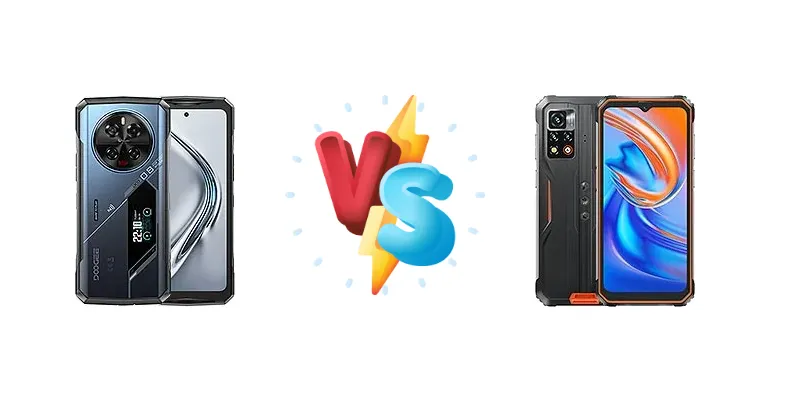
The rugged smartphone market is heating up, offering increasingly capable devices for outdoor enthusiasts and demanding professionals. The Doogee V40 Pro and Blackview BV9200 represent compelling options, but cater to different priorities. The V40 Pro focuses on raw processing power with its Dimensity 7300, while the BV9200 emphasizes fast charging and a brighter display. This comparison dissects their strengths and weaknesses to determine which device delivers the best overall experience.
🏆 Quick Verdict
For users prioritizing performance and long-term battery health, the Doogee V40 Pro is the clear winner. Its Dimensity 7300 chipset offers a significant performance leap over the Blackview BV9200’s Helio G96, and the 1200 charge cycle rating suggests superior longevity. However, the BV9200’s 66W charging and brighter screen are compelling advantages for those valuing convenience and outdoor visibility.
| Network |
|---|
| 2G bands | GSM 850 / 900 / 1800 / 1900 | GSM 850 / 900 / 1800 / 1900 |
| 3G bands | HSDPA 800 / 850 / 900 / 1700(AWS) / 1900 / 2100 | HSDPA 850 / 900 / 1700(AWS) / 1900 / 2100 |
| 4G bands | LTE | 1, 2, 3, 4, 5, 7, 8, 12, 13, 17, 18, 19, 20, 25, 26, 28, 34, 38, 39, 40, 41, 66 |
| 5G bands | SA/NSA | - |
| Speed | HSPA, LTE, 5G | HSPA, LTE |
| Technology | GSM / CDMA / HSPA / LTE / 5G | GSM / CDMA / HSPA / LTE |
| | - | CDMA 800 / 1900 |
| Launch |
|---|
| Announced | 2024, October 07 | 2022, December 28 |
| Status | Available. Released 2024, October 25 | Available. Released 2023, January 09 |
| Body |
|---|
| Dimensions | - | 174.5 x 81.8 x 13.6 mm (6.87 x 3.22 x 0.54 in) |
| SIM | Nano-SIM + Nano-SIM | Nano-SIM + Nano-SIM |
| Weight | - | 310 g (10.93 oz) |
| | - | IP68/IP69K dust/water resistant (up to 1.5m for 30 min)
Drop-to-concrete resistance from up to 1.8m
MIL-STD-810H compliant |
| Display |
|---|
| Protection | Corning Gorilla Glass, Mohs level 6 | Corning Gorilla Glass 5 |
| Resolution | 1080 x 2460 pixels* (~396 ppi density) | 1080 x 2408 pixels, 20:9 ratio (~400 ppi density) |
| Size | 6.78 inches, 109.2 cm2 | 6.6 inches, 104.9 cm2 (~73.5% screen-to-body ratio) |
| Type | IPS LCD, 120Hz | IPS LCD, 120Hz |
| Platform |
|---|
| CPU | Octa-core (4x2.5 GHz Cortex-A78 & 4x2.0 GHz Cortex-A55) | Octa-core (2x2.05 GHz Cortex-A76 & 6x2.0 GHz Cortex-A55) |
| Chipset | Mediatek Dimensity 7300 (4 nm) | Mediatek MT6781 Helio G96 (12 nm) |
| GPU | Mali-G615 MC2 | Mali-G52 MC2 |
| OS | Android 14 | Android 12, Doke-OS 3.1 |
| Memory |
|---|
| Card slot | microSDXC (dedicated slot) | microSDXC (dedicated slot) |
| Internal | 512GB 16GB RAM | 256GB 8GB RAM |
| | - | UFS 2.1 |
| Main Camera |
|---|
| Features | Dual-LED flash, HDR, panorama | LED flash, HDR, panorama |
| Quad | 200 MP, f/2.0, (wide), 1/1.47", PDAF
8 MP, f/2.4, 80mm (telephoto), 1/4.4"
20 MP, f/1.8, (night vision), 1/2.78", 2 infrared night vision lights
8 MP, f/2.2, 119˚ (ultrawide), 1/4.0" | - |
| Single | - | 16 MP, (wide), 1/3", 1.0µm |
| Triple | - | 50 MP, f/1.8, (wide), 1/2.76", 0.64µm, PDAF
8 MP, f/1.8, 120˚, (ultrawide), AF
Auxiliary lens |
| Video | 4K@30fps, 1080p@30fps, gyro-EIS | 1440p@30fps, 1080p@30fps |
| Selfie camera |
|---|
| Single | 32 MP, f/1.8, (wide), 1/2.7" | 16 MP, f/2.0, (wide), 1/3", 1.0µm |
| Video | 1080p@30fps | 1080p |
| Sound |
|---|
| 3.5mm jack | - | No |
| 35mm jack | Unspecified | No |
| Loudspeaker | Yes | Yes, with dual speakers |
| Comms |
|---|
| Bluetooth | 5.2, A2DP, LE | 5.2, A2DP, LE |
| NFC | Yes | Yes |
| Positioning | GPS (L1+L5), GLONASS, GALILEO, BDS | GPS, GLONASS, GALILEO, BDS |
| Radio | Unspecified | FM radio |
| USB | USB Type-C 2.0, OTG | USB Type-C, OTG |
| WLAN | Wi-Fi 802.11 a/b/g/n/ac/6, dual-band | Wi-Fi 802.11 a/b/g/n/ac, dual-band |
| Features |
|---|
| Sensors | Fingerprint (side-mounted), accelerometer, gyro, proximity, compass | Fingerprint (side-mounted), accelerometer, gyro, proximity, compass, barometer |
| Battery |
|---|
| Charging | 33W wired
Reverse wired | 66W wired
30W wireless |
| Type | 8680 mAh | 5000 mAh |
| Misc |
|---|
| Colors | Blue, Silver | Black, Orange, Green |
| Price | About 510 EUR | About 200 EUR |
| EU LABEL |
|---|
| Battery | 131:56h endurance, 1200 cycles | - |
| Energy | Class C | - |
| Free fall | Class A (270 falls) | - |
| Repairability | Class C | - |
Doogee V40 Pro
- Superior processing power with Dimensity 7300
- Exceptional battery endurance (131:56h)
- Long-term battery health with 1200 charge cycles
- Charging speed is slower than the BV9200
- Display brightness not specified, potentially lower than BV9200
Blackview BV9200
- Faster charging speeds (66W wired, 30W wireless)
- Brighter display (481 nits) for outdoor visibility
- High contrast ratio (1423:1) for vibrant colors
- Less powerful processor (Helio G96)
- Likely shorter battery life compared to V40 Pro
Display Comparison
The Blackview BV9200 boasts a brighter display, measured at 481 nits, which is crucial for outdoor visibility. While the Doogee V40 Pro’s display specs are not provided, the BV9200’s 1423:1 contrast ratio ensures deeper blacks and more vibrant colors. The difference in brightness will be immediately noticeable in direct sunlight, giving the BV9200 an edge for field work or outdoor adventures. However, without knowing the V40 Pro’s panel type or refresh rate, a complete assessment is difficult; the BV9200’s brightness is a definitive advantage.
Camera Comparison
Neither device’s camera specifications are detailed enough for a comprehensive comparison. However, given the market positioning, it’s likely the Doogee V40 Pro will feature a more advanced camera system. The focus should be on the main sensor resolution and aperture, as these are the primary determinants of image quality. Without this information, it’s difficult to assess the BV9200’s camera capabilities beyond its potential for decent daylight shots. The prevalence of 2MP macro lenses on both devices suggests they are largely marketing features and should not be a deciding factor.
Performance
The Doogee V40 Pro’s Mediatek Dimensity 7300 (4nm) chipset represents a substantial upgrade over the Blackview BV9200’s Helio G96 (12nm). The Dimensity 7300’s newer architecture – featuring 4x2.5 GHz Cortex-A78 and 4x2.0 GHz Cortex-A55 cores – delivers significantly faster processing speeds and improved power efficiency compared to the BV9200’s 2x2.05 GHz Cortex-A76 and 6x2.0 GHz Cortex-A55 configuration. The 4nm process node further enhances efficiency, reducing thermal throttling during sustained workloads. This translates to smoother multitasking, faster app loading times, and a better gaming experience on the V40 Pro.
Battery Life
The Doogee V40 Pro’s endurance is rated at 131:56h, a strong indicator of excellent battery life. While the BV9200’s battery capacity isn’t specified, the V40 Pro’s longevity is further bolstered by its 1200 charge cycle rating, suggesting the battery will retain a higher capacity over its lifespan. The BV9200 compensates with significantly faster charging – 66W wired and 30W wireless – compared to the V40 Pro’s 33W wired and reverse wired charging. This means the BV9200 can top up much quicker, but the V40 Pro will likely last longer between charges.
Buying Guide
Buy the Doogee V40 Pro if you need a rugged phone capable of handling demanding tasks like video editing, gaming, or running multiple apps simultaneously, and if you value long-term battery health. Buy the Blackview BV9200 if you prioritize fast charging, a brighter display for outdoor use, and are primarily focused on everyday tasks and moderate gaming.
Frequently Asked Questions
❓ Does the Mediatek Dimensity 7300 in the Doogee V40 Pro get hot during extended gaming sessions?
The Dimensity 7300’s 4nm process node is designed for improved thermal efficiency. While some heat generation is inevitable during demanding tasks, the V40 Pro should experience less throttling than the Blackview BV9200, which uses the less efficient 12nm Helio G96. Rugged phone designs also typically incorporate heat dissipation features to mitigate thermal issues.
❓ How long does it realistically take to fully charge the Blackview BV9200 with the 66W charger?
While Blackview doesn't provide exact figures, 66W charging typically takes a smartphone from 0-100% in approximately 45-60 minutes, assuming a battery capacity around 5000mAh. The BV9200’s charging speed is a significant advantage over the Doogee V40 Pro’s 33W charging.
❓ Is the wireless charging on the Blackview BV9200 useful for outdoor activities?
The 30W wireless charging is convenient, but requires a wireless charging pad. While useful in a base camp or vehicle, it’s less practical for on-the-go charging during activities like hiking or climbing where access to a pad is limited. The Doogee V40 Pro’s reverse wired charging could be more useful in such scenarios, allowing you to charge other devices.