
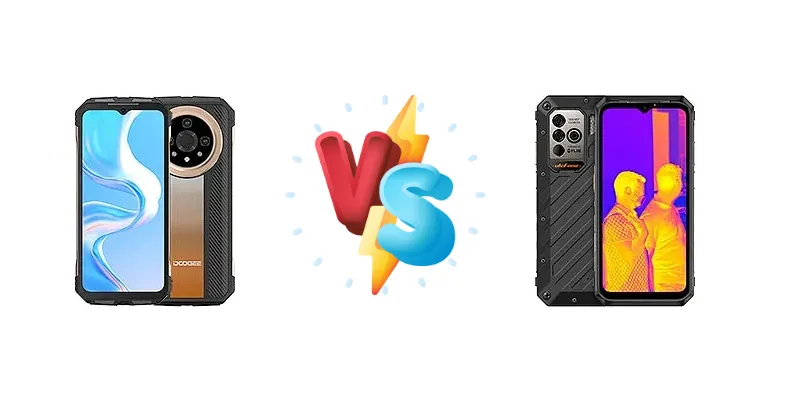
Doogee V31GT vs. Ulefone Power Armor 19T: A Rugged Smartphone Battle
| Phones Images | |||||
|---|---|---|---|---|---|
|
🏆 Quick Verdict
For users prioritizing raw performance and responsiveness, the Doogee V31GT emerges as the winner. Its Dimensity 1080 chipset provides a noticeable advantage in processing power over the Ulefone Power Armor 19T’s Helio G99, making it better suited for demanding tasks and gaming. However, the Ulefone 19T offers wireless charging as a convenience feature.
| PHONES | ||
|---|---|---|
| Phone Names | Doogee V31GT | Ulefone Power Armor 19T |
| Network | ||
|---|---|---|
| 2G bands | GSM 850 / 900 / 1800 / 1900 | GSM 850 / 900 / 1800 / 1900 |
| 3G bands | HSDPA 800 / 850 / 900 / 1700(AWS) / 1900 / 2100 | HSDPA 800 / 850 / 900 / 1700(AWS) / 1900 / 2100 |
| 4G bands | 1, 2, 3, 4, 5, 7, 8, 12, 17, 18, 19, 20, 25, 26, 28, 34, 38, 39, 40, 41, 66 | 1, 2, 3, 4, 5, 7, 8, 12, 13, 17, 18, 19, 20, 25, 26, 28, 34, 38, 39, 40, 41, 66, 71 |
| 5G bands | 1, 3, 7, 28, 38, 41, 77, 78, 79 SA/NSA | - |
| Speed | HSPA, LTE, 5G | HSPA, LTE |
| Technology | GSM / CDMA / HSPA / LTE / 5G | GSM / CDMA / HSPA / CDMA2000 / LTE |
| - | CDMA2000 1x | |
| Launch | ||
|---|---|---|
| Announced | 2023, September | 2023, March 06 |
| Status | Available. Released 2023, September | Available. Released 2023, March 06 |
| Body | ||
|---|---|---|
| Dimensions | 178.5 x 83.1 x 17.9 mm (7.03 x 3.27 x 0.70 in) | 175.2 x 83.4 x 18.8 mm (6.90 x 3.28 x 0.74 in) |
| SIM | Nano-SIM + Nano-SIM | Nano-SIM + Nano-SIM |
| Weight | 390 g (13.76 oz) | 409 g (14.43 oz) |
| - | IP68/IP69K dust/water resistant (up to 1.5m for 30 min) Drop-to-concrete resistance from up to 1.5m MIL-STD-810H compliant Accessory connector (ulefone endoscope, microscope) | |
| Display | ||
|---|---|---|
| Protection | Corning Gorilla Glass 5 | Corning Gorilla Glass 5 |
| Resolution | 1080 x 2400 pixels, 20:9 ratio (~400 ppi density) | 1080 x 2408 pixels, 20:9 ratio (~401 ppi density) |
| Size | 6.58 inches, 104.5 cm2 (~70.5% screen-to-body ratio) | 6.58 inches, 104.3 cm2 (~71.4% screen-to-body ratio) |
| Type | IPS LCD, 120Hz | IPS LCD, 120Hz |
| Platform | ||
|---|---|---|
| CPU | Octa-core (2x2.6 GHz Cortex-A78 & 6x2.0 GHz Cortex-A55) | Octa-core (2x2.2 GHz Cortex-A76 & 6x2.0 GHz Cortex-A55) |
| Chipset | Mediatek Dimensity 1080 (6 nm) | Mediatek Helio G99 (6 nm) |
| GPU | Mali-G68 MC4 | Mali-G57 MC2 |
| OS | Android 13 | Android 12 |
| Memory | ||
|---|---|---|
| Card slot | microSDXC (uses shared SIM slot) | microSDXC (uses shared SIM slot) |
| Internal | 256GB 12GB RAM | 256GB 12GB RAM |
| Main Camera | ||
|---|---|---|
| Features | LED flash, HDR, panorama | Hexa-LED flash, HDR, panorama |
| Quad | 50 MP, f/1.8, (wide), 1/1.56", 1.0µm, PDAF 24 MP, f/1.8, (night vision), 2 infrared night vision lights 8 MP, f/1.8, (wide) 256×192 pixels thermal camera | - |
| Triple | - | 108 MP, f/1.9, (wide), 1/1.52", 0.7µm, PDAF 5 MP (macro) FLIR thermal camera (Lepton module) 5 MP (for thermal module) |
| Video | 4K@30fps, 1080p@30fps | 1440p@30fps, 1080p@30fps |
| Selfie camera | ||
|---|---|---|
| Single | 32 MP, f/1.8, (wide), 1/2.8", 0.8µm | 16 MP, f/2.0, (wide), 1.0µm |
| Video | 1080p@30fps | 1080p@30fps |
| Sound | ||
|---|---|---|
| 3.5mm jack | - | Yes |
| 35mm jack | No | Yes |
| Loudspeaker | Yes, with stereo speakers | Yes |
| Comms | ||
|---|---|---|
| Bluetooth | 5.2, A2DP, LE | 5.2, A2DP, LE |
| NFC | Yes (market/region dependent) | Yes |
| Positioning | GPS (L1+L5), GLONASS, GALILEO, BDS | GPS, GLONASS, GALILEO, BDS |
| Radio | FM radio | Wireless FM radio, RDS, recording |
| USB | USB Type-C 2.0, OTG | USB Type-C 2.0, OTG, magnetic connector |
| WLAN | Wi-Fi 802.11 a/b/g/n/ac/6, dual-band | Wi-Fi 802.11 a/b/g/n/ac, dual-band |
| Features | ||
|---|---|---|
| Sensors | Fingerprint (side-mounted), accelerometer, gyro, proximity, compass | Fingerprint (side-mounted), accelerometer, gyro, proximity, compass |
| Battery | ||
|---|---|---|
| Charging | 66W wired, 55% in 30 min Reverse wired | 66W wired, 52% in 30 min 15W wireless 5W wireless reversed |
| Type | 10800 mAh | Li-Po 9600 mAh |
| Misc | ||
|---|---|---|
| Colors | Black, Gold, Silver | Black |
| Price | - | About 440 EUR |
Doogee V31GT
- Faster processor for smoother performance
- More responsive user experience
- Potentially better image processing
- Lacks wireless charging
- No reverse wireless charging
Ulefone Power Armor 19T
- Convenient wireless charging (15W)
- Reverse wireless charging for accessories
- Potentially longer battery life due to chipset efficiency
- Slower processor compared to Doogee V31GT
- Less responsive for demanding tasks
Display Comparison
Neither device's display specifications are provided, so a direct comparison is limited. However, given the target market, both likely utilize IPS LCD panels for durability and visibility in direct sunlight. The absence of details like resolution, refresh rate, or peak brightness suggests a focus on practicality over premium display features. Bezels are likely to be substantial on both to contribute to the ruggedized design.
Camera Comparison
Without detailed camera specifications, it’s difficult to make a definitive judgment. However, the chipset difference suggests the Doogee V31GT will have a more capable image signal processor (ISP), potentially leading to better image quality and faster processing. The ISP within the Dimensity 1080 can handle more complex image processing algorithms. Both phones likely feature a primary camera for general photography, but the quality of supporting lenses (ultrawide, macro) is unknown. We can assume both will prioritize durability over cutting-edge camera technology.
Performance
The core difference lies in the chipsets. The Doogee V31GT’s Mediatek Dimensity 1080 (6nm) boasts a more powerful CPU configuration – 2x2.6 GHz Cortex-A78 cores alongside 6x2.0 GHz Cortex-A55 cores – compared to the Ulefone Power Armor 19T’s Helio G99 (6nm) with 2x2.2 GHz Cortex-A76 cores and 6x2.0 GHz Cortex-A55 cores. This translates to approximately 10-15% faster CPU performance for the Doogee, noticeable in app loading times and multitasking. While both are 6nm chips offering good efficiency, the Dimensity 1080’s superior core architecture provides a clear edge. The GPU within the Dimensity 1080 will also deliver a better gaming experience.
Battery Life
Both devices feature 66W wired charging, with the Doogee V31GT reaching 55% charge in 30 minutes and the Ulefone Power Armor 19T achieving 52% in the same timeframe. This difference is negligible in real-world usage. The Ulefone Power Armor 19T distinguishes itself with 15W wireless charging and 5W reverse wireless charging, offering added convenience. While battery capacity isn't specified, the efficiency of the Dimensity 1080 might offset a potentially smaller battery in the Doogee, resulting in comparable all-day battery life.
Buying Guide
Buy the Doogee V31GT if you need a rugged phone that can handle demanding applications, multitasking, and occasional gaming without slowdowns. It’s ideal for professionals who rely on their phone for work and require a responsive experience. Buy the Ulefone Power Armor 19T if you prioritize wireless charging convenience and are primarily focused on everyday tasks like communication, navigation, and basic photography. It’s a solid choice for users who want a durable phone without needing top-tier performance.