
Doogee V31GT vs S98 Pro: A Deep Dive into Rugged Smartphone Performance
| Phones Images | |||||
|---|---|---|---|---|---|
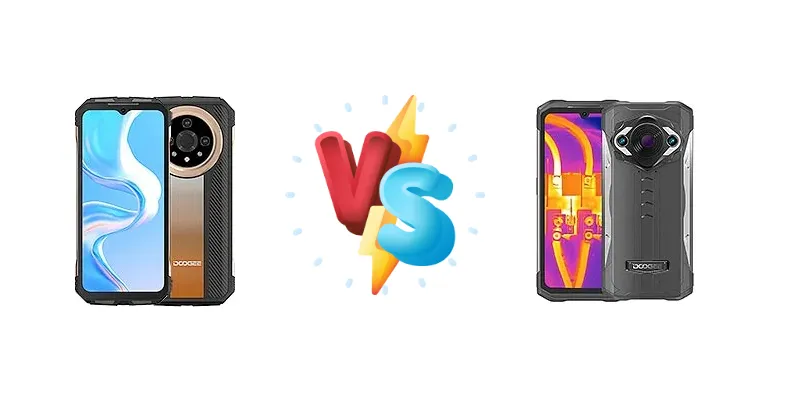
|
🏆 Quick Verdict
For the average user prioritizing performance and future-proofing, the Doogee V31GT is the clear winner. Its Dimensity 1080 chipset offers a significant performance leap over the S98 Pro’s Helio G96, coupled with faster 66W charging. While the S98 Pro offers wireless charging, the V31GT’s superior processing power makes it the better choice for gaming and demanding applications.
| PHONES | ||
|---|---|---|
| Phone Names | Doogee V31GT | Doogee S98 Pro |
| Network | ||
|---|---|---|
| 2G bands | GSM 850 / 900 / 1800 / 1900 | GSM 850 / 900 / 1800 / 1900 |
| 3G bands | HSDPA 800 / 850 / 900 / 1700(AWS) / 1900 / 2100 | HSDPA 800 / 850 / 900 / 1700(AWS) / 1900 / 2100 |
| 4G bands | 1, 2, 3, 4, 5, 7, 8, 12, 17, 18, 19, 20, 25, 26, 28, 34, 38, 39, 40, 41, 66 | 1, 2, 3, 4, 5, 7, 8, 12, 13, 17, 18, 19, 20, 25, 26, 28, 34, 38, 39, 40, 41, 66 |
| 5G bands | 1, 3, 7, 28, 38, 41, 77, 78, 79 SA/NSA | - |
| Speed | HSPA, LTE, 5G | HSPA, LTE |
| Technology | GSM / CDMA / HSPA / LTE / 5G | GSM / CDMA / HSPA / LTE |
| Launch | ||
|---|---|---|
| Announced | 2023, September | 2022, May 27 |
| Status | Available. Released 2023, September | Available. Released 2022, June 06 |
| Body | ||
|---|---|---|
| Dimensions | 178.5 x 83.1 x 17.9 mm (7.03 x 3.27 x 0.70 in) | 172 x 82 x 15.5 mm (6.77 x 3.23 x 0.61 in) |
| SIM | Nano-SIM + Nano-SIM | Nano-SIM + Nano-SIM |
| Weight | 390 g (13.76 oz) | 320 g (11.29 oz) |
| Display | ||
|---|---|---|
| Protection | Corning Gorilla Glass 5 | Corning Gorilla Glass |
| Resolution | 1080 x 2400 pixels, 20:9 ratio (~400 ppi density) | 1080 x 2340 pixels, 19.5:9 ratio (~409 ppi density) |
| Size | 6.58 inches, 104.5 cm2 (~70.5% screen-to-body ratio) | 6.3 inches, 97.4 cm2 (~69.1% screen-to-body ratio) |
| Type | IPS LCD, 120Hz | IPS LCD, 500 nits (peak) |
| Platform | ||
|---|---|---|
| CPU | Octa-core (2x2.6 GHz Cortex-A78 & 6x2.0 GHz Cortex-A55) | Octa-core (2x2.05 GHz Cortex-A76 & 6x2.0 GHz Cortex-A55) |
| Chipset | Mediatek Dimensity 1080 (6 nm) | Mediatek MT6781 Helio G96 (12 nm) |
| GPU | Mali-G68 MC4 | Mali-G57 MC2 |
| OS | Android 13 | Android 12 |
| Memory | ||
|---|---|---|
| Card slot | microSDXC (uses shared SIM slot) | microSDXC (dedicated slot) |
| Internal | 256GB 12GB RAM | 256GB 8GB RAM |
| Main Camera | ||
|---|---|---|
| Features | LED flash, HDR, panorama | Dual-LED flash, HDR, panorama |
| Quad | 50 MP, f/1.8, (wide), 1/1.56", 1.0µm, PDAF 24 MP, f/1.8, (night vision), 2 infrared night vision lights 8 MP, f/1.8, (wide) 256×192 pixels thermal camera | - |
| Triple | - | 48 MP, f/1.8, (wide), PDAF 20 MP, f/1.8, (night vision), 2 infrared night vision lights Thermal imaging camera |
| Video | 4K@30fps, 1080p@30fps | 1440p, 1080p |
| Selfie camera | ||
|---|---|---|
| Single | 32 MP, f/1.8, (wide), 1/2.8", 0.8µm | 16 MP, f/2.0, (wide) |
| Video | 1080p@30fps | 1080p |
| Sound | ||
|---|---|---|
| 35mm jack | No | Unspecified |
| Loudspeaker | Yes, with stereo speakers | Yes |
| Comms | ||
|---|---|---|
| Bluetooth | 5.2, A2DP, LE | 5.1, A2DP, LE |
| NFC | Yes (market/region dependent) | Yes |
| Positioning | GPS (L1+L5), GLONASS, GALILEO, BDS | GPS, GLONASS, BDS, GALILEO |
| Radio | FM radio | FM radio |
| USB | USB Type-C 2.0, OTG | USB Type-C 2.0, OTG |
| WLAN | Wi-Fi 802.11 a/b/g/n/ac/6, dual-band | Wi-Fi 802.11 a/b/g/n/ac, dual-band |
| Features | ||
|---|---|---|
| Sensors | Fingerprint (side-mounted), accelerometer, gyro, proximity, compass | Fingerprint (side-mounted), accelerometer, gyro, proximity, compass |
| Battery | ||
|---|---|---|
| Charging | 66W wired, 55% in 30 min Reverse wired | 33W wired 15W wireless |
| Type | 10800 mAh | 6000 mAh |
| Misc | ||
|---|---|---|
| Colors | Black, Gold, Silver | Black |
| Price | - | About 470 EUR |
Doogee V31GT
- Significantly faster processor (Dimensity 1080)
- Faster 66W wired charging
- More efficient 6nm process node
- No wireless charging
- Potentially higher price point
Doogee S98 Pro
- Wireless charging support
- Potentially lower price point
- Adequate performance for basic tasks
- Slower processor (Helio G96)
- Slower 33W wired charging
- Less efficient 12nm process node
Display Comparison
Neither device’s display specifications are provided, so a direct comparison is limited. However, given the V31GT’s focus on modern specs, it’s reasonable to assume it may feature a higher refresh rate panel. The S98 Pro, positioned as a more value-oriented option, likely utilizes a standard 60Hz display. Both will likely feature IPS LCD panels given the rugged nature of the phones, prioritizing durability over OLED’s fragility. Bezels are expected to be similar on both, designed for grip and protection.
Camera Comparison
Without specific camera sensor details, a detailed comparison is difficult. However, Doogee often focuses on megapixel count. Assuming both phones feature similar secondary sensors, the primary sensor quality will be the deciding factor. A larger sensor, coupled with effective image processing, will yield better low-light performance and dynamic range. The V31GT’s newer chipset may also offer more advanced image signal processing capabilities. We can expect both phones to offer a standard set of camera modes, but the V31GT is likely to produce sharper, more detailed images.
Performance
The core difference lies in the chipsets. The Doogee V31GT’s Mediatek Dimensity 1080 (6nm) is a substantial upgrade over the S98 Pro’s Helio G96 (12nm). The Dimensity 1080’s Cortex-A78 cores, clocked at 2.6 GHz, deliver significantly higher single-core and multi-core performance compared to the G96’s 2.05 GHz Cortex-A76 cores. The 6nm process node also translates to improved power efficiency and reduced thermal throttling during sustained workloads. This means the V31GT will handle graphically intensive games and demanding applications with greater ease and consistency. The S98 Pro’s G96 is adequate for everyday tasks, but will struggle with more demanding applications.
Battery Life
Battery capacity isn’t specified, but the charging speeds are a key differentiator. The V31GT’s 66W wired charging is significantly faster than the S98 Pro’s 33W wired charging. Doogee claims 55% charge in 30 minutes for the V31GT, while the S98 Pro will take considerably longer. The S98 Pro does offer 15W wireless charging, a convenience the V31GT lacks. However, the faster wired charging of the V31GT mitigates the lack of wireless charging, allowing for quicker top-ups when needed. The overall battery life will depend on the actual battery capacity, but the V31GT’s more efficient chipset should contribute to longer runtimes.
Buying Guide
Buy the Doogee V31GT if you need a rugged phone capable of handling demanding tasks like gaming, video editing, or running multiple apps simultaneously. Its modern chipset and faster charging will provide a smoother, more responsive experience. Buy the Doogee S98 Pro if you prioritize wireless charging convenience and are primarily focused on everyday tasks like calls, messaging, and light social media use. The G96 is sufficient for these workloads, and the wireless charging adds a layer of usability.