
Doogee V30 vs Ulefone Power Armor 19T: Which Rugged Phone Reigns Supreme?
| Phones Images | |||||
|---|---|---|---|---|---|
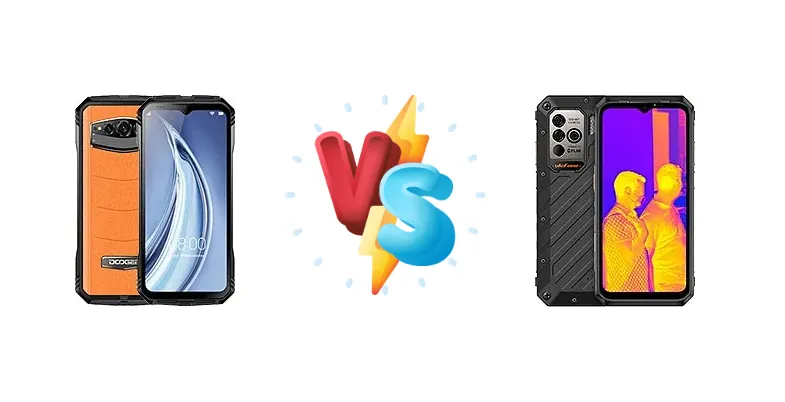
|
🏆 Quick Verdict
For users prioritizing raw processing power and responsiveness, the Doogee V30 emerges as the winner. Its Dimensity 900 chipset provides a noticeable performance edge over the Ulefone Power Armor 19T’s Helio G99, making it better suited for demanding tasks and gaming. However, the Ulefone offers a compelling value proposition for those on a tighter budget.
| PHONES | ||
|---|---|---|
| Phone Names | Doogee V30 | Ulefone Power Armor 19T |
| Network | ||
|---|---|---|
| 2G bands | GSM 850 / 900 / 1800 / 1900 | GSM 850 / 900 / 1800 / 1900 |
| 3G bands | HSDPA 800 / 850 / 900 / 1700(AWS) / 1900 / 2100 | HSDPA 800 / 850 / 900 / 1700(AWS) / 1900 / 2100 |
| 4G bands | 1, 2, 3, 4, 5, 7, 8, 12, 17, 18, 19, 20, 25, 26, 28, 34, 38, 39, 40, 41, 66 | 1, 2, 3, 4, 5, 7, 8, 12, 13, 17, 18, 19, 20, 25, 26, 28, 34, 38, 39, 40, 41, 66, 71 |
| 5G bands | 1, 3, 7, 28, 38, 41, 77, 78, 79 SA/NSA | - |
| Speed | HSPA, LTE, 5G | HSPA, LTE |
| Technology | GSM / CDMA / HSPA / LTE / 5G | GSM / CDMA / HSPA / CDMA2000 / LTE |
| - | CDMA2000 1x | |
| Launch | ||
|---|---|---|
| Announced | 2022, December 12 | 2023, March 06 |
| Status | Available. Released 2022, December 22 | Available. Released 2023, March 06 |
| Body | ||
|---|---|---|
| Dimensions | 178.4 x 83.1 x 18.3 mm (7.02 x 3.27 x 0.72 in) | 175.2 x 83.4 x 18.8 mm (6.90 x 3.28 x 0.74 in) |
| SIM | Nano-SIM + eSIM | Nano-SIM + Nano-SIM |
| Weight | 376 g (13.26 oz) | 409 g (14.43 oz) |
| - | IP68/IP69K dust/water resistant (up to 1.5m for 30 min) Drop-to-concrete resistance from up to 1.5m MIL-STD-810H compliant Accessory connector (ulefone endoscope, microscope) | |
| Display | ||
|---|---|---|
| Protection | Corning Gorilla Glass 5 | Corning Gorilla Glass 5 |
| Resolution | 1080 x 2408 pixels, 20:9 ratio (~401 ppi density) | 1080 x 2408 pixels, 20:9 ratio (~401 ppi density) |
| Size | 6.58 inches, 104.3 cm2 (~70.4% screen-to-body ratio) | 6.58 inches, 104.3 cm2 (~71.4% screen-to-body ratio) |
| Type | IPS LCD, 120Hz | IPS LCD, 120Hz |
| Platform | ||
|---|---|---|
| CPU | Octa-core (2x2.4 GHz Cortex-A78 & 6x2.0 GHz Cortex-A55) | Octa-core (2x2.2 GHz Cortex-A76 & 6x2.0 GHz Cortex-A55) |
| Chipset | Mediatek Dimensity 900 (6 nm) | Mediatek Helio G99 (6 nm) |
| GPU | Mali-G68 MC4 | Mali-G57 MC2 |
| OS | Android 12 | Android 12 |
| Memory | ||
|---|---|---|
| Card slot | microSDXC (uses shared SIM slot) | microSDXC (uses shared SIM slot) |
| Internal | 256GB 8GB RAM | 256GB 12GB RAM |
| Main Camera | ||
|---|---|---|
| Features | Dual-LED flash, HDR, panorama | Hexa-LED flash, HDR, panorama |
| Triple | 108 MP, f/1.8, (wide), 1/1.52", 0.7µm, PDAF 20 MP, f/1.8, (night vision), 2 infrared night vision lights 16 MP, f/2.2, 130˚ (ultrawide) | 108 MP, f/1.9, (wide), 1/1.52", 0.7µm, PDAF 5 MP (macro) FLIR thermal camera (Lepton module) 5 MP (for thermal module) |
| Video | 4K@30fps, 1080p@30fps | 1440p@30fps, 1080p@30fps |
| Selfie camera | ||
|---|---|---|
| Single | 32 MP, f/2.0, (wide), 1/2.8", 0.8µm | 16 MP, f/2.0, (wide), 1.0µm |
| Video | 4K@30fps, 1080p@30fps | 1080p@30fps |
| Sound | ||
|---|---|---|
| 3.5mm jack | - | Yes |
| 35mm jack | No | Yes |
| Loudspeaker | Yes, with stereo speakers | Yes |
| Comms | ||
|---|---|---|
| Bluetooth | 5.2, A2DP, LE | 5.2, A2DP, LE |
| NFC | Yes (market/region dependent) | Yes |
| Positioning | GPS (L1+L5), GLONASS, GALILEO, BDS | GPS, GLONASS, GALILEO, BDS |
| Radio | FM radio | Wireless FM radio, RDS, recording |
| USB | USB Type-C 2.0, OTG | USB Type-C 2.0, OTG, magnetic connector |
| WLAN | Wi-Fi 802.11 a/b/g/n/ac/6, dual-band | Wi-Fi 802.11 a/b/g/n/ac, dual-band |
| Features | ||
|---|---|---|
| Sensors | Fingerprint (side-mounted), accelerometer, gyro, proximity, compass | Fingerprint (side-mounted), accelerometer, gyro, proximity, compass |
| Battery | ||
|---|---|---|
| Charging | 66W wired, 55% in 30 min 15W wireless Reverse wired | 66W wired, 52% in 30 min 15W wireless 5W wireless reversed |
| Type | 10800 mAh | Li-Po 9600 mAh |
| Misc | ||
|---|---|---|
| Colors | Orange, Black | Black |
| Price | About 330 EUR | About 440 EUR |
Doogee V30
- More powerful Dimensity 900 chipset
- Faster charging speed (55% in 30 min)
- Reverse wired charging capability
- Potentially higher price point
- May generate more heat under sustained load
Ulefone Power Armor 19T
- More affordable price
- Solid performance for everyday tasks
- 66W fast charging
- Less powerful Helio G99 chipset
- No reverse charging
Display Comparison
Neither device’s display specifications are provided, so a direct comparison is limited. However, given the market segment, both likely utilize IPS LCD panels for durability and visibility in direct sunlight. The absence of LTPO technology suggests neither will offer adaptive refresh rates for power saving. Bezels are likely to be substantial on both to contribute to drop protection. Color accuracy will likely be secondary to robustness.
Camera Comparison
Without detailed camera specifications beyond the chipsets, a precise comparison is difficult. However, the chipset difference suggests the Doogee V30 will likely have a more capable image signal processor (ISP), leading to better image processing and potentially improved low-light performance. The Ulefone Power Armor 19T will likely focus on providing a functional camera experience for documentation and casual photography. The prevalence of 2MP macro lenses in this segment suggests both phones may include one, but their utility is limited due to the small sensor size and lack of optical image stabilization (OIS).
Performance
The Doogee V30’s Mediatek Dimensity 900 (6nm) represents a significant step up in processing power compared to the Ulefone Power Armor 19T’s Helio G99 (6nm). The Dimensity 900 utilizes two Cortex-A78 cores clocked at 2.4 GHz, versus the G99’s Cortex-A76 cores at 2.2 GHz. While both are octa-core CPUs, the A78 architecture offers superior single-core performance, translating to snappier app launches and smoother multitasking. This difference will be most noticeable when running demanding applications or switching between multiple apps. The 6nm process node on both chips contributes to improved efficiency, but the Dimensity 900’s more advanced core design gives it the edge.
Battery Life
Both the Doogee V30 and Ulefone Power Armor 19T support 66W wired charging, with the Doogee reaching 55% charge in 30 minutes and the Ulefone achieving 52%. This minimal difference in charging speed is unlikely to be noticeable in real-world use. Both also offer 15W wireless charging, and the Doogee adds reverse wired charging, a useful feature for topping up accessories. While battery capacity isn’t specified, the focus on fast charging suggests both manufacturers prioritize minimizing downtime over maximizing total capacity. The slightly faster charging of the Doogee V30, combined with its more efficient processor, could translate to slightly better overall battery life for power users.
Buying Guide
Buy the Doogee V30 if you need a rugged phone capable of handling demanding applications like video editing, resource-intensive games, or frequent multitasking. Its superior chipset and potentially better thermal management will provide a smoother, more consistent experience. Buy the Ulefone Power Armor 19T if you prioritize affordability and still require a durable, reliable device for everyday tasks, navigation, and basic photography. It’s an excellent choice for users who need a tough phone without breaking the bank.