
Doogee V30 vs Oukitel WP210: A Deep Dive into Rugged Smartphone Performance
| Phones Images | |||||
|---|---|---|---|---|---|
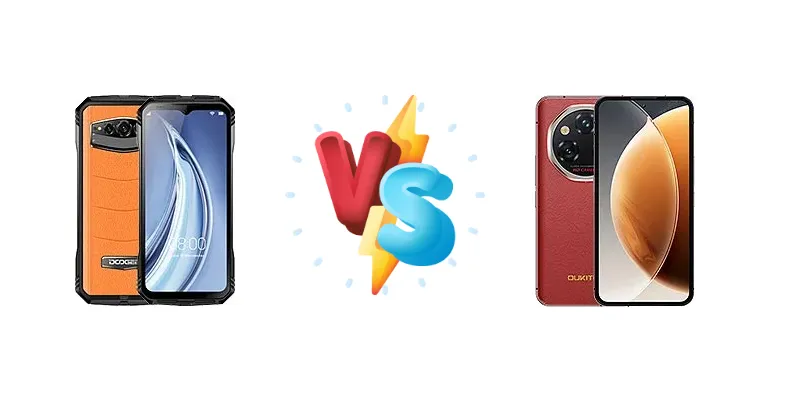
|
🏆 Quick Verdict
For the average user prioritizing all-day (and multi-day) battery life and raw processing power, the Oukitel WP210 is the clear winner. While the Doogee V30’s 66W charging is convenient, it can’t compensate for the WP210’s superior chipset and reported 86:17h endurance. However, users who value faster charging speeds and a slightly newer chipset may find the V30 appealing.
| PHONES | ||
|---|---|---|
| Phone Names | Doogee V30 | Oukitel WP210 |
| Network | ||
|---|---|---|
| 2G bands | GSM 850 / 900 / 1800 / 1900 | GSM 850 / 900 / 1800 / 1900 |
| 3G bands | HSDPA 800 / 850 / 900 / 1700(AWS) / 1900 / 2100 | HSDPA 800 / 850 / 900 / 1700(AWS) / 1900 / 2100 |
| 4G bands | 1, 2, 3, 4, 5, 7, 8, 12, 17, 18, 19, 20, 25, 26, 28, 34, 38, 39, 40, 41, 66 | 1, 2, 3, 4, 5, 7, 8, 12, 13, 17, 18, 19, 20, 25, 26, 28, 34, 38, 39, 40, 41, 66, 71 |
| 5G bands | 1, 3, 7, 28, 38, 41, 77, 78, 79 SA/NSA | 1, 2, 3, 5, 7, 8, 12, 20, 25, 28, 34, 38, 39, 40, 41, 48, 66, 71, 77, 78 SA/NSA |
| Speed | HSPA, LTE, 5G | HSPA, LTE, 5G |
| Technology | GSM / CDMA / HSPA / LTE / 5G | GSM / HSPA / LTE / 5G |
| Launch | ||
|---|---|---|
| Announced | 2022, December 12 | 2025, July |
| Status | Available. Released 2022, December 22 | Available. Released 2025, July 15 |
| Body | ||
|---|---|---|
| Dimensions | 178.4 x 83.1 x 18.3 mm (7.02 x 3.27 x 0.72 in) | 163.6 x 77.9 x 13.7 mm (6.44 x 3.07 x 0.54 in) |
| SIM | Nano-SIM + eSIM | Nano-SIM + Nano-SIM |
| Weight | 376 g (13.26 oz) | 311 g (10.97 oz) |
| Display | ||
|---|---|---|
| Protection | Corning Gorilla Glass 5 | Corning Gorilla Glass 5, Mohs level 5 |
| Resolution | 1080 x 2408 pixels, 20:9 ratio (~401 ppi density) | 1080 x 2408 pixels, 20:9 ratio (~394 ppi density) |
| Size | 6.58 inches, 104.3 cm2 (~70.4% screen-to-body ratio) | 6.7 inches, 108.1 cm2 (~84.9% screen-to-body ratio) |
| Type | IPS LCD, 120Hz | IPS LCD, 120Hz, 500 nits |
| Platform | ||
|---|---|---|
| CPU | Octa-core (2x2.4 GHz Cortex-A78 & 6x2.0 GHz Cortex-A55) | Octa-core (1x3.1 GHz Cortex-A78 & 3x3.0 GHz Cortex-A78 & 4x2.0 GHz Cortex-A55) |
| Chipset | Mediatek Dimensity 900 (6 nm) | Mediatek Dimensity 8200 (4 nm) |
| GPU | Mali-G68 MC4 | Mali-G610 MC6 |
| OS | Android 12 | Android 15 |
| Memory | ||
|---|---|---|
| Card slot | microSDXC (uses shared SIM slot) | microSDXC (uses shared SIM slot) |
| Internal | 256GB 8GB RAM | 512GB 12GB RAM |
| Main Camera | ||
|---|---|---|
| Features | Dual-LED flash, HDR, panorama | LED flash, HDR, panorama |
| Triple | 108 MP, f/1.8, (wide), 1/1.52", 0.7µm, PDAF 20 MP, f/1.8, (night vision), 2 infrared night vision lights 16 MP, f/2.2, 130˚ (ultrawide) | 108 MP, f/1.9, (wide), 1/1.8", PDAF 2 MP (macro) Auxiliary lens |
| Video | 4K@30fps, 1080p@30fps | 4K@30fps |
| Selfie camera | ||
|---|---|---|
| Single | 32 MP, f/2.0, (wide), 1/2.8", 0.8µm | 32 MP, f/2.2, (wide), 1/2.74" |
| Video | 4K@30fps, 1080p@30fps | 1080p@30fps |
| Sound | ||
|---|---|---|
| 35mm jack | No | No |
| Loudspeaker | Yes, with stereo speakers | Yes |
| Comms | ||
|---|---|---|
| Bluetooth | 5.2, A2DP, LE | 5.3, A2DP, LE |
| NFC | Yes (market/region dependent) | Yes |
| Positioning | GPS (L1+L5), GLONASS, GALILEO, BDS | GPS (L1+L5), GLONASS, GALILEO, BDS |
| Radio | FM radio | FM radio |
| USB | USB Type-C 2.0, OTG | USB Type-C 2.0 |
| WLAN | Wi-Fi 802.11 a/b/g/n/ac/6, dual-band | Wi-Fi 802.11 a/b/g/n/ac/6, dual-band |
| Features | ||
|---|---|---|
| Sensors | Fingerprint (side-mounted), accelerometer, gyro, proximity, compass | Fingerprint (side-mounted), accelerometer, gyro, proximity, compass |
| Battery | ||
|---|---|---|
| Charging | 66W wired, 55% in 30 min 15W wireless Reverse wired | 45W wired |
| Type | 10800 mAh | Li-Po 8800 mAh |
| Misc | ||
|---|---|---|
| Colors | Orange, Black | Gray, Black, Red |
| Price | About 330 EUR | - |
| EU LABEL | ||
|---|---|---|
| Battery | - | 86:17h endurance, 1000 cycles |
| Energy | - | Class B |
| Free fall | - | Class A (270 falls) |
| Repairability | - | Class C |
Doogee V30
- Faster 66W wired charging
- 15W wireless charging support
- Potentially more compact design (speculation)
- Less powerful Dimensity 900 chipset
- Lower battery endurance compared to WP210
- 6nm process may lead to more heat
Oukitel WP210
- More powerful Dimensity 8200 chipset
- Exceptional 86:17h battery endurance
- 1000 charge cycle battery longevity
- Slower 45W wired charging
- Potentially larger and heavier design (speculation)
- No wireless charging
Display Comparison
Neither device’s display specifications are provided, so a direct comparison is limited. However, given the rugged nature of both phones, we can assume both utilize durable, likely IPS LCD panels. The absence of LTPO technology suggests neither will offer adaptive refresh rates for power saving. Bezels are likely to be substantial on both to provide drop protection. Color accuracy will likely be secondary to durability.
Camera Comparison
Without detailed camera specifications, a comprehensive comparison is impossible. However, the market segment suggests both phones will prioritize practicality over photographic excellence. We can assume both will feature a main sensor, ultrawide, and potentially a macro lens. The absence of information regarding sensor size, OIS, or lens apertures prevents a meaningful assessment. It’s likely image processing will focus on providing usable images in challenging conditions rather than artistic flair.
Performance
The Oukitel WP210’s Mediatek Dimensity 8200 (4nm) represents a significant leap in performance and efficiency over the Doogee V30’s Dimensity 900 (6nm). The 4nm process node allows for higher transistor density and lower power consumption, translating to less thermal throttling during sustained workloads. The WP210’s CPU configuration – 1x3.1 GHz Cortex-A78, 3x3.0 GHz Cortex-A78, and 4x2.0 GHz Cortex-A55 – is more aggressive than the V30’s 2x2.4 GHz Cortex-A78 & 6x2.0 GHz Cortex-A55, promising faster application loading and smoother multitasking. While both utilize octa-core architectures, the WP210’s superior chipset will benefit gamers and power users.
Battery Life
The Oukitel WP210’s standout feature is its reported 86:17h endurance and 1000 charge cycles, indicating a focus on longevity. While the Doogee V30 offers 66W wired charging – capable of reaching 55% charge in 30 minutes – and 15W wireless charging, the WP210’s sheer battery capacity and endurance likely outweigh the V30’s faster charging speed for most users. The WP210’s 45W wired charging is slower, but the extended battery life minimizes the need for frequent top-ups.
Buying Guide
Buy the Doogee V30 if you need a rugged phone with a focus on quick top-ups and are frequently near a power source. Its 66W charging is ideal for those who dislike waiting. Buy the Oukitel WP210 if you prioritize extended battery life above all else, especially if you work or travel in areas with limited access to charging infrastructure. The Dimensity 8200 also provides a performance edge for demanding tasks.