
Doogee V30 vs. Nokia XR21: A Deep Dive into Rugged Smartphone Performance
| Phones Images | |||||
|---|---|---|---|---|---|
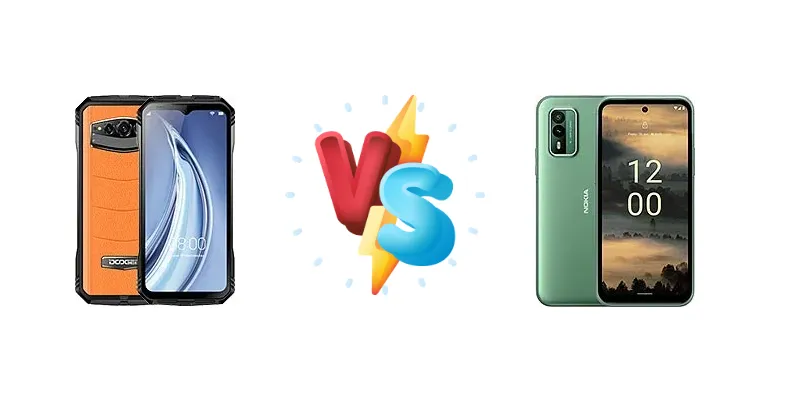
|
🏆 Quick Verdict
For users prioritizing performance and faster charging, the Doogee V30 is the clear winner. Its Dimensity 900 chipset delivers a noticeable performance edge. However, the Nokia XR21 offers a more refined, efficient experience and benefits from Nokia’s software support, making it ideal for users valuing longevity and reliability.
| PHONES | ||
|---|---|---|
| Phone Names | Doogee V30 | Nokia XR21 |
| Network | ||
|---|---|---|
| 2G bands | GSM 850 / 900 / 1800 / 1900 | GSM 850 / 900 / 1800 / 1900 |
| 3G bands | HSDPA 800 / 850 / 900 / 1700(AWS) / 1900 / 2100 | HSDPA 850 / 900 / 1700(AWS) / 1900 / 2100 |
| 4G bands | 1, 2, 3, 4, 5, 7, 8, 12, 17, 18, 19, 20, 25, 26, 28, 34, 38, 39, 40, 41, 66 | 1, 2, 3, 4, 5, 7, 8, 12, 13, 17, 20, 25, 26, 28, 32, 38, 39, 40, 41, 42, 43, 48, 66, 71 |
| 5G bands | 1, 3, 7, 28, 38, 41, 77, 78, 79 SA/NSA | 1, 2, 3, 5, 7, 20, 25, 28, 40, 41, 66, 71, 77, 78, 79 SA/NSA |
| Speed | HSPA, LTE, 5G | HSPA, LTE, 5G |
| Technology | GSM / CDMA / HSPA / LTE / 5G | GSM / HSPA / LTE / 5G |
| Launch | ||
|---|---|---|
| Announced | 2022, December 12 | 2023, May 03 |
| Status | Available. Released 2022, December 22 | Available. Released 2023, June 11 |
| Body | ||
|---|---|---|
| Build | - | Glass front (Gorilla Glass Victus), plastic back, plastic frame |
| Dimensions | 178.4 x 83.1 x 18.3 mm (7.02 x 3.27 x 0.72 in) | 168 x 78.6 x 10.5 mm (6.61 x 3.09 x 0.41 in) |
| SIM | Nano-SIM + eSIM | Nano-SIM + Nano-SIM + eSIM (max 2 at a time) |
| Weight | 376 g (13.26 oz) | 231 g (8.15 oz) |
| - | IP68/IP69K dust/water resistant (up to 1.5m for 60 min) Drop-to-concrete resistance from up to 1.8m MIL-STD-810H compliant | |
| Display | ||
|---|---|---|
| Protection | Corning Gorilla Glass 5 | Corning Gorilla Glass Victus |
| Resolution | 1080 x 2408 pixels, 20:9 ratio (~401 ppi density) | 1080 x 2400 pixels, 20:9 ratio (~406 ppi density) |
| Size | 6.58 inches, 104.3 cm2 (~70.4% screen-to-body ratio) | 6.49 inches, 101.7 cm2 (~77.0% screen-to-body ratio) |
| Type | IPS LCD, 120Hz | IPS LCD, 120Hz, 450 nits (typ), 550 nits (HBM) |
| Platform | ||
|---|---|---|
| CPU | Octa-core (2x2.4 GHz Cortex-A78 & 6x2.0 GHz Cortex-A55) | Octa-core (2x2.2 GHz Kryo 660 Gold & 6x1.7 GHz Kryo 660 Silver) |
| Chipset | Mediatek Dimensity 900 (6 nm) | Qualcomm SM6375 Snapdragon 695 5G (6 nm) |
| GPU | Mali-G68 MC4 | Adreno 619 |
| OS | Android 12 | Android 12 |
| Memory | ||
|---|---|---|
| Card slot | microSDXC (uses shared SIM slot) | Unspecified |
| Internal | 256GB 8GB RAM | 128GB 6GB RAM |
| Main Camera | ||
|---|---|---|
| Dual | - | 64 MP, f/1.8, (wide), 1/2.0", PDAF 8 MP, f/2.2, (ultrawide), 1/4.0", 1.12µm |
| Features | Dual-LED flash, HDR, panorama | Dual-LED dual-tone flash, second LED flash, HDR, panorama |
| Triple | 108 MP, f/1.8, (wide), 1/1.52", 0.7µm, PDAF 20 MP, f/1.8, (night vision), 2 infrared night vision lights 16 MP, f/2.2, 130˚ (ultrawide) | - |
| Video | 4K@30fps, 1080p@30fps | 1080p@30fps |
| Selfie camera | ||
|---|---|---|
| Single | 32 MP, f/2.0, (wide), 1/2.8", 0.8µm | 16 MP, f/2.4 (wide) |
| Video | 4K@30fps, 1080p@30fps | 1080p@30fps |
| Sound | ||
|---|---|---|
| 3.5mm jack | - | Yes |
| 35mm jack | No | Yes |
| Loudspeaker | Yes, with stereo speakers | Yes, with stereo speakers |
| Comms | ||
|---|---|---|
| Bluetooth | 5.2, A2DP, LE | 5.1, A2DP, LE, aptX Adaptive |
| NFC | Yes (market/region dependent) | Yes (market/region dependent) |
| Positioning | GPS (L1+L5), GLONASS, GALILEO, BDS | GPS (L1+L5), GLONASS (G1), BDS (B1I+B1c+B2a), GALILEO (E1+E5a), QZSS (L1+L5), NavIC (L5) |
| Radio | FM radio | Unspecified |
| USB | USB Type-C 2.0, OTG | USB Type-C 2.0, OTG |
| WLAN | Wi-Fi 802.11 a/b/g/n/ac/6, dual-band | Wi-Fi 802.11 a/b/g/n/ac/6, dual-band |
| Features | ||
|---|---|---|
| Sensors | Fingerprint (side-mounted), accelerometer, gyro, proximity, compass | Fingerprint (side-mounted), accelerometer, gyro, proximity, compass, barometer |
| Battery | ||
|---|---|---|
| Charging | 66W wired, 55% in 30 min 15W wireless Reverse wired | 33W wired, PD2.0, QC3 |
| Type | 10800 mAh | Li-Po 4800 mAh |
| Misc | ||
|---|---|---|
| Colors | Orange, Black | Midnight Black, Pine Green |
| Price | About 330 EUR | About 570 EUR |
Doogee V30
- Faster 66W wired charging significantly reduces downtime.
- More powerful Dimensity 900 chipset for demanding tasks.
- Wireless and reverse wired charging offer added convenience.
- Potentially shorter battery life due to higher power consumption.
- Software support may not be as long-term as Nokia.
Nokia XR21
- Efficient Snapdragon 695 chipset for sustained performance.
- Nokia’s reputation for long-term software updates and security patches.
- Potentially longer battery life due to efficient chipset.
- Slower 33W charging takes longer to replenish the battery.
- Less powerful chipset may struggle with demanding games and apps.
Display Comparison
Neither device's display specifications are provided, so a direct comparison is limited. However, given the Doogee V30's focus on performance, it's reasonable to expect a higher refresh rate panel, potentially 90Hz or 120Hz, to complement the chipset. The Nokia XR21, aiming for efficiency, likely utilizes a standard 60Hz panel. Bezels are likely similar given the rugged design constraints of both. Color accuracy will depend on panel calibration, a detail not provided.
Camera Comparison
Without detailed camera specifications, a precise comparison is difficult. However, the chipset difference suggests the Doogee V30 has more processing power available for image signal processing (ISP), potentially leading to better dynamic range and noise reduction. The Nokia XR21’s Snapdragon 695 ISP is capable, but likely less sophisticated. The presence or absence of Optical Image Stabilization (OIS) on either device is unknown, but would be a significant differentiator. The marketing materials for both devices will likely emphasize ruggedness over photographic excellence, so expecting flagship-level camera performance is unrealistic.
Performance
The Doogee V30’s Mediatek Dimensity 900 (6nm) boasts a more powerful CPU configuration – 2x2.4 GHz Cortex-A78 cores and 6x2.0 GHz Cortex-A55 cores – compared to the Nokia XR21’s Qualcomm Snapdragon 695 5G (6nm) with 2x2.2 GHz Kryo 660 Gold and 6x1.7 GHz Kryo 660 Silver. This translates to a tangible performance advantage for the Doogee V30 in CPU-intensive tasks and gaming. While both are 6nm chips, the Dimensity 900’s core architecture provides a higher peak performance. The Snapdragon 695 prioritizes efficiency, potentially leading to better sustained performance under prolonged load, but will fall behind in bursty workloads. The Doogee V30 will likely handle graphically demanding games at higher settings.
Battery Life
Battery capacity is not specified for either device. However, the charging speeds reveal a key difference. The Doogee V30’s 66W wired charging, capable of reaching 55% in 30 minutes, is significantly faster than the Nokia XR21’s 33W wired charging with PD2.0 and QC3. This means the Doogee V30 can top up quickly, crucial for users who need to minimize downtime. The Nokia XR21’s slower charging suggests a focus on battery health and potentially a larger battery capacity to offset the slower charging speed. The Doogee V30 also offers 15W wireless and reverse wired charging, features absent on the Nokia XR21.
Buying Guide
Buy the Doogee V30 if you need a rugged phone for demanding tasks like mobile gaming, video editing, or running resource-intensive applications. Its 66W charging is a significant advantage for those constantly on the move. Buy the Nokia XR21 if you prefer a phone that prioritizes battery life, consistent performance for everyday tasks, and long-term software support, making it a dependable companion for outdoor adventures and work.