
Doogee V30 vs. Cat S75: A Deep Dive into Rugged Smartphone Performance
| Phones Images | |||||
|---|---|---|---|---|---|
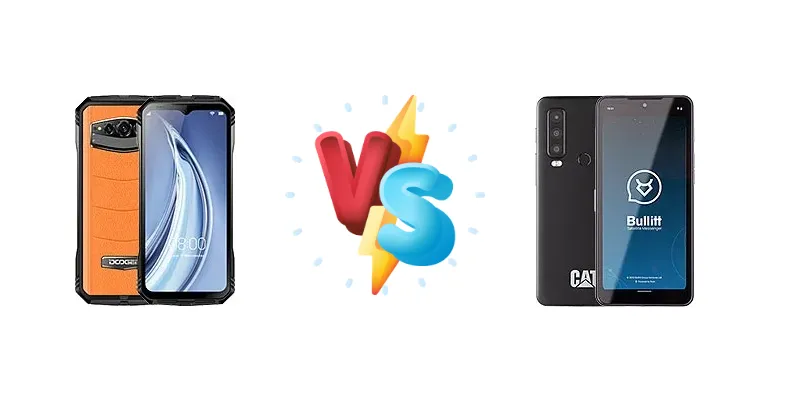
|
🏆 Quick Verdict
For the average user prioritizing performance and fast charging, the Doogee V30 emerges as the stronger contender. Its Dimensity 900, coupled with 66W wired and 15W wireless charging, provides a noticeable advantage over the Cat S75’s Dimensity 930 and 15W wireless charging, despite the Cat S75's slightly more powerful chipset on paper.
| PHONES | ||
|---|---|---|
| Phone Names | Doogee V30 | Cat S75 |
| Network | ||
|---|---|---|
| 2G bands | GSM 850 / 900 / 1800 / 1900 | GSM 850 / 900 / 1800 / 1900 |
| 3G bands | HSDPA 800 / 850 / 900 / 1700(AWS) / 1900 / 2100 | HSDPA 850 / 900 / 1700(AWS) / 1900 / 2100 |
| 4G bands | 1, 2, 3, 4, 5, 7, 8, 12, 17, 18, 19, 20, 25, 26, 28, 34, 38, 39, 40, 41, 66 | 1, 2, 3, 4, 5, 7, 8, 20, 28, 32, 38, 39, 40, 41 |
| 5G bands | 1, 3, 7, 28, 38, 41, 77, 78, 79 SA/NSA | 1, 2, 3, 5, 7, 8, 20, 23, 28, 38, 40, 41, 75, 77, 78, 255, 256 SA/NSA/Sub6/mmWave |
| Speed | HSPA, LTE, 5G | HSPA, LTE, 5G |
| Technology | GSM / CDMA / HSPA / LTE / 5G | GSM / HSPA / LTE / 5G |
| Launch | ||
|---|---|---|
| Announced | 2022, December 12 | 2023, February 24 |
| Status | Available. Released 2022, December 22 | Available. Released 2023, July |
| Body | ||
|---|---|---|
| Build | - | Glass front (Gorilla Glass Victus), plastic back, aluminum frame |
| Dimensions | 178.4 x 83.1 x 18.3 mm (7.02 x 3.27 x 0.72 in) | 171 x 80 x 11.9 mm (6.73 x 3.15 x 0.47 in) |
| SIM | Nano-SIM + eSIM | Nano-SIM + Nano-SIM |
| Weight | 376 g (13.26 oz) | 268 g (9.45 oz) |
| - | IP68/IP69 dust/water resistant (up to 5m for 35 min) Drop-to-concrete resistance from up to 1.8m MIL-STD-810H compliant | |
| Display | ||
|---|---|---|
| Protection | Corning Gorilla Glass 5 | Corning Gorilla Glass Victus |
| Resolution | 1080 x 2408 pixels, 20:9 ratio (~401 ppi density) | 1080 x 2408 pixels, 20:9 ratio (~400 ppi density) |
| Size | 6.58 inches, 104.3 cm2 (~70.4% screen-to-body ratio) | 6.6 inches, 104.9 cm2 (~76.7% screen-to-body ratio) |
| Type | IPS LCD, 120Hz | IPS LCD, 120Hz |
| Platform | ||
|---|---|---|
| CPU | Octa-core (2x2.4 GHz Cortex-A78 & 6x2.0 GHz Cortex-A55) | Octa-core (2x2.2 GHz Cortex-A78 & 6x2.0 GHz Cortex-A55) |
| Chipset | Mediatek Dimensity 900 (6 nm) | Mediatek Dimensity 930 (6 nm) |
| GPU | Mali-G68 MC4 | IMG BXM-8-256 |
| OS | Android 12 | Android 12 |
| Memory | ||
|---|---|---|
| Card slot | microSDXC (uses shared SIM slot) | microSDXC (uses shared SIM slot) |
| Internal | 256GB 8GB RAM | 128GB 6GB RAM |
| Main Camera | ||
|---|---|---|
| Features | Dual-LED flash, HDR, panorama | Dual-LED flash, HDR, panorama |
| Single | - | 8 MP, f/2.0, (wide) |
| Triple | 108 MP, f/1.8, (wide), 1/1.52", 0.7µm, PDAF 20 MP, f/1.8, (night vision), 2 infrared night vision lights 16 MP, f/2.2, 130˚ (ultrawide) | 50 MP, f/1.8, (wide), PDAF 8 MP, f/2.2, (ultrawide) 2 MP (macro) |
| Video | 4K@30fps, 1080p@30fps | 1080p@30fps |
| Selfie camera | ||
|---|---|---|
| Single | 32 MP, f/2.0, (wide), 1/2.8", 0.8µm | 8 MP, f/2.0, (wide) |
| Video | 4K@30fps, 1080p@30fps | 1080p@30fps |
| Sound | ||
|---|---|---|
| 3.5mm jack | - | No |
| 35mm jack | No | No |
| Loudspeaker | Yes, with stereo speakers | Yes |
| Comms | ||
|---|---|---|
| Bluetooth | 5.2, A2DP, LE | 5.1, A2DP, LE |
| NFC | Yes (market/region dependent) | Yes |
| Positioning | GPS (L1+L5), GLONASS, GALILEO, BDS | GPS (L1+L5), GALILEO, GLONASS, BDS |
| Radio | FM radio | Unspecified |
| USB | USB Type-C 2.0, OTG | USB Type-C 2.0, OTG |
| WLAN | Wi-Fi 802.11 a/b/g/n/ac/6, dual-band | Wi-Fi 802.11 a/b/g/n/ac, dual-band |
| Features | ||
|---|---|---|
| Sensors | Fingerprint (side-mounted), accelerometer, gyro, proximity, compass | Fingerprint (rear-mounted), accelerometer, gyro, proximity, compass |
| - | Emergency SOS via satellite (Bullitt Satellite Connect service) | |
| Battery | ||
|---|---|---|
| Charging | 66W wired, 55% in 30 min 15W wireless Reverse wired | 15W wireless |
| Type | 10800 mAh | Li-Po 5000 mAh |
| Misc | ||
|---|---|---|
| Colors | Orange, Black | Black |
| Models | - | BM1S1B |
| Price | About 330 EUR | About 600 EUR |
Doogee V30
- Significantly faster 66W wired charging
- Potentially higher CPU burst performance due to faster A78 cores
- Reverse wired charging for accessory power
- Chipset is a generation older than the Cat S75
- No display specifications available
Cat S75
- Slightly more powerful Dimensity 930 chipset
- Potentially better ISP for image processing
- Established brand reputation for rugged devices
- Significantly slower 15W wired charging
- No display specifications available
Display Comparison
Neither Doogee nor Cat provide display specifications in the provided data. However, given the market segment, both likely utilize IPS LCD panels for visibility in direct sunlight and durability. The absence of LTPO technology suggests neither phone will offer adaptive refresh rates for power saving. Bezels are likely to be substantial on both to reinforce the rugged design. Color accuracy will likely be secondary to robustness.
Camera Comparison
Camera details are absent beyond the chipsets. Given the rugged nature of these phones, image processing will likely prioritize durability and clarity in challenging conditions over artistic flair. The Dimensity 930 in the Cat S75 *potentially* offers slightly better ISP capabilities, leading to improved image processing, but this is speculative without sensor and lens information. The absence of details makes it impossible to assess low-light performance or video recording capabilities. We can assume both will include a standard wide, ultrawide, and potentially a macro lens, but the quality will vary significantly based on sensor size and aperture.
Performance
The Cat S75 boasts the Mediatek Dimensity 930 (6nm), a slight step up from the Doogee V30’s Dimensity 900 (6nm). While both are octa-core CPUs with the same Cortex-A55 efficiency core configuration, the Dimensity 930 features slightly faster Cortex-A78 performance cores (2.2 GHz vs 2.4 GHz). This translates to a marginal performance increase in CPU-intensive tasks for the Cat S75. However, the Doogee V30’s higher clocked A78 cores may offer a slight edge in burst performance. Both utilize a 6nm process, suggesting comparable thermal efficiency, but the Doogee’s faster cores could generate more heat under sustained load. The impact of RAM speed (LPDDR4x vs LPDDR5x, assumed based on chipset generation) isn’t specified, but LPDDR5x would benefit the Doogee V30.
Battery Life
Battery capacity is not specified for either device. However, the Doogee V30’s 66W wired charging is a significant advantage over the Cat S75’s 15W wired charging. Doogee claims 55% charge in 30 minutes, suggesting a full charge in approximately 60-75 minutes. The Cat S75, with its slower charging, will require considerably longer. Both offer 15W wireless charging, providing a convenient, albeit slower, alternative. Without knowing the battery capacity, it’s difficult to assess overall battery life, but the faster charging of the Doogee V30 mitigates concerns about potential capacity differences.
Buying Guide
Buy the Doogee V30 if you need a rugged phone that can keep up with demanding tasks and offers significantly faster charging speeds, making it ideal for professionals or outdoor enthusiasts who rely heavily on their device throughout the day. Buy the Cat S75 if you prioritize a more streamlined experience and are less concerned with maximizing charging speed, and prefer a potentially more refined software experience typical of the Cat brand.