
Doogee V20 vs. Ulefone Armor 12 5G: A Head-to-Head Rugged Smartphone Showdown
| Phones Images | |||||
|---|---|---|---|---|---|
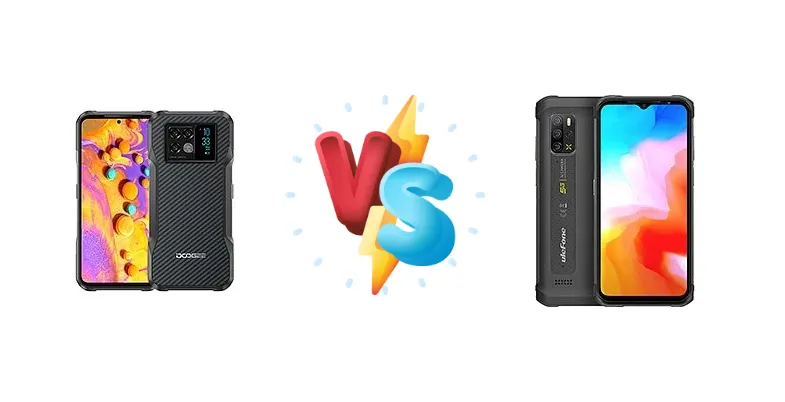
|
🏆 Quick Verdict
For the average user prioritizing convenience and faster power-ups, the Doogee V20 emerges as the winner. While both phones share the same core processing power, the V20’s 33W wired charging and addition of reverse wireless charging offer a significant advantage over the Ulefone Armor 12 5G’s 18W wired charging.
| PHONES | ||
|---|---|---|
| Phone Names | Doogee V20 | Ulefone Armor 12 5G |
| Network | ||
|---|---|---|
| 2G bands | GSM 850 / 900 / 1800 / 1900 | GSM 850 / 900 / 1800 / 1900 |
| 3G bands | HSDPA 800 / 850 / 900 / 1700(AWS) / 1900 / 2100 | HSDPA 850 / 900 / 1700(AWS) / 1900 / 2100 |
| 4G bands | 1, 2, 3, 4, 5, 7, 8, 12, 13, 17, 18, 19, 20, 25, 26, 28, 34, 38, 39, 40, 41, 66 | 1, 2, 3, 4, 5, 7, 8, 12, 13, 17, 18, 19, 20, 25, 26, 28, 34, 38, 39, 40, 41, 66 |
| 5G bands | 1, 3, 5, 7, 8, 20, 28, 38, 40, 41, 77, 78, 79 | 1, 3, 28, 38, 41, 77, 78 SA/NSA |
| Speed | HSPA, LTE, 5G | HSPA, LTE, 5G |
| Technology | GSM / CDMA / HSPA / LTE / 5G | GSM / CDMA / HSPA / EVDO / LTE / 5G |
| - | CDMA2000 1xEV-DO | |
| Launch | ||
|---|---|---|
| Announced | 2021, November 27 | 2021, August 14 |
| Status | Available. Released 2022, January | Available. Released 2021, August 23 |
| Body | ||
|---|---|---|
| Build | - | Front glass, aluminum back with rubber, aluminum frame |
| Dimensions | 170.5 x 81.2 x 14 mm (6.71 x 3.20 x 0.55 in) | 175.9 x 82.5 x 14.3 mm (6.93 x 3.25 x 0.56 in) |
| SIM | Nano-SIM + Nano-SIM | Nano-SIM + Nano-SIM |
| Weight | 296 g (10.44 oz) | 296 g (10.44 oz) |
| - | IP68 dust/water resistant (up to 1.5m for 30 min) Drop-to-concrete resistance from up to 1.2m MIL-STD-810G compliant | |
| Display | ||
|---|---|---|
| Protection | Corning Gorilla Glass | - |
| Resolution | 1080 x 2400 pixels, 20:9 ratio (~409 ppi density) | 720 x 1560 pixels, 19.5:9 ratio (~264 ppi density) |
| Size | 6.43 inches, 99.8 cm2 (~72.1% screen-to-body ratio) | 6.52 inches, 104.4 cm2 (~71.9% screen-to-body ratio) |
| Type | AMOLED, 500 nits (peak) | IPS LCD |
| Platform | ||
|---|---|---|
| CPU | Octa-core (2x2.2 GHz Cortex-A76 & 6x2.0 GHz Cortex-A55) | Octa-core (2x2.2 GHz Cortex-A76 & 6x2.0 GHz Cortex-A55) |
| Chipset | Mediatek Dimensity 700 (7 nm) | Mediatek Dimensity 700 (7 nm) |
| GPU | Mali-G57 MC2 | Mali-G57 MC2 |
| OS | Android 11 | Android 11 |
| Memory | ||
|---|---|---|
| Card slot | microSDXC (uses shared SIM slot) | microSDXC |
| Internal | 256GB 8GB RAM | 128GB 8GB RAM |
| Main Camera | ||
|---|---|---|
| Features | Dual-LED flash, HDR, panorama | Dual-LED flash, HDR, panorama |
| Quad | - | 48 MP, f/1.8, 26mm (wide), 1/2.0", 0.8µm, PDAF 8 MP, f/2.2, (ultrawide) 2 MP (macro) Auxiliary lens |
| Single | - | 16 MP, f/2.2 |
| Triple | 64 MP, f/1.8, (wide), PDAF 8 MP, f/2.2, 130˚, (ultrawide) 20 MP, f/1.8, (night vision), 2 infrared night vision lights | - |
| Video | 1440p, 1080p | 1440p@30fps |
| Selfie camera | ||
|---|---|---|
| Features | - | HDR, panorama |
| Single | 16 MP, f/2.0, (wide) | 16 MP, f/2.2 |
| Video | 1080p | 1080p@30fps |
| Sound | ||
|---|---|---|
| 3.5mm jack | - | No |
| 35mm jack | Unspecified | No |
| Loudspeaker | Yes | Yes, with dual speakers |
| Comms | ||
|---|---|---|
| Bluetooth | 5.1, A2DP, LE | 5.1, A2DP, LE |
| NFC | Yes | Yes |
| Positioning | GPS, GLONASS, BDS, GALILEO | GPS, GLONASS, GALILEO, BDS |
| Radio | FM radio | Wireless FM radio, RDS |
| USB | USB Type-C 2.0, OTG | USB Type-C 2.0, OTG |
| WLAN | Wi-Fi 802.11 a/b/g/n/ac, dual-band | Wi-Fi 802.11 a/b/g/n/ac, Wi-Fi Direct |
| Features | ||
|---|---|---|
| Sensors | Fingerprint (side-mounted), accelerometer, gyro, proximity, compass | Fingerprint (side-mounted), accelerometer, gyro, proximity, compass, coulombmeter |
| Battery | ||
|---|---|---|
| Charging | 33W wired 15W wireless Reverse wired | 18W wired 15W wireless |
| Type | 6000 mAh | Li-Po 5180 mAh |
| Misc | ||
|---|---|---|
| Colors | Black, Gray, Red | Black/Orange, Gray/Black |
| Price | About 440 EUR | About 370 EUR |
Doogee V20
- Faster 33W wired charging for quicker power-ups.
- Includes 15W wireless charging for added convenience.
- Offers reverse wired charging for topping up accessories.
- Rugged design may result in a bulkier form factor.
- Potential for higher price compared to the Ulefone Armor 12 5G.
Ulefone Armor 12 5G
- Rugged and durable construction for harsh environments.
- 5G connectivity for fast data speeds.
- 15W wireless charging provides charging flexibility.
- Slower 18W wired charging takes longer to fully charge.
- Lacks reverse wireless charging functionality.
Display Comparison
Both the Doogee V20 and Ulefone Armor 12 5G likely utilize IPS LCD panels, common in the rugged segment for their durability. Without specific brightness data, it’s difficult to declare a clear winner. However, the absence of LTPO technology on either device suggests standard refresh rate operation, impacting power consumption during prolonged use. Bezels are expected to be substantial on both, prioritizing screen protection over a modern, edge-to-edge aesthetic.
Camera Comparison
The provided data doesn’t detail camera specifications beyond the chipset. Given the market segment, both phones likely feature a multi-camera setup with a primary sensor, ultrawide, and potentially a macro lens. Without sensor size, aperture, or OIS information, a direct comparison is impossible. It’s reasonable to assume both will offer acceptable image quality in good lighting conditions, but low-light performance will be heavily reliant on software processing. The inclusion of a 2MP macro lens on either device is likely for marketing purposes, offering limited practical benefit.
Performance
At the heart of both devices lies the Mediatek Dimensity 700 (7nm). This chipset features an octa-core configuration with 2x2.2 GHz Cortex-A76 and 6x2.0 GHz Cortex-A55 cores, delivering comparable performance for everyday tasks and moderate gaming. The shared chipset means performance differences will likely stem from RAM management and software optimization, areas not specified in the provided data. Thermal throttling, a common concern in rugged phones due to limited internal space, will likely be similar on both, though the V20’s potentially more efficient charging system *could* indirectly contribute to slightly better sustained performance.
Battery Life
While battery capacity isn’t specified, the charging capabilities are a key differentiator. The Doogee V20 supports 33W wired charging, significantly faster than the Ulefone Armor 12 5G’s 18W wired charging. This translates to a quicker 0-100% charge time for the V20. Both devices offer 15W wireless charging, providing a convenient alternative. Crucially, the Doogee V20 adds reverse wired charging, allowing it to function as a power bank for other devices – a feature absent on the Ulefone Armor 12 5G.
Buying Guide
Buy the Doogee V20 if you need a rugged phone with faster charging speeds, the convenience of wireless charging, and the added utility of reverse wireless charging to top up accessories. Buy the Ulefone Armor 12 5G if you prioritize a potentially lower price point and are less concerned with rapid recharging, accepting a slower 18W wired charging solution. Both are excellent choices for outdoor enthusiasts and demanding work environments.