
Doogee V20 vs Nokia XR20: A Deep Dive into Rugged Smartphone Performance
| Phones Images | |||||
|---|---|---|---|---|---|
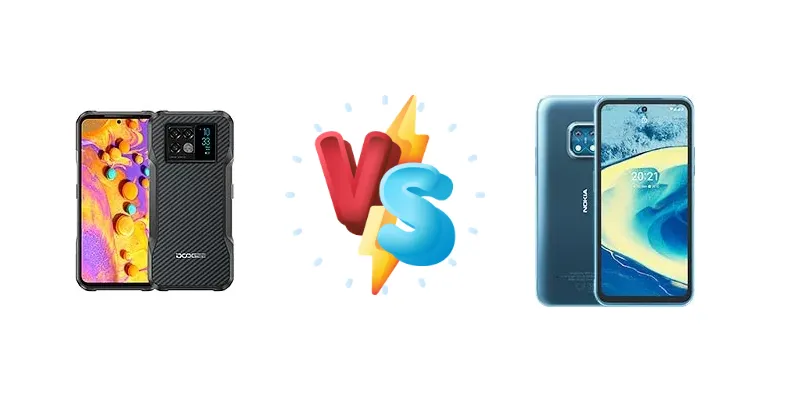
|
🏆 Quick Verdict
For users prioritizing performance and faster charging, the Doogee V20 emerges as the winner. Its Mediatek Dimensity 700 chipset offers a noticeable performance edge over the Snapdragon 480 in the Nokia XR20, and the 33W charging significantly reduces downtime. However, the Nokia XR20 remains a strong contender for those valuing software purity and guaranteed updates.
| PHONES | ||
|---|---|---|
| Phone Names | Doogee V20 | Nokia XR20 |
| Network | ||
|---|---|---|
| 2G bands | GSM 850 / 900 / 1800 / 1900 | GSM 850 / 900 / 1800 / 1900 |
| 3G bands | HSDPA 800 / 850 / 900 / 1700(AWS) / 1900 / 2100 | HSDPA 850 / 900 / 1700(AWS) / 1900 / 2100 |
| 4G bands | 1, 2, 3, 4, 5, 7, 8, 12, 13, 17, 18, 19, 20, 25, 26, 28, 34, 38, 39, 40, 41, 66 | 1, 2, 3, 4, 5, 7, 8, 12, 13, 14, 20, 25, 26, 28, 30, 38, 40, 41, 48, 66, 71 |
| 5G bands | 1, 3, 5, 7, 8, 20, 28, 38, 40, 41, 77, 78, 79 | 2, 5, 25, 38, 41, 48, 66, 77, 78 SA/NSA |
| Speed | HSPA, LTE, 5G | HSPA, LTE, 5G |
| Technology | GSM / CDMA / HSPA / LTE / 5G | GSM / CDMA / HSPA / EVDO / LTE / 5G |
| - | CDMA2000 1xEV-DO | |
| Launch | ||
|---|---|---|
| Announced | 2021, November 27 | 2021, July 27 |
| Status | Available. Released 2022, January | Available. Released 2021, August 04 |
| Body | ||
|---|---|---|
| Dimensions | 170.5 x 81.2 x 14 mm (6.71 x 3.20 x 0.55 in) | 171.6 x 81.5 x 10.6 mm (6.76 x 3.21 x 0.42 in) |
| SIM | Nano-SIM + Nano-SIM | · Nano-SIM· Nano-SIM + Nano-SIM |
| Weight | 296 g (10.44 oz) | 248 g (8.75 oz) |
| - | IP68 dust/water resistant (up to 1.5m for 60 min) Drop-to-concrete resistance from up to 1.8m MIL-STD-810H compliant | |
| Display | ||
|---|---|---|
| Protection | Corning Gorilla Glass | Corning Gorilla Glass Victus |
| Resolution | 1080 x 2400 pixels, 20:9 ratio (~409 ppi density) | 1080 x 2400 pixels, 20:9 ratio (~395 ppi density) |
| Size | 6.43 inches, 99.8 cm2 (~72.1% screen-to-body ratio) | 6.67 inches, 107.4 cm2 (~76.8% screen-to-body ratio) |
| Type | AMOLED, 500 nits (peak) | IPS LCD, 550 nits |
| Platform | ||
|---|---|---|
| CPU | Octa-core (2x2.2 GHz Cortex-A76 & 6x2.0 GHz Cortex-A55) | Octa-core (2x2.0 GHz Kryo 460 & 6x1.8 GHz Kryo 460) |
| Chipset | Mediatek Dimensity 700 (7 nm) | Qualcomm SM4350 Snapdragon 480 5G (8 nm) |
| GPU | Mali-G57 MC2 | Adreno 619 |
| OS | Android 11 | Android 11, upgradable to Android 13 |
| Memory | ||
|---|---|---|
| Card slot | microSDXC (uses shared SIM slot) | microSDXC (uses shared SIM slot) |
| Internal | 256GB 8GB RAM | 64GB 4GB RAM, 128GB 6GB RAM |
| Main Camera | ||
|---|---|---|
| Dual | - | 48 MP, f/1.8, (wide), 1/2.25", 0.8µm, PDAF 13 MP, f/2.4, 123˚ (ultrawide), 1/3.0", 1.12µm |
| Features | Dual-LED flash, HDR, panorama | Zeiss optics, Dual-LED dual-tone flash, second LED flash, HDR, panorama |
| Single | - | 8 MP, f/2.0 (wide), 1/4.0", 1.12µm |
| Triple | 64 MP, f/1.8, (wide), PDAF 8 MP, f/2.2, 130˚, (ultrawide) 20 MP, f/1.8, (night vision), 2 infrared night vision lights | - |
| Video | 1440p, 1080p | 1080p@30fps |
| Selfie camera | ||
|---|---|---|
| Single | 16 MP, f/2.0, (wide) | 8 MP, f/2.0 (wide), 1/4.0", 1.12µm |
| Video | 1080p | 1080p@30fps |
| Sound | ||
|---|---|---|
| 3.5mm jack | - | Yes |
| 35mm jack | Unspecified | Yes |
| Loudspeaker | Yes | Yes, with stereo speakers |
| Comms | ||
|---|---|---|
| Bluetooth | 5.1, A2DP, LE | 5.1, A2DP, LE, aptX Adaptive |
| NFC | Yes | Yes |
| Positioning | GPS, GLONASS, BDS, GALILEO | GPS (L1+L5), GLONASS, BDS, GALILEO, QZSS, NavIC |
| Radio | FM radio | Unspecified |
| USB | USB Type-C 2.0, OTG | USB Type-C 3.0 |
| WLAN | Wi-Fi 802.11 a/b/g/n/ac, dual-band | Wi-Fi 802.11 a/b/g/n/ac/6, dual-band, Wi-Fi Direct |
| Features | ||
|---|---|---|
| Sensors | Fingerprint (side-mounted), accelerometer, gyro, proximity, compass | Fingerprint (side-mounted), accelerometer, gyro, proximity, compass, barometer |
| Battery | ||
|---|---|---|
| Charging | 33W wired 15W wireless Reverse wired | 18W wired 15W wireless |
| Type | 6000 mAh | Li-Po 4630 mAh |
| Misc | ||
|---|---|---|
| Colors | Black, Gray, Red | Ultra Blue, Granite Gray |
| Models | - | TA-1368, TA-1362 |
| Price | About 440 EUR | About 270 EUR |
| SAR EU | - | 1.13 W/kg (head) 1.43 W/kg (body) |
Doogee V20
- Faster 33W wired charging for quicker top-ups.
- More powerful Mediatek Dimensity 700 chipset for smoother performance.
- Potentially better image processing thanks to the Dimensity 700’s ISP.
- Software updates may be less frequent compared to Nokia.
- Brand recognition is lower than Nokia.
Nokia XR20
- Guaranteed software updates and long-term support from Nokia.
- Clean and streamlined Android experience.
- Strong brand reputation for reliability.
- Slower 18W wired charging.
- Less powerful Qualcomm Snapdragon 480 chipset.
- Potentially less capable image processing.
Display Comparison
Neither device boasts a cutting-edge display. Details are missing, but assuming both utilize IPS LCD panels common in this price bracket, the display experience will be similar. The focus here is on durability, not visual fidelity. Bezels are likely comparable, and color accuracy will be adequate for outdoor visibility, but not color-critical work. The absence of high refresh rates is expected.
Camera Comparison
Without detailed camera specs beyond the chipsets, a direct comparison is limited. However, the chipset plays a role in image signal processing (ISP) capabilities. The Dimensity 700 generally offers more robust ISP features, potentially leading to better image quality in challenging lighting conditions. The Nokia XR20 likely prioritizes a more natural image processing style, consistent with Nokia’s brand identity, while the Doogee V20 might lean towards more vibrant, saturated colors. The absence of information regarding sensor sizes and lens apertures makes a definitive judgment impossible, but the chipset advantage favors the Doogee V20.
Performance
The Doogee V20’s Mediatek Dimensity 700, fabricated on a 7nm process, holds a clear advantage over the Nokia XR20’s Qualcomm Snapdragon 480 5G (8nm). The Dimensity 700’s Cortex-A76 cores, clocked at 2.2 GHz, provide a significant boost in single-core performance compared to the Snapdragon 480’s 2.0 GHz Kryo 460 cores. This translates to snappier app launches and smoother multitasking. While both are octa-core CPUs, the architectural differences and process node give the Doogee V20 a performance edge, particularly for graphically intensive tasks. The Snapdragon 480’s 8nm process, while more efficient than older nodes, can’t match the 7nm Dimensity 700’s performance-per-watt.
Battery Life
Both devices offer 15W wireless charging, a welcome feature in this segment. However, the Doogee V20’s 33W wired charging is a substantial advantage over the Nokia XR20’s 18W wired charging. This means significantly faster top-ups, reducing downtime. While battery capacity isn’t specified, the faster charging of the V20 mitigates any potential disadvantage from a slightly smaller battery. A full charge on the V20 will be considerably quicker, making it ideal for users who need to quickly replenish their battery during breaks.
Buying Guide
Buy the Doogee V20 if you need a rugged phone for demanding tasks like mobile gaming, frequent outdoor use with heavy app usage, or require the fastest possible charging speeds. Buy the Nokia XR20 if you prefer a streamlined Android experience with guaranteed software updates, prioritize a brand known for reliability, and your usage is primarily focused on communication, navigation, and light media consumption.