
Doogee V20 vs. Doogee S96 Pro: A Deep Dive into Rugged Smartphone Performance
| Phones Images | |||||
|---|---|---|---|---|---|
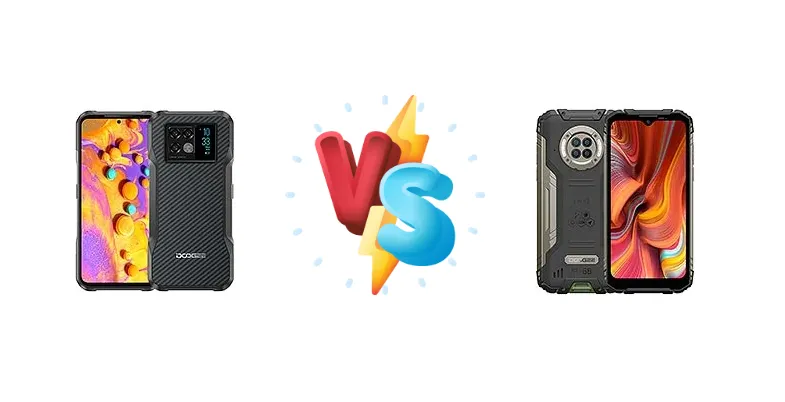
|
🏆 Quick Verdict
For most users, the Doogee V20 emerges as the better choice. Its more efficient Dimensity 700 chipset, coupled with faster 33W wired and 15W wireless charging, provides a smoother, more convenient experience. While the S96 Pro's Helio G90 has a slight edge in raw GPU power, the V20's overall package is more compelling.
| PHONES | ||
|---|---|---|
| Phone Names | Doogee V20 | Doogee S96 Pro |
| Network | ||
|---|---|---|
| 2G bands | GSM 850 / 900 / 1800 / 1900 | GSM 850 / 900 / 1800 / 1900 |
| 3G bands | HSDPA 800 / 850 / 900 / 1700(AWS) / 1900 / 2100 | HSDPA 800 / 850 / 900 / 1700(AWS) / 1900 / 2100 |
| 4G bands | 1, 2, 3, 4, 5, 7, 8, 12, 13, 17, 18, 19, 20, 25, 26, 28, 34, 38, 39, 40, 41, 66 | 1, 2, 3, 4, 5, 7, 8, 12, 13, 17, 18, 19, 20, 25, 26, 28, 38, 40, 66 |
| 5G bands | 1, 3, 5, 7, 8, 20, 28, 38, 40, 41, 77, 78, 79 | - |
| Speed | HSPA, LTE, 5G | HSPA, LTE |
| Technology | GSM / CDMA / HSPA / LTE / 5G | GSM / CDMA / HSPA / LTE |
| Launch | ||
|---|---|---|
| Announced | 2021, November 27 | 2020, October 26. Released 2020, November |
| Status | Available. Released 2022, January | Discontinued |
| Body | ||
|---|---|---|
| Dimensions | 170.5 x 81.2 x 14 mm (6.71 x 3.20 x 0.55 in) | 167 x 81.4 x 15.5 mm (6.57 x 3.20 x 0.61 in) |
| SIM | Nano-SIM + Nano-SIM | Nano-SIM + Nano-SIM |
| Weight | 296 g (10.44 oz) | 310 g (10.93 oz) |
| Display | ||
|---|---|---|
| Protection | Corning Gorilla Glass | Corning Gorilla Glass |
| Resolution | 1080 x 2400 pixels, 20:9 ratio (~409 ppi density) | 720 x 1520 pixels, 19:9 ratio (~270 ppi density) |
| Size | 6.43 inches, 99.8 cm2 (~72.1% screen-to-body ratio) | 6.22 inches, 96.6 cm2 (~71.0% screen-to-body ratio) |
| Type | AMOLED, 500 nits (peak) | IPS LCD |
| Platform | ||
|---|---|---|
| CPU | Octa-core (2x2.2 GHz Cortex-A76 & 6x2.0 GHz Cortex-A55) | Octa-core (2x2.0 GHz Cortex-A76 & 6x2.0 GHz Cortex-A55) |
| Chipset | Mediatek Dimensity 700 (7 nm) | Mediatek MT6785 Helio G90 (12 nm) |
| GPU | Mali-G57 MC2 | Mali-G76 MC4 |
| OS | Android 11 | Android 10 |
| Memory | ||
|---|---|---|
| Card slot | microSDXC (uses shared SIM slot) | microSDXC (dedicated slot) |
| Internal | 256GB 8GB RAM | 128GB 8GB RAM |
| Main Camera | ||
|---|---|---|
| Features | Dual-LED flash, HDR, panorama | Quad-LED flash, HDR, panorama |
| Quad | - | 48 MP, f/1.8, (wide), PDAF 8 MP, f/2.2, 130˚, (ultrawide) 20 MP, f/2.8, (night vision), 4 infrared night vision lights 2 MP (macro) |
| Triple | 64 MP, f/1.8, (wide), PDAF 8 MP, f/2.2, 130˚, (ultrawide) 20 MP, f/1.8, (night vision), 2 infrared night vision lights | - |
| Video | 1440p, 1080p | 1080p |
| Selfie camera | ||
|---|---|---|
| Single | 16 MP, f/2.0, (wide) | 16 MP, f/2.0, (wide) |
| Video | 1080p | 1080p |
| Sound | ||
|---|---|---|
| 35mm jack | Unspecified | Yes |
| Loudspeaker | Yes | Yes |
| Comms | ||
|---|---|---|
| Bluetooth | 5.1, A2DP, LE | 5.0, A2DP, LE |
| NFC | Yes | Yes |
| Positioning | GPS, GLONASS, BDS, GALILEO | GPS, GLONASS, BDS, GALILEO |
| Radio | FM radio | FM radio |
| USB | USB Type-C 2.0, OTG | USB Type-C 2.0, OTG |
| WLAN | Wi-Fi 802.11 a/b/g/n/ac, dual-band | Wi-Fi 802.11 a/b/g/n/ac, dual-band |
| Features | ||
|---|---|---|
| Sensors | Fingerprint (side-mounted), accelerometer, gyro, proximity, compass | Fingerprint (side-mounted), accelerometer, gyro, proximity, compass |
| Battery | ||
|---|---|---|
| Charging | 33W wired 15W wireless Reverse wired | 24W wired 10W wireless |
| Type | 6000 mAh | 6350 mAh |
| Misc | ||
|---|---|---|
| Colors | Black, Gray, Red | Black, Orange, Green |
| Price | About 440 EUR | About 280 EUR |
Doogee V20
- Faster 33W wired and 15W wireless charging
- More efficient Dimensity 700 chipset
- Potential for smoother display experience (higher refresh rate)
- Reverse wired charging capability
- Potentially slightly lower GPU performance compared to S96 Pro
- Detailed display specs are unavailable
Doogee S96 Pro
- Stronger GPU performance for gaming
- Established Helio G90 chipset
- Rugged design and build quality
- Competitive price point
- Slower 24W wired and 10W wireless charging
- Less efficient Helio G90 chipset
- Likely limited to 60Hz display refresh rate
Display Comparison
Neither Doogee provides detailed display specifications beyond resolution. However, the choice of chipset impacts display capabilities. The Dimensity 700 in the V20 supports higher refresh rates (potentially 90Hz, though unconfirmed) than the Helio G90 in the S96 Pro, which is likely limited to 60Hz. This translates to smoother scrolling and animations on the V20. While both likely utilize IPS LCD panels given the price point, the V20’s newer chipset could offer slightly better image processing for improved color accuracy.
Camera Comparison
Without detailed camera specs, a direct comparison is difficult. However, the chipset plays a role in image signal processing (ISP). The Dimensity 700’s ISP is more advanced, potentially leading to better noise reduction and dynamic range in photos and videos. Both phones likely feature a multi-camera setup, but the V20’s ISP could extract more detail from the main sensor. The presence of a 2MP macro lens on both devices is largely a marketing feature with limited practical benefit.
Performance
The core difference lies in the chipsets. The Doogee V20’s Mediatek Dimensity 700 (7nm) boasts a more efficient architecture than the S96 Pro’s Helio G90 (12nm). While the G90’s CPU clock speeds are similar (2x2.0 GHz Cortex-A76 & 6x2.0 GHz Cortex-A55), the Dimensity 700’s newer process node and improved CPU design deliver better sustained performance and thermal management. The G90 excels in GPU performance, potentially offering a slight advantage in demanding games, but at the cost of increased heat generation. The V20’s efficiency is crucial for prolonged use and battery life.
Battery Life
The charging capabilities are a significant differentiator. The Doogee V20 supports 33W wired charging and 15W wireless charging, while the S96 Pro is limited to 24W wired and 10W wireless. This means the V20 will charge significantly faster, reducing downtime. While battery capacity isn’t specified, the Dimensity 700’s efficiency should translate to comparable or better battery life despite potentially having a smaller capacity than the S96 Pro. The addition of reverse wired charging on the V20 is a useful convenience feature.
Buying Guide
Buy the Doogee V20 if you prioritize all-around performance, faster charging speeds (both wired and wireless), and a more modern chipset for future software updates. Buy the Doogee S96 Pro if you are a mobile gamer who values maximizing GPU performance and are less concerned about charging convenience or long-term software support.