
Doogee V20 vs. Cat S62 Pro: A Deep Dive into Rugged Smartphone Performance
| Phones Images | |||||
|---|---|---|---|---|---|
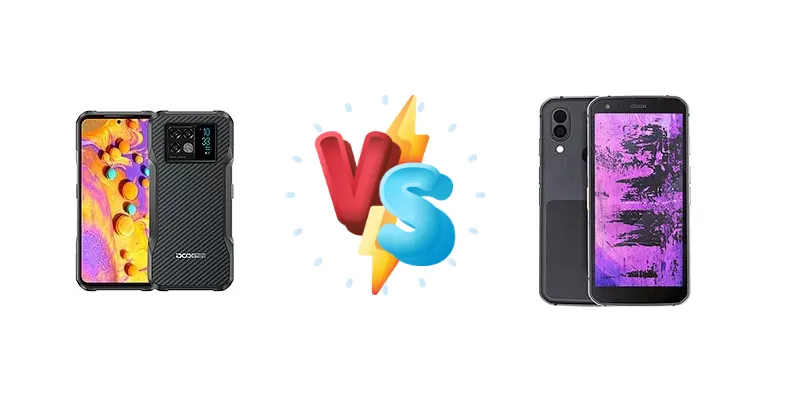
|
🏆 Quick Verdict
For the average user prioritizing performance and future-proofing, the Doogee V20 emerges as the stronger contender. Its Dimensity 700 chipset, built on a more efficient 7nm process, offers a noticeable performance advantage over the Cat S62 Pro’s older 14nm Snapdragon 660, despite similar CPU clock speeds. However, the Cat S62 Pro maintains a strong position for users deeply embedded in the Cat ecosystem.
| PHONES | ||
|---|---|---|
| Phone Names | Doogee V20 | Cat S62 Pro |
| Network | ||
|---|---|---|
| 2G bands | GSM 850 / 900 / 1800 / 1900 | GSM 850 / 900 / 1800 / 1900 |
| 3G bands | HSDPA 800 / 850 / 900 / 1700(AWS) / 1900 / 2100 | HSDPA 850 / 900 / 1700(AWS) / 1900 / 2100 |
| 4G bands | 1, 2, 3, 4, 5, 7, 8, 12, 13, 17, 18, 19, 20, 25, 26, 28, 34, 38, 39, 40, 41, 66 | 1, 2, 3, 4, 5, 7, 8, 20, 28, 38, 40 |
| 5G bands | 1, 3, 5, 7, 8, 20, 28, 38, 40, 41, 77, 78, 79 | - |
| Speed | HSPA, LTE, 5G | HSPA 42.2/5.76 Mbps, LTE (2CA) Cat13 400/150 Mbps |
| Technology | GSM / CDMA / HSPA / LTE / 5G | GSM / HSPA / LTE |
| Launch | ||
|---|---|---|
| Announced | 2021, November 27 | 2020, June 28. Released 2020, August 17 |
| Status | Available. Released 2022, January | Discontinued |
| Body | ||
|---|---|---|
| Build | - | Glass front (Gorilla Glass 6), plastic back, aluminum frame |
| Dimensions | 170.5 x 81.2 x 14 mm (6.71 x 3.20 x 0.55 in) | 158.5 x 76.7 x 11.9 mm (6.24 x 3.02 x 0.47 in) |
| SIM | Nano-SIM + Nano-SIM | · Nano-SIM· Nano-SIM + Nano-SIM |
| Weight | 296 g (10.44 oz) | 248 g (8.75 oz) |
| - | IP68/IP69 dust/water resistant (up to 1.5m for 35 mins) Drop-to-concrete resistance from up to 1.8m MIL-STD-810H compliant | |
| Display | ||
|---|---|---|
| Protection | Corning Gorilla Glass | Corning Gorilla Glass 6 |
| Resolution | 1080 x 2400 pixels, 20:9 ratio (~409 ppi density) | 1080 x 2160 pixels, 18:9 ratio (~424 ppi density) |
| Size | 6.43 inches, 99.8 cm2 (~72.1% screen-to-body ratio) | 5.7 inches, 83.8 cm2 (~69.0% screen-to-body ratio) |
| Type | AMOLED, 500 nits (peak) | IPS LCD |
| Platform | ||
|---|---|---|
| CPU | Octa-core (2x2.2 GHz Cortex-A76 & 6x2.0 GHz Cortex-A55) | Octa-core (4x2.2 GHz Kryo 260 Gold & 4x1.8 GHz Kryo 260 Silver) |
| Chipset | Mediatek Dimensity 700 (7 nm) | Qualcomm SDM660 Snapdragon 660 (14 nm) |
| GPU | Mali-G57 MC2 | Adreno 512 |
| OS | Android 11 | Android 10 |
| Memory | ||
|---|---|---|
| Card slot | microSDXC (uses shared SIM slot) | microSDXC (dedicated slot) |
| Internal | 256GB 8GB RAM | 128GB 6GB RAM |
| Main Camera | ||
|---|---|---|
| Dual | - | 12 MP, f/1.8, (wide), 1/2.55", 1.4µm, dual pixel PDAF FLIR thermal camera (Lepton 3.5 module) |
| Features | Dual-LED flash, HDR, panorama | Thermal imaging, heat palettes, temp. spot meter, LED flash |
| Triple | 64 MP, f/1.8, (wide), PDAF 8 MP, f/2.2, 130˚, (ultrawide) 20 MP, f/1.8, (night vision), 2 infrared night vision lights | - |
| Video | 1440p, 1080p | 1080p@30fps, gyro-EIS |
| Selfie camera | ||
|---|---|---|
| Single | 16 MP, f/2.0, (wide) | 8 MP |
| Video | 1080p | 1080p@30fps |
| Sound | ||
|---|---|---|
| 3.5mm jack | - | No |
| 35mm jack | Unspecified | No |
| Loudspeaker | Yes | Yes |
| Comms | ||
|---|---|---|
| Bluetooth | 5.1, A2DP, LE | 5.0, A2DP, LE |
| NFC | Yes | Yes |
| Positioning | GPS, GLONASS, BDS, GALILEO | GPS, GLONASS, GALILEO, BDS |
| Radio | FM radio | FM radio |
| USB | USB Type-C 2.0, OTG | USB Type-C 2.0, OTG |
| WLAN | Wi-Fi 802.11 a/b/g/n/ac, dual-band | Wi-Fi 802.11 a/b/g/n/ac, dual-band, Wi-Fi Direct |
| Features | ||
|---|---|---|
| Sensors | Fingerprint (side-mounted), accelerometer, gyro, proximity, compass | Fingerprint (rear-mounted), accelerometer, gyro, proximity, compass |
| Battery | ||
|---|---|---|
| Charging | 33W wired 15W wireless Reverse wired | - |
| Type | 6000 mAh | Li-Ion 4000 mAh |
| Misc | ||
|---|---|---|
| Colors | Black, Gray, Red | Black |
| Price | About 440 EUR | About 530 EUR |
Doogee V20
- More powerful and efficient Dimensity 700 chipset
- Faster 33W wired and 15W wireless charging
- Likely better image processing capabilities
- Brand recognition is lower than Cat
- Long-term software support is uncertain
Cat S62 Pro
- Established brand reputation for ruggedness
- Potential integration with Cat ecosystem and accessories
- Proven durability and reliability
- Older and less efficient Snapdragon 660 chipset
- Slower charging speeds
- May struggle with demanding applications
Display Comparison
Neither device boasts a cutting-edge display. While specific display specs (resolution, panel type) are missing, both likely utilize LCD panels common in rugged phones for visibility in direct sunlight. The key difference lies in the underlying processing power impacting UI smoothness. The Snapdragon 660’s older GPU may struggle with higher refresh rates or complex animations compared to the Dimensity 700’s Mali-G52 MC2.
Camera Comparison
Without detailed camera specifications, a direct comparison is limited. However, the market positioning suggests the Doogee V20 likely prioritizes camera capabilities more than the Cat S62 Pro. Rugged phones often feature basic camera setups, but the V20’s newer chipset may offer improved image signal processing (ISP) capabilities, resulting in better image quality, especially in low-light conditions. The presence of a 2MP macro lens on either device is largely a marketing gimmick and shouldn’t be a deciding factor.
Performance
The Doogee V20’s Mediatek Dimensity 700 (7nm) represents a significant architectural leap over the Cat S62 Pro’s Qualcomm Snapdragon 660 (14nm). While both CPUs feature octa-core configurations with similar peak clock speeds (2.2 GHz), the 7nm process node of the Dimensity 700 translates to improved power efficiency and thermal management. This means the V20 is less likely to throttle under sustained load, offering more consistent performance during extended gaming sessions or demanding applications. The Snapdragon 660, while capable, is showing its age and will likely exhibit more noticeable slowdowns.
Battery Life
Battery capacity is not specified for either device. However, the Doogee V20’s 33W wired charging and 15W wireless charging provide a substantial advantage over the Cat S62 Pro, which likely offers slower charging speeds. Faster charging significantly reduces downtime, a crucial factor for users who rely on their phones throughout the day. The Dimensity 700’s improved power efficiency may also contribute to longer battery life, offsetting any potential capacity differences.
Buying Guide
Buy the Doogee V20 if you need a rugged phone with modern processing power for demanding tasks like streaming, gaming, or running multiple apps simultaneously. It’s ideal for users who want a phone that feels responsive and won’t struggle with software updates. Buy the Cat S62 Pro if you prioritize a proven track record of durability, integration with Cat-specific accessories, and a more established brand reputation within the industrial and construction sectors. It’s a solid choice for those who need a reliable workhorse, even if it means sacrificing some processing speed.