
Doogee V20 vs Blackview BV8800: A Deep Dive into Rugged Smartphone Performance
| Phones Images | |||||
|---|---|---|---|---|---|
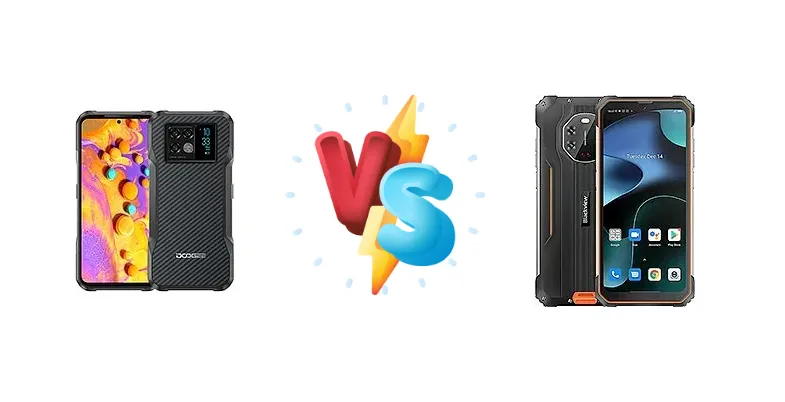
|
🏆 Quick Verdict
For most users, the Blackview BV8800 offers a more balanced package. Its exceptional 199-hour endurance rating and 33W charging provide peace of mind, outweighing the Doogee V20’s marginally faster CPU architecture. However, users prioritizing the latest chipset tech will find the V20 appealing.
| PHONES | ||
|---|---|---|
| Phone Names | Doogee V20 | Blackview BV8800 |
| Network | ||
|---|---|---|
| 2G bands | GSM 850 / 900 / 1800 / 1900 | GSM 850 / 900 / 1800 / 1900 |
| 3G bands | HSDPA 800 / 850 / 900 / 1700(AWS) / 1900 / 2100 | HSDPA 800 / 850 / 900 / 1700(AWS) / 1900 / 2100 |
| 4G bands | 1, 2, 3, 4, 5, 7, 8, 12, 13, 17, 18, 19, 20, 25, 26, 28, 34, 38, 39, 40, 41, 66 | 1, 2, 3, 4, 5, 7, 8, 12, 13, 17, 18, 19, 20, 25, 26, 28, 30, 34, 38, 39, 40, 41, 66 |
| 5G bands | 1, 3, 5, 7, 8, 20, 28, 38, 40, 41, 77, 78, 79 | - |
| Speed | HSPA, LTE, 5G | HSPA, LTE |
| Technology | GSM / CDMA / HSPA / LTE / 5G | GSM / CDMA / HSPA / CDMA2000 / LTE |
| - | CDMA2000 1x | |
| Launch | ||
|---|---|---|
| Announced | 2021, November 27 | 2021, December 24 |
| Status | Available. Released 2022, January | Available. Released 2022, January 10 |
| Body | ||
|---|---|---|
| Dimensions | 170.5 x 81.2 x 14 mm (6.71 x 3.20 x 0.55 in) | 176.2 x 83.5 x 17.7 mm (6.94 x 3.29 x 0.70 in) |
| SIM | Nano-SIM + Nano-SIM | Nano-SIM + Nano-SIM |
| Weight | 296 g (10.44 oz) | 367 g (12.95 oz) |
| - | IP68/IP69K dust/water resistant (up to 1.5m for 30 min) Drop-to-concrete resistance from up to 1.5m MIL-STD-810H compliant | |
| Display | ||
|---|---|---|
| Protection | Corning Gorilla Glass | - |
| Resolution | 1080 x 2400 pixels, 20:9 ratio (~409 ppi density) | 1080 x 2408 pixels, 20:9 ratio (~401 ppi density) |
| Size | 6.43 inches, 99.8 cm2 (~72.1% screen-to-body ratio) | 6.58 inches, 104.3 cm2 (~70.9% screen-to-body ratio) |
| Type | AMOLED, 500 nits (peak) | IPS LCD, 90Hz, 480 nits |
| Platform | ||
|---|---|---|
| CPU | Octa-core (2x2.2 GHz Cortex-A76 & 6x2.0 GHz Cortex-A55) | Octa-core (2x2.05 GHz Cortex-A76 & 6x2.0 GHz Cortex-A55) |
| Chipset | Mediatek Dimensity 700 (7 nm) | Mediatek MT6781 Helio G96 (12 nm) |
| GPU | Mali-G57 MC2 | Mali-G57 MC2 |
| OS | Android 11 | Android 11, Doke-OS 3.0 |
| Memory | ||
|---|---|---|
| Card slot | microSDXC (uses shared SIM slot) | No |
| Internal | 256GB 8GB RAM | 128GB 8GB RAM |
| - | UFS 2.1 | |
| Main Camera | ||
|---|---|---|
| Features | Dual-LED flash, HDR, panorama | Dual-LED flash, HDR, panorama |
| Quad | - | 50 MP, f/1.8, (wide), PDAF 8 MP, f/2.2, 117˚ (ultrawide) 20 MP, f/1.8, (IR camera), 2 IR emitters Auxiliary lens |
| Single | - | 16 MP, f/2.0, (wide) |
| Triple | 64 MP, f/1.8, (wide), PDAF 8 MP, f/2.2, 130˚, (ultrawide) 20 MP, f/1.8, (night vision), 2 infrared night vision lights | - |
| Video | 1440p, 1080p | 1440p@30fps |
| Selfie camera | ||
|---|---|---|
| Single | 16 MP, f/2.0, (wide) | 16 MP, f/2.0, (wide) |
| Video | 1080p | 1080p@30fps |
| Sound | ||
|---|---|---|
| 3.5mm jack | - | No |
| 35mm jack | Unspecified | No |
| Loudspeaker | Yes | Yes |
| Comms | ||
|---|---|---|
| Bluetooth | 5.1, A2DP, LE | 5.2, A2DP, LE |
| NFC | Yes | Yes |
| Positioning | GPS, GLONASS, BDS, GALILEO | GPS, GLONASS, GALILEO, BDS |
| Radio | FM radio | FM radio |
| USB | USB Type-C 2.0, OTG | USB Type-C 2.0, OTG |
| WLAN | Wi-Fi 802.11 a/b/g/n/ac, dual-band | Wi-Fi 802.11 a/b/g/n/ac |
| Features | ||
|---|---|---|
| Sensors | Fingerprint (side-mounted), accelerometer, gyro, proximity, compass | Fingerprint (side-mounted), accelerometer, gyro, proximity, compass, barometer |
| Battery | ||
|---|---|---|
| Charging | 33W wired 15W wireless Reverse wired | 33W wired, 31% in 30 min, 100% in 90 min Reverse wired |
| Type | 6000 mAh | 8380 mAh |
| Misc | ||
|---|---|---|
| Colors | Black, Gray, Red | Black, Orange, Green |
| Price | About 440 EUR | About 350 EUR |
| Tests | ||
|---|---|---|
| Battery life | - | Endurance rating 199h |
| Camera | - | Photo / Video |
| Display | - | Contrast ratio: 1348:1 (nominal) |
| Loudspeaker | - | -29.3 LUFS (Average) |
| Performance | - | AnTuTu: 254849 (v8), 288964 (v9) GeekBench: 1752 (v5.1) GFXBench: 10fps (ES 3.1 onscreen) |
Doogee V20
- More modern chipset architecture (Dimensity 700)
- Faster CPU clock speeds
- Wireless charging support
- No specified battery endurance rating
- Limited camera details
Blackview BV8800
- Exceptional 199-hour battery endurance
- High peak brightness (501 nits)
- Fast 33W wired charging
- Older chipset (Helio G96)
- Less future-proof architecture
Display Comparison
Both the Doogee V20 and Blackview BV8800 share a contrast ratio of 1348:1, suggesting similar visual depth. However, the Blackview BV8800’s measured peak brightness of 501 nits is a crucial advantage, ensuring better visibility in direct sunlight – a common scenario for rugged phone users. While panel technology isn’t specified, the brightness difference suggests the BV8800’s display is optimized for outdoor use. Bezels are not specified, so a visual comparison is needed to determine which device offers a more immersive experience.
Camera Comparison
Both devices list 'Photo / Video' capabilities, but lack specific details regarding sensor size, aperture, or image stabilization. Without this information, a meaningful comparison is difficult. The absence of details suggests neither phone is positioned as a photography powerhouse. The presence of a 2MP macro camera on either device is likely a marketing feature with limited practical benefit, given the small sensor size and limited image quality. Focusing on the main sensor specifications would be crucial for a proper camera assessment.
Performance
The Doogee V20’s Mediatek Dimensity 700 (7nm) represents a more modern architecture than the Blackview BV8800’s Helio G96 (12nm). The 7nm process generally translates to improved power efficiency and thermal performance. While both CPUs feature an octa-core configuration with 2x Cortex-A76 and 6x Cortex-A55 cores, the Dimensity 700’s higher clock speeds (2.2 GHz vs 2.05 GHz) suggest a slight edge in raw processing power. However, the real-world impact will depend on software optimization and thermal throttling. The BV8800’s G96 is a capable chip, but the V20’s newer architecture offers a potential advantage for future software updates and demanding applications.
Battery Life
The Blackview BV8800’s standout feature is its exceptional battery endurance, rated at 199 hours. This significantly surpasses what is typically expected from a smartphone, making it ideal for extended use away from power outlets. Both phones support 33W wired charging, with the BV8800 achieving 31% charge in 30 minutes and 100% in 90 minutes. The Doogee V20 offers 33W wired and 15W wireless charging, adding convenience, but the BV8800’s longer runtime is a more significant benefit for the target audience.
Buying Guide
Buy the Doogee V20 if you need a phone with a more modern chipset for potentially smoother multitasking and future software support. This is ideal for users who frequently switch between apps or anticipate needing longer-term performance. Buy the Blackview BV8800 if you prioritize all-day (and multi-day) battery life and a proven track record of durability. This is the better choice for those working in remote locations or engaging in extended outdoor activities where charging isn't readily available.