
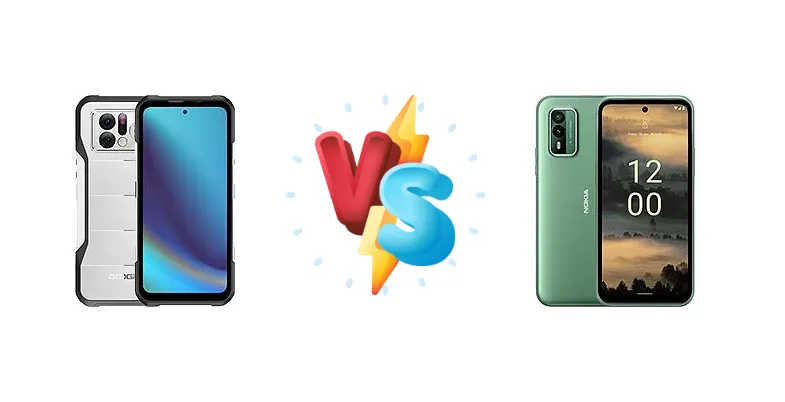
Doogee V20 Pro vs Nokia XR21: A Head-to-Head Rugged Smartphone Showdown
| Phones Images | |||||
|---|---|---|---|---|---|
|
🏆 Quick Verdict
For most users prioritizing a balance of performance and affordability, the Nokia XR21 emerges as the better choice. Its Snapdragon 695, built on a more efficient 6nm process, offers a slight edge in power efficiency and potentially sustained performance, coupled with broader charging compatibility. The Doogee V20 Pro remains a viable option for those seeking a lower entry price.
| PHONES | ||
|---|---|---|
| Phone Names | Doogee V20 Pro | Nokia XR21 |
| Network | ||
|---|---|---|
| 2G bands | GSM 850 / 900 / 1800 / 1900 | GSM 850 / 900 / 1800 / 1900 |
| 3G bands | HSDPA 800 / 850 / 900 / 1700(AWS) / 1900 / 2100 | HSDPA 850 / 900 / 1700(AWS) / 1900 / 2100 |
| 4G bands | 1, 2, 3, 4, 5, 7, 8, 12, 13, 17, 18, 19, 20, 25, 26, 28, 34, 38, 39, 40, 41, 66 | 1, 2, 3, 4, 5, 7, 8, 12, 13, 17, 20, 25, 26, 28, 32, 38, 39, 40, 41, 42, 43, 48, 66, 71 |
| 5G bands | 1, 3, 5, 7, 8, 20, 28, 38, 40, 41, 77, 78, 79 | 1, 2, 3, 5, 7, 20, 25, 28, 40, 41, 66, 71, 77, 78, 79 SA/NSA |
| Speed | HSPA, LTE, 5G | HSPA, LTE, 5G |
| Technology | GSM / CDMA / HSPA / LTE / 5G | GSM / HSPA / LTE / 5G |
| Launch | ||
|---|---|---|
| Announced | 2023, May 28 | 2023, May 03 |
| Status | Available. Released 2023, June 01 | Available. Released 2023, June 11 |
| Body | ||
|---|---|---|
| Build | - | Glass front (Gorilla Glass Victus), plastic back, plastic frame |
| Dimensions | 170.5 x 81.2 x 14 mm (6.71 x 3.20 x 0.55 in) | 168 x 78.6 x 10.5 mm (6.61 x 3.09 x 0.41 in) |
| SIM | Nano-SIM + Nano-SIM | Nano-SIM + Nano-SIM + eSIM (max 2 at a time) |
| Weight | 296 g (10.44 oz) | 231 g (8.15 oz) |
| - | IP68/IP69K dust/water resistant (up to 1.5m for 60 min) Drop-to-concrete resistance from up to 1.8m MIL-STD-810H compliant | |
| Display | ||
|---|---|---|
| Protection | Corning Gorilla Glass 5 | Corning Gorilla Glass Victus |
| Resolution | 1080 x 2400 pixels, 20:9 ratio (~409 ppi density) | 1080 x 2400 pixels, 20:9 ratio (~406 ppi density) |
| Size | 6.43 inches, 99.8 cm2 (~72.1% screen-to-body ratio) | 6.49 inches, 101.7 cm2 (~77.0% screen-to-body ratio) |
| Type | AMOLED, 500 nits (peak) | IPS LCD, 120Hz, 450 nits (typ), 550 nits (HBM) |
| Platform | ||
|---|---|---|
| CPU | Octa-core (2x2.2 GHz Cortex-A76 & 6x2.0 GHz Cortex-A55) | Octa-core (2x2.2 GHz Kryo 660 Gold & 6x1.7 GHz Kryo 660 Silver) |
| Chipset | Mediatek Dimensity 700 (7 nm) | Qualcomm SM6375 Snapdragon 695 5G (6 nm) |
| GPU | Mali-G57 MC2 | Adreno 619 |
| OS | Android 12 | Android 12 |
| Memory | ||
|---|---|---|
| Card slot | microSDXC (uses shared SIM slot) | Unspecified |
| Internal | 256GB 12GB RAM | 128GB 6GB RAM |
| Main Camera | ||
|---|---|---|
| Dual | - | 64 MP, f/1.8, (wide), 1/2.0", PDAF 8 MP, f/2.2, (ultrawide), 1/4.0", 1.12µm |
| Features | Dual-LED flash, HDR, panorama | Dual-LED dual-tone flash, second LED flash, HDR, panorama |
| Triple | 64 MP, f/1.8, (wide), PDAF, OIS 8 MP, f/1.8, (wide) 24 MP, f/1.8, (night vision), 2 infrared night vision lights | - |
| Video | 1440p, 1080p | 1080p@30fps |
| Selfie camera | ||
|---|---|---|
| Single | 16 MP, f/2.0, (wide) | 16 MP, f/2.4 (wide) |
| Video | 1440p, 1080p | 1080p@30fps |
| Sound | ||
|---|---|---|
| 3.5mm jack | - | Yes |
| 35mm jack | Unspecified | Yes |
| Loudspeaker | Yes | Yes, with stereo speakers |
| Comms | ||
|---|---|---|
| Bluetooth | 5.1, A2DP, LE | 5.1, A2DP, LE, aptX Adaptive |
| NFC | Yes | Yes (market/region dependent) |
| Positioning | GPS, GLONASS, BDS, GALILEO | GPS (L1+L5), GLONASS (G1), BDS (B1I+B1c+B2a), GALILEO (E1+E5a), QZSS (L1+L5), NavIC (L5) |
| Radio | FM radio | Unspecified |
| USB | USB Type-C 2.0, OTG | USB Type-C 2.0, OTG |
| WLAN | Wi-Fi 802.11 a/b/g/n/ac, dual-band | Wi-Fi 802.11 a/b/g/n/ac/6, dual-band |
| Features | ||
|---|---|---|
| Sensors | Fingerprint (side-mounted), accelerometer, gyro, proximity, compass | Fingerprint (side-mounted), accelerometer, gyro, proximity, compass, barometer |
| Battery | ||
|---|---|---|
| Charging | 33W wired Reverse wired | 33W wired, PD2.0, QC3 |
| Type | 6000 mAh | Li-Po 4800 mAh |
| Misc | ||
|---|---|---|
| Colors | Black, Silver, Orange, Blue | Midnight Black, Pine Green |
| Price | About 460 EUR | About 570 EUR |
Doogee V20 Pro
- More affordable price point
- Rugged design for durability
- Reverse wired charging capability
- Less efficient 7nm chipset
- Potentially lower sustained performance
- Limited charging standard support
Nokia XR21
- More efficient 6nm chipset
- PD2.0 and QC3 fast charging support
- Potentially better sustained performance
- Higher price compared to Doogee V20 Pro
- Rugged design may not be significantly different
- No reverse wireless charging
Display Comparison
Neither Doogee nor Nokia provide display specs beyond resolution. However, the choice of chipset suggests potential differences in graphics rendering. The XR21's Snapdragon 695, with its Adreno 619 GPU, likely delivers a smoother experience for casual gaming and video playback compared to the V20 Pro's Dimensity 700 and its Mali-G52 MC2. The lack of high refresh rate panels on both devices suggests a focus on battery life over visual fluidity.
Camera Comparison
Without detailed camera specifications, a direct comparison is difficult. However, the market positioning of Nokia typically emphasizes image processing and color accuracy. While the Doogee V20 Pro may offer competitive hardware, the Nokia XR21 likely delivers more consistent and natural-looking photos, particularly in challenging lighting conditions. The absence of information regarding sensor size and OIS makes it impossible to definitively declare a winner, but Nokia's software optimization is a key differentiator.
Performance
The core difference lies in the chipsets: Mediatek Dimensity 700 (7nm) versus Qualcomm Snapdragon 695 (6nm). While both feature octa-core CPUs with similar peak clock speeds (2.2 GHz), the Snapdragon 695 benefits from a smaller 6nm fabrication process. This translates to improved power efficiency and potentially better thermal management under sustained load. The Snapdragon's Kryo 660 Gold cores are also architecturally more modern than the Cortex-A76 in the Dimensity 700, offering a slight performance advantage in single-core tasks. The XR21 is likely to handle multitasking and moderately demanding apps with greater ease.
Battery Life
Both devices feature 33W wired charging, but the Nokia XR21 adds support for PD2.0 and QC3, offering broader compatibility with chargers and potentially faster charging speeds in certain scenarios. While battery capacity isn't specified, the Snapdragon 695's 6nm process contributes to better power efficiency, potentially offsetting any capacity differences. The XR21's charging standards provide more flexibility for users with existing fast chargers.
Buying Guide
Buy the Doogee V20 Pro if you need a highly affordable rugged phone and aren't heavily reliant on demanding applications. It's ideal for basic communication, navigation, and occasional photography in harsh environments. Buy the Nokia XR21 if you prefer a more refined user experience, faster charging standards (PD2.0, QC3), and a chipset that offers a slight advantage in sustained performance for moderate multitasking and gaming.