
Doogee V11 vs. Ulefone Armor 9E: A Deep Dive into Rugged Smartphone Performance
| Phones Images | |||||
|---|---|---|---|---|---|
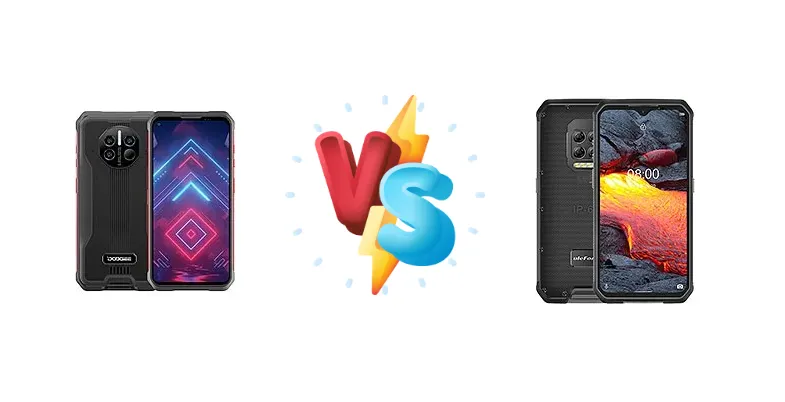
|
🏆 Quick Verdict
For users prioritizing speed and future-proofing, the Doogee V11 is the clear winner. Its Dimensity 700 chipset offers a noticeable performance advantage over the Ulefone Armor 9E’s Helio P90, coupled with significantly faster 65W charging. However, the 9E remains a viable option for those on a tighter budget or who prioritize efficiency.
| PHONES | ||
|---|---|---|
| Phone Names | Doogee V11 | Ulefone Armor 9E |
| Network | ||
|---|---|---|
| 2G bands | GSM 850 / 900 / 1800 / 1900 | GSM 850 / 900 / 1800 / 1900 |
| 3G bands | HSDPA 800 / 850 / 900 / 1700(AWS) / 1900 / 2100 | HSDPA 850 / 900 / 1700(AWS) / 1900 / 2100 |
| 4G bands | 1, 2, 3, 4, 5, 7, 8, 12, 13, 17, 18, 19, 20, 25, 26, 28, 34, 38, 39, 40, 41, 66 | 1, 2, 3, 4, 5, 7, 8, 12, 13, 17, 18, 19, 20, 25, 26, 28, 34, 38, 39, 40, 41, 66 |
| 5G bands | 1, 3, 5, 7, 8, 20, 28, 38, 40, 41, 77, 78, 79 | - |
| Speed | HSPA, LTE, 5G | HSPA 42.2/11.5 Mbps, LTE Cat12 600/150 Mbps |
| Technology | GSM / CDMA / HSPA / LTE / 5G | GSM / CDMA / HSPA / EVDO / LTE |
| - | CDMA2000 1xEV-DO | |
| Launch | ||
|---|---|---|
| Announced | 2022, July 15 | 2020, September 08. Released 2020, September 08 |
| Status | Available. Released 2022, July | Discontinued |
| Body | ||
|---|---|---|
| Build | - | Front glass, aluminum back with rubber, aluminum frame |
| Dimensions | 169.3 x 81.2 x 16.1 mm (6.67 x 3.20 x 0.63 in) | 168.2 x 82 x 15 mm (6.62 x 3.23 x 0.59 in) |
| SIM | Nano-SIM + Nano-SIM | Nano-SIM + Nano-SIM |
| Weight | 340 g (11.99 oz) | 324 g (11.43 oz) |
| - | IP68/IP69K dust/water resistant (up to 1.5m for 30 min) Drop-to-concrete resistance from up to 1.2m MIL-STD-810G compliant | |
| Display | ||
|---|---|---|
| Protection | Corning Gorilla Glass | Scratch-resistant glass, oleophobic coating |
| Resolution | 720 x 1560 pixels, 19.5:9 ratio (~269 ppi density) | 1080 x 2340 pixels, 19.5:9 ratio (~409 ppi density) |
| Size | 6.39 inches, 100.2 cm2 (~72.9% screen-to-body ratio) | 6.3 inches, 97.4 cm2 (~70.6% screen-to-body ratio) |
| Type | IPS LCD | IPS LCD |
| Platform | ||
|---|---|---|
| CPU | Octa-core (2x2.2 GHz Cortex-A76 & 6x2.0 GHz Cortex-A55) | Octa-core (2x2.2 GHz Cortex-A75 & 6x2.0 GHz Cortex-A55) |
| Chipset | Mediatek Dimensity 700 (7 nm) | Mediatek MT6779 Helio P90 (12 nm) |
| GPU | Mali-G57 MC2 | PowerVR GM9446 |
| OS | Android 11 | Android 10 |
| Memory | ||
|---|---|---|
| Card slot | Unspecified | microSDXC (uses shared SIM slot) |
| Internal | 128GB 8GB RAM | 128GB 8GB RAM |
| - | UFS 2.1 | |
| Main Camera | ||
|---|---|---|
| Features | Dual-LED flash, HDR, panorama | Quad-LED flash, HDR, panorama |
| Quad | - | 64 MP, f/1.9, 26mm (wide), 1/1.72", 0.8µm, PDAF 8 MP, f/2.4, 100˚ (ultrawide), 1/4.0", 1.12µm 2 MP (macro) Auxiliary lens |
| Triple | 48 MP, f/1.8, (wide), PDAF 8 MP, f/2.2, 130˚, (ultrawide) Auxiliary lens | - |
| Video | 1440p, 1080p | 4K@30fps, 1080p@30fps |
| Selfie camera | ||
|---|---|---|
| Features | - | HDR, panorama |
| Single | 16 MP, f/2.0, (wide) | 8 MP, f/2.2 |
| Video | 1080p | 1080p@30fps |
| Sound | ||
|---|---|---|
| 3.5mm jack | - | Yes |
| 35mm jack | No | Yes |
| Loudspeaker | Yes | Yes |
| Comms | ||
|---|---|---|
| Bluetooth | 5.2, A2DP, LE | 5.0, A2DP, LE |
| NFC | Yes | Yes |
| Positioning | GPS, GLONASS, BDS, GALILEO | GPS, GLONASS, GALILEO, BDS |
| Radio | FM radio | FM radio, RDS, recording |
| USB | USB Type-C 2.0, OTG | USB Type-C 2.0, OTG, accessory connector |
| WLAN | Wi-Fi 802.11 a/b/g/n/ac, dual-band | Wi-Fi 802.11 a/b/g/n/ac, Wi-Fi Direct |
| Features | ||
|---|---|---|
| Sensors | Fingerprint (side-mounted), accelerometer, gyro, proximity, compass, infrared thermometer (surface temperature) | Fingerprint (side-mounted), accelerometer, gyro, proximity, compass, coulombmeter |
| - | Endoscope mount (camera sold separately) | |
| Battery | ||
|---|---|---|
| Charging | 65W wired 10W wireless Reverse wired | 18W wired |
| Type | 8500 mAh | Li-Po 6600 mAh |
| Misc | ||
|---|---|---|
| Colors | Black, Orange, Red | Black |
| Price | About 350 EUR | About 290 EUR |
Doogee V11
- Faster processor (Dimensity 700)
- 65W fast charging
- Wireless and reverse charging support
- Potentially higher price
- Rugged design may add bulk
Ulefone Armor 9E
- More affordable price point
- Decent performance for everyday tasks
- Rugged and durable build
- Slower processor (Helio P90)
- Slow 18W charging
- Lacks wireless charging
Display Comparison
Neither device's display specifications are provided, so a direct comparison is limited. However, given the Armor 9E's older chipset, it's likely to feature an LCD panel, while the V11 *could* potentially have a more modern IPS LCD. The absence of details like resolution, refresh rate, and peak brightness makes it difficult to assess visual quality. Bezels are likely to be substantial on both, given the ruggedized design requirements.
Camera Comparison
Without specific camera sensor details, a detailed comparison is challenging. However, the market positioning of these devices suggests the V11 likely benefits from more advanced image processing capabilities due to its newer chipset. The Helio P90, while capable, lacks the dedicated image signal processor (ISP) advancements found in newer Mediatek chips. The presence of a 2MP macro lens on the Armor 9E is a common, but often underwhelming, feature; its utility is limited by the small sensor size and lack of optical image stabilization (OIS).
Performance
The Doogee V11’s Mediatek Dimensity 700 (7nm) represents a significant architectural leap over the Ulefone Armor 9E’s Helio P90 (12nm). The Dimensity 700 utilizes newer Cortex-A76 cores alongside A55 efficiency cores, offering superior single-core and multi-core performance. The 7nm process node also translates to better power efficiency and reduced thermal throttling under sustained loads. While both CPUs feature a 2x2.2 GHz core configuration, the A76 cores in the Dimensity 700 are demonstrably faster than the A75 cores in the Helio P90. This benefits users who engage in gaming, video editing, or other processor-intensive activities.
Battery Life
The Doogee V11’s 65W wired charging is a game-changer compared to the Ulefone Armor 9E’s 18W charging. This translates to significantly faster top-up times, reducing downtime. While battery capacity isn't specified, the faster charging speed of the V11 mitigates the impact of a potentially smaller battery. The V11 also includes 10W wireless charging and reverse wired charging, features absent on the Armor 9E, adding to its convenience.
Buying Guide
Buy the Doogee V11 if you need a rugged phone capable of handling demanding tasks like gaming or running multiple apps simultaneously, and if fast charging is a priority. You'll benefit from a more responsive experience and less downtime. Buy the Ulefone Armor 9E if you prefer a more budget-friendly option that still offers excellent durability and a decent level of performance for everyday tasks, and aren't concerned about having the absolute fastest charging speeds.