
Doogee V11 vs. Samsung Galaxy XCover Pro: A Deep Dive into Rugged Performance
| Phones Images | |||||
|---|---|---|---|---|---|
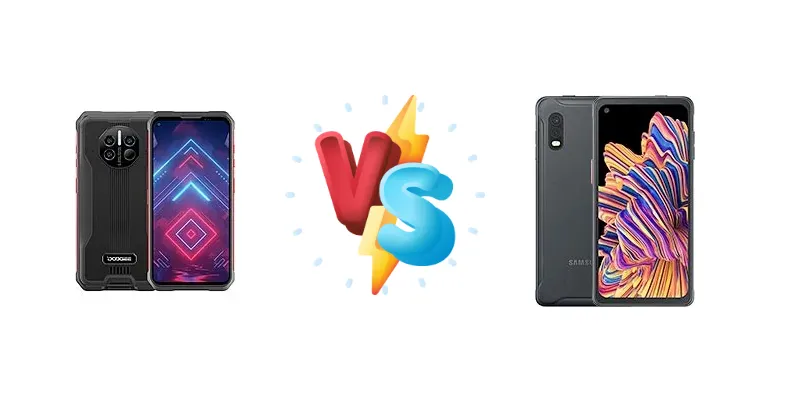
|
🏆 Quick Verdict
For most users prioritizing performance and charging speed, the Doogee V11 emerges as the winner. Its Mediatek Dimensity 700 chipset and 65W charging significantly outperform the Samsung Galaxy XCover Pro’s aging Exynos 9611 and slow 15W charging. However, Samsung’s software support and enterprise features remain compelling for specific professional use cases.
| PHONES | ||
|---|---|---|
| Phone Names | Doogee V11 | Samsung Galaxy XCover Pro |
| Network | ||
|---|---|---|
| 2G bands | GSM 850 / 900 / 1800 / 1900 | GSM 850 / 900 / 1800 / 1900 |
| 3G bands | HSDPA 800 / 850 / 900 / 1700(AWS) / 1900 / 2100 | HSDPA 850 / 900 / 1900 / 2100 - International |
| 4G bands | 1, 2, 3, 4, 5, 7, 8, 12, 13, 17, 18, 19, 20, 25, 26, 28, 34, 38, 39, 40, 41, 66 | 1, 2, 3, 5, 7, 8, 20, 28, 38, 40, 41 - International |
| 5G bands | 1, 3, 5, 7, 8, 20, 28, 38, 40, 41, 77, 78, 79 | - |
| Speed | HSPA, LTE, 5G | HSPA 42.2/5.76 Mbps, LTE (3CA) Cat11 600/50 Mbps |
| Technology | GSM / CDMA / HSPA / LTE / 5G | GSM / HSPA / LTE |
| - | 1, 2, 3, 4, 5, 7, 12, 13, 14, 20, 29, 38, 40, 41, 66 - Canada | |
| Launch | ||
|---|---|---|
| Announced | 2022, July 15 | 2020, January |
| Status | Available. Released 2022, July | Available. Released 2020, January |
| Body | ||
|---|---|---|
| Dimensions | 169.3 x 81.2 x 16.1 mm (6.67 x 3.20 x 0.63 in) | 159.9 x 76.7 x 10 mm (6.30 x 3.02 x 0.39 in) |
| SIM | Nano-SIM + Nano-SIM | · Nano-SIM· Nano-SIM + Nano-SIM |
| Weight | 340 g (11.99 oz) | 218 g (7.69 oz) |
| - | IP68 dust/water resistant (up to 1.5m for 35 min) Drop-to-concrete resistance from up to 1.5m MIL-STD-810G compliant* *does not guarantee ruggedness or use in extreme conditions | |
| Display | ||
|---|---|---|
| Protection | Corning Gorilla Glass | Corning Gorilla Glass 5 |
| Resolution | 720 x 1560 pixels, 19.5:9 ratio (~269 ppi density) | 1080 x 2340 pixels, 19.5:9 ratio (~409 ppi density) |
| Size | 6.39 inches, 100.2 cm2 (~72.9% screen-to-body ratio) | 6.3 inches, 97.4 cm2 (~79.4% screen-to-body ratio) |
| Type | IPS LCD | IPS LCD |
| Platform | ||
|---|---|---|
| CPU | Octa-core (2x2.2 GHz Cortex-A76 & 6x2.0 GHz Cortex-A55) | Octa-core (4x2.3 GHz Cortex-A73 & 4x1.7 GHz Cortex-A53) |
| Chipset | Mediatek Dimensity 700 (7 nm) | Exynos 9611 (10 nm) |
| GPU | Mali-G57 MC2 | Mali-G72 MP3 |
| OS | Android 11 | Android 10, upgradable to Android 13, One UI 5 |
| Memory | ||
|---|---|---|
| Card slot | Unspecified | microSDXC (dedicated slot) |
| Internal | 128GB 8GB RAM | 64GB 4GB RAM |
| Main Camera | ||
|---|---|---|
| Dual | - | 25 MP, f/1.7, 26mm (wide), PDAF 8 MP, f/2.2, 123˚ (ultrawide), 1/4.0", 1.12µm |
| Features | Dual-LED flash, HDR, panorama | Dual-LED flash, HDR, panorama |
| Triple | 48 MP, f/1.8, (wide), PDAF 8 MP, f/2.2, 130˚, (ultrawide) Auxiliary lens | - |
| Video | 1440p, 1080p | 1080p@30fps |
| Selfie camera | ||
|---|---|---|
| Features | - | HDR |
| Single | 16 MP, f/2.0, (wide) | 13 MP, f/2.0, (wide), 1/3.1", 1.12µm |
| Video | 1080p | 1080p@30fps |
| Sound | ||
|---|---|---|
| 3.5mm jack | - | Yes |
| 35mm jack | No | Yes |
| Loudspeaker | Yes | Yes |
| Comms | ||
|---|---|---|
| Bluetooth | 5.2, A2DP, LE | 5.0, A2DP, LE |
| NFC | Yes | Yes |
| Positioning | GPS, GLONASS, BDS, GALILEO | GPS, GLONASS, GALILEO, BDS |
| Radio | FM radio | FM radio (market/region dependent) |
| USB | USB Type-C 2.0, OTG | USB Type-C 2.0 |
| WLAN | Wi-Fi 802.11 a/b/g/n/ac, dual-band | Wi-Fi 802.11 a/b/g/n/ac/k/v/r, dual-band, Wi-Fi Direct |
| Features | ||
|---|---|---|
| Sensors | Fingerprint (side-mounted), accelerometer, gyro, proximity, compass, infrared thermometer (surface temperature) | Fingerprint (side-mounted), accelerometer, gyro, proximity, compass |
| - | ANT+ | |
| Battery | ||
|---|---|---|
| Charging | 65W wired 10W wireless Reverse wired | 15W wired |
| Type | 8500 mAh | Li-Po 4050 mAh, removable |
| Misc | ||
|---|---|---|
| Colors | Black, Orange, Red | Black |
| Models | - | SM-G715FN/DS, SM-G715FN, SM-G715F, SM-G715W, SM-G715U, SM-G715U1 |
| Price | About 350 EUR | About 120 EUR |
| SAR EU | - | 0.47 W/kg (head) 1.23 W/kg (body) |
Doogee V11
- Significantly faster 65W charging
- More modern and efficient Dimensity 700 chipset
- Potentially better value for money
- Wireless and reverse wired charging
- Less established brand reputation
- Software update support may be limited
Samsung Galaxy XCover Pro
- Samsung’s Knox security platform
- Long-term software support (potentially)
- Established brand reliability
- Enterprise-focused features
- Slow 15W charging
- Outdated Exynos 9611 chipset
- Lower performance compared to the V11
- Higher price point
Display Comparison
Neither device boasts a cutting-edge display. Details on panel type (IPS vs AMOLED) and resolution are missing for both, but both are likely to be 1080p+ to maintain usability. The focus here is on durability, not visual fidelity. The lack of high refresh rates is expected in this segment. The XCover Pro’s display is likely optimized for outdoor visibility, a common Samsung trait, but without specific nit brightness data, it’s difficult to quantify. The V11’s display is likely adequate, but the XCover Pro may have a slight edge in real-world outdoor usability.
Camera Comparison
Camera details beyond sensor counts are scarce, but the focus on ruggedness suggests image quality isn’t the primary selling point. Both phones likely feature a main sensor, ultrawide, and potentially a depth or macro lens. The V11’s camera system is likely geared towards quick snapshots, while the XCover Pro may offer more refined image processing, typical of Samsung’s software. Without specific aperture and sensor size data, it’s difficult to declare a clear winner. The 2MP macro lens found on many phones in this class, including potentially both, offers limited practical benefit.
Performance
The Doogee V11’s Mediatek Dimensity 700 (7nm) represents a significant architectural advantage over the Samsung Galaxy XCover Pro’s Exynos 9611 (10nm). The Dimensity 700 utilizes newer Cortex-A76 cores, offering superior single-core performance compared to the XCover Pro’s Cortex-A73 cores. This translates to snappier app launches and smoother multitasking. The 7nm process node also contributes to better power efficiency. While both are octa-core CPUs, the architectural differences mean the V11 will handle demanding applications and sustained workloads more effectively. The XCover Pro’s older chipset will likely exhibit more noticeable throttling under prolonged stress.
Battery Life
The battery capacity is not specified for either device, but the charging capabilities highlight a major difference. The Doogee V11’s 65W wired charging is a game-changer, promising a full charge in under an hour. It also includes 10W wireless and reverse wired charging for added convenience. The Samsung Galaxy XCover Pro’s 15W wired charging is comparatively slow, requiring significantly longer to reach 100%. Even with a potentially larger battery capacity on the XCover Pro, the V11’s faster charging mitigates concerns about battery life for users who need to quickly top up their device.
Buying Guide
Buy the Doogee V11 if you need a rugged phone with snappy performance for everyday tasks and faster charging to minimize downtime. It’s ideal for outdoor enthusiasts, construction workers, or anyone who frequently finds themselves in harsh conditions and values speed. Buy the Samsung Galaxy XCover Pro if you prioritize long-term software support, Samsung’s Knox security platform for enterprise deployment, and a more established brand reputation, even if it means sacrificing processing power and charging convenience.