
Doogee V10 vs. Samsung Galaxy XCover 5: A Rugged Smartphone Showdown
| Phones Images | |||||
|---|---|---|---|---|---|
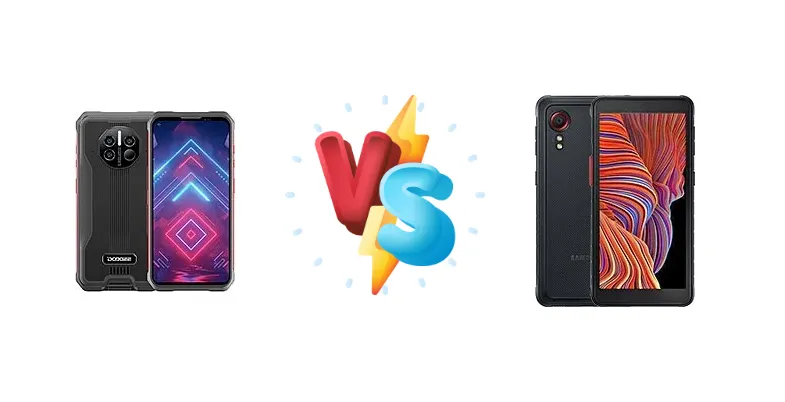
|
🏆 Quick Verdict
For users prioritizing raw performance and faster charging, the Doogee V10 is the clear winner. Its Dimensity 700 chipset offers a noticeable speed advantage. However, the Samsung Galaxy XCover 5 provides a more refined user experience and benefits from Samsung’s software support, making it ideal for those valuing reliability and ecosystem integration.
| PHONES | ||
|---|---|---|
| Phone Names | Doogee V10 | Samsung Galaxy XCover 5 |
| Network | ||
|---|---|---|
| 2G bands | GSM 850 / 900 / 1800 / 1900 | GSM 850 / 900 / 1800 / 1900 |
| 3G bands | HSDPA 800 / 850 / 900 / 1700(AWS) / 1900 / 2100 | HSDPA 850 / 900 / 1700(AWS) / 1900 / 2100 |
| 4G bands | 1, 2, 3, 4, 5, 7, 8, 12, 13, 17, 18, 19, 20, 25, 26, 28, 34, 38, 39, 40, 41, 66 | 1, 2, 3, 4, 5, 7, 8, 12, 17, 20, 26, 28, 38, 40, 41, 66 |
| 5G bands | 1, 3, 5, 7, 8, 20, 28, 38, 40, 41, 77, 78, 79 | - |
| Speed | HSPA, LTE, 5G | HSPA, LTE |
| Technology | GSM / CDMA / HSPA / LTE / 5G | GSM / HSPA / LTE |
| Launch | ||
|---|---|---|
| Announced | 2021, August 02 | 2021, March 04 |
| Status | Available. Released 2021, August | Available. Released 2021, March 12 |
| Body | ||
|---|---|---|
| Dimensions | 169.3 x 81.2 x 16.1 mm (6.67 x 3.20 x 0.63 in) | 147.1 x 71.6 x 9.2 mm (5.79 x 2.82 x 0.36 in) |
| SIM | Nano-SIM + Nano-SIM | · Nano-SIM· Nano-SIM + Nano-SIM |
| Weight | 340 g (11.99 oz) | 172 g (6.07 oz) |
| - | IP68 dust/water resistant (up to 1.5m for 30 min) MIL-STD-810H compliant | |
| Display | ||
|---|---|---|
| Protection | Corning Gorilla Glass | - |
| Resolution | 720 x 1560 pixels, 19.5:9 ratio (~269 ppi density) | 720 x 1480 pixels, 18.5:9 ratio (~311 ppi density) |
| Size | 6.39 inches, 100.2 cm2 (~72.9% screen-to-body ratio) | 5.3 inches, 71.3 cm2 (~67.7% screen-to-body ratio) |
| Type | IPS LCD | PLS LCD |
| Platform | ||
|---|---|---|
| CPU | Octa-core (2x2.2 GHz Cortex-A76 & 6x2.0 GHz Cortex-A55) | Octa-core (4x2.0 GHz Cortex-A55 & 4x2.0 GHz Cortex-A55) |
| Chipset | Mediatek Dimensity 700 (7 nm) | Exynos 850 (8 nm) |
| GPU | Mali-G57 MC2 | Mali-G52 |
| OS | Android 11 | Android 11, upgradable to Android 14, One UI 6.1 |
| Memory | ||
|---|---|---|
| Card slot | Unspecified | microSDXC (dedicated slot) |
| Internal | 128GB 8GB RAM | 64GB 4GB RAM |
| - | eMMC 5.1 | |
| Main Camera | ||
|---|---|---|
| Features | Dual-LED flash, HDR, panorama | Dual LED flash, HDR, panorama |
| Single | - | 16 MP, f/1.8, PDAF |
| Triple | 48 MP, f/1.8, (wide), PDAF 8 MP, f/2.2, 130˚, (ultrawide) Auxiliary lens | - |
| Video | 1440p, 1080p | 1080p@30fps |
| Selfie camera | ||
|---|---|---|
| Single | 16 MP, f/2.0, (wide) | 5 MP, f/2.2 |
| Video | 1080p | - |
| Sound | ||
|---|---|---|
| 3.5mm jack | - | Yes |
| 35mm jack | No | Yes |
| Loudspeaker | Yes | Yes |
| Comms | ||
|---|---|---|
| Bluetooth | 5.2, A2DP, LE | 5.0, A2DP, LE |
| NFC | Yes | Yes |
| Positioning | GPS, GLONASS, BDS, GALILEO | GPS, GLONASS, GALILEO, BDS |
| Radio | FM radio | Unspecified |
| USB | USB Type-C 2.0, OTG | USB Type-C 2.0, charging connector pins |
| WLAN | Wi-Fi 802.11 a/b/g/n/ac, dual-band | Wi-Fi 802.11 a/b/g/n/ac, dual-band, Wi-Fi Direct |
| Features | ||
|---|---|---|
| Sensors | Fingerprint (side-mounted), accelerometer, gyro, proximity, compass, infrared thermometer (surface temperature) | Accelerometer, gyro, proximity, compass |
| Battery | ||
|---|---|---|
| Charging | 33W wired, 45% in 30 min 10W wireless Reverse wired | 15W wired |
| Type | 8500 mAh | Li-Ion 3000 mAh, removable |
| Misc | ||
|---|---|---|
| Colors | Black, Orange, Red | Black |
| Models | - | SM-G525F, SM-G525F/DS, SM-G525N |
| Price | About 350 EUR | £ 61.49 / € 74.89 |
| SAR EU | - | 0.70 W/kg (head) 1.27 W/kg (body) |
Doogee V10
- Faster processor for demanding tasks
- Significantly faster 33W charging
- Wireless and reverse wired charging support
- Less established brand reputation
- Software updates may be less frequent
Samsung Galaxy XCover 5
- Samsung’s reliable software and updates
- Efficient processor for all-day battery life
- Established ecosystem and accessory compatibility
- Slower 15W charging
- Less powerful processor for intensive tasks
Display Comparison
Neither device boasts a cutting-edge display. Both likely utilize LCD panels, common in rugged phones for their durability. While specific nit brightness isn't provided, the XCover 5's focus on outdoor visibility suggests a potentially brighter panel. The V10's display specs are unknown, but the XCover 5 benefits from Samsung's color calibration expertise, likely offering more accurate colors. Bezels are expected to be substantial on both, prioritizing screen protection over a modern, edge-to-edge design.
Camera Comparison
Without detailed camera specs, a direct comparison is difficult. However, the market positioning suggests the XCover 5 will likely offer more refined image processing. Both phones likely feature a primary camera for general photography, but the V10's chipset may allow for faster image processing. The inclusion of a 2MP macro camera on either device is largely a marketing tactic, offering limited practical benefit due to the small sensor size and lack of optical image stabilization (OIS). The XCover 5’s Samsung image processing algorithms are generally well-regarded for producing natural-looking photos.
Performance
The core difference lies in the chipsets. The Doogee V10’s Mediatek Dimensity 700 (7nm) offers a significant architectural advantage over the Samsung Galaxy XCover 5’s Exynos 850 (8nm). The Dimensity 700’s Cortex-A76 cores provide substantially more processing power than the XCover 5’s all-Cortex-A55 configuration. This translates to faster app loading, smoother multitasking, and better performance in demanding applications. While the XCover 5’s Exynos 850 is efficient, it’s geared towards everyday tasks, not intensive workloads. The V10’s 5G modem is also a benefit for users in areas with 5G coverage.
Battery Life
The battery capacity isn't specified for either device, but the charging speeds reveal a key difference. The Doogee V10’s 33W wired charging is significantly faster than the XCover 5’s 15W charging. The V10 can achieve 45% charge in 30 minutes, a substantial advantage for users needing quick top-ups. The V10 also offers 10W wireless charging and reverse wired charging, features absent on the XCover 5. While the XCover 5 may have a slightly larger battery capacity, the V10’s faster charging mitigates this advantage, especially for users who frequently need to recharge.
Buying Guide
Buy the Doogee V10 if you need a rugged phone for demanding tasks like mobile gaming, running specialized field apps, or frequent data transfers, and value faster 33W charging. Buy the Samsung Galaxy XCover 5 if you prefer a more streamlined experience, prioritize battery efficiency for multi-day use, and appreciate the Samsung ecosystem with its software updates and accessory compatibility.