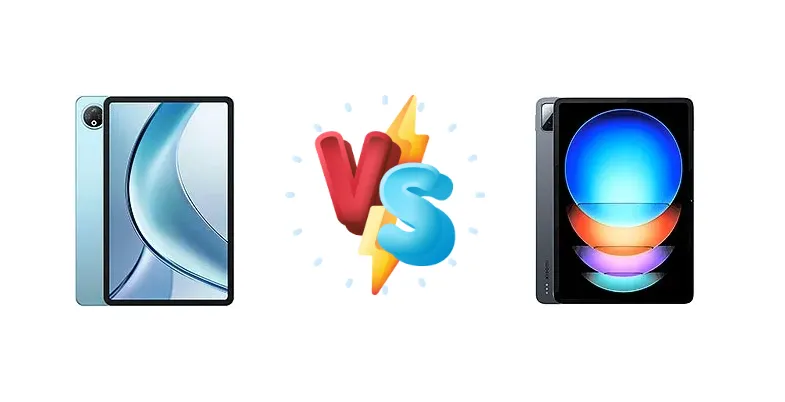
The Android tablet market is heating up, with options ranging from budget-friendly media consumption devices to high-performance productivity powerhouses. We’re pitting the Doogee V Pad, a rugged and long-lasting tablet, against the Xiaomi Pad 6S Pro 12.4, a flagship boasting cutting-edge processing and rapid charging, to determine which tablet best suits your needs.
🏆 Quick Verdict
For the average user prioritizing raw performance and a premium experience, the Xiaomi Pad 6S Pro 12.4 is the clear winner. Its Snapdragon 8 Gen 2 chipset and 120W charging significantly outperform the Doogee V Pad. However, the Doogee V Pad’s exceptional battery endurance and rugged build quality make it a compelling choice for those needing a durable, long-lasting device.
| Network |
|---|
| 2G bands | GSM 850 / 900 / 1800 / 1900 | N/A |
| 3G bands | HSDPA 850 / 900 / 1900 / 2100 | N/A |
| 4G bands | 1, 3, 5, 7, 8, 20, 28, B34, 38, 39, 40, 41 | - |
| 5G bands | 1, 3, 7, 8, 28, 38, 41, 77, 78 SA/NSA | - |
| EDGE | - | N/A |
| GPRS | - | N/A |
| Speed | HSPA, LTE, 5G | - |
| Technology | GSM / HSPA / LTE / 5G | No cellular connectivity |
| Launch |
|---|
| Announced | 2025, June | 2024, February 22 |
| Status | Available. Released 2025, June | Available. Released 2024, February 22 |
| Body |
|---|
| Build | - | Glass front (Gorilla Glass 5), aluminum frame, aluminum back |
| Dimensions | 279.5 x 175 x 8 mm (11.00 x 6.89 x 0.31 in) | 278.7 x 191.6 x 6.3 mm (10.97 x 7.54 x 0.25 in) |
| SIM | Nano-SIM + Nano-SIM | No |
| Weight | 572 g (1.26 lb) | 590 g (1.30 lb) |
| Display |
|---|
| Protection | Mohs level 5 | Corning Gorilla Glass 5 |
| Resolution | 1200 x 2000 pixels, 5:3 ratio (~194 ppi density) | 2032 x 3048 pixels, 3:2 ratio (~295 ppi density) |
| Size | 12.0 inches, 409.9 cm2 (~83.8% screen-to-body ratio) | 12.4 inches, 457.8 cm2 (~85.7% screen-to-body ratio) |
| Type | IPS LCD | IPS LCD, 68B colors, 144Hz, HDR10, Dolby Vision, 900 nits (peak) |
| Platform |
|---|
| CPU | Octa-core (2x2.6 GHz Cortex-A78 & 6x2.0 GHz Cortex-A55) | Octa-core (1x3.2 GHz Cortex-X3 & 2x2.8 GHz Cortex-A715 & 2x2.8 GHz Cortex-A710 & 3x2.0 GHz Cortex-A510) |
| Chipset | Mediatek MT8791 (6 nm) | Qualcomm SM8550-AB Snapdragon 8 Gen 2 (4 nm) |
| GPU | Mali-G68 MC4 | Adreno 740 |
| OS | Android 15 | Android 14, up to 3 major Android upgrades, HyperOS |
| Memory |
|---|
| Card slot | microSDXC (uses shared SIM slot) | No |
| Internal | 256GB 8GB RAM | 256GB 8GB RAM, 256GB 12GB RAM, 512GB 12GB RAM, 1TB 16GB RAM |
| Main Camera |
|---|
| Dual | - | 50 MP, f/1.8, (wide), 1/2.76", 0.64µm, PDAF
Auxiliary lens |
| Features | LED flash | LED flash, HDR, panorama |
| Single | 13 MP | - |
| Video | 1080p@30fps | 4K@30/60fps, 1080p@30/60fps |
| Selfie camera |
|---|
| Single | 8 MP | 32 MP, f/2.2, (wide), 1/3.6", 0.61µm |
| Video | Yes | 1080p@30fps |
| Sound |
|---|
| 35mm jack | No | No |
| Loudspeaker | Yes, with stereo speakers (4 speakers) | Yes, with stereo speakers (6 speakers) |
| Comms |
|---|
| Bluetooth | 5.2, A2DP, LE | 5.3, A2DP, LE, LHDC |
| NFC | No | Yes (file transfer only) |
| Positioning | GPS, GALILEO, GLONASS, BDS | No |
| Radio | No | No |
| USB | USB Type-C | USB Type-C 3.2, accessory connector |
| WLAN | Wi-Fi 802.11 a/b/g/n/ac/6, dual-band | Wi-Fi 802.11 a/b/g/n/a/6/7, dual-band, Wi-Fi Direct |
| Features |
|---|
| Sensors | - | Fingerprint (side-mounted), accelerometer, gyro, proximity (accessories only), compass |
| Battery |
|---|
| Charging | 10W wired | 120W wired, PD3.0, QC4, 45% in 10 min, 100% in 35 min |
| Type | 8800 mAh | 10000 mAh |
| Misc |
|---|
| Colors | Black, Blue | Black, Blue, Green |
| Models | - | 24018RPACG |
| Price | About 350 EUR | About 700 EUR |
| SAR EU | - | 0.99 W/kg (body) |
| EU LABEL |
|---|
| Battery | 92:32h endurance, 800 cycles | - |
| Energy | Class E | - |
| Free fall | Class C (104 falls) | - |
| Repairability | Class B | - |
Doogee V Pad
- Exceptional battery endurance (92:32h)
- Rugged build quality for durability
- Long battery lifespan (800 charge cycles)
- Slow 10W charging
- Less powerful Mediatek MT8791 chipset
- Likely inferior display quality
Xiaomi Pad 6S Pro 12.4
- Flagship Snapdragon 8 Gen 2 performance
- Ultra-fast 120W charging
- Bright and high-contrast display (848 nits, 1378:1)
- Shorter battery endurance (11:14h)
- Less durable build quality
- Higher price point (likely)
Display Comparison
The Xiaomi Pad 6S Pro 12.4 boasts a significantly more impressive display, achieving a measured peak brightness of 848 nits and a 1378:1 contrast ratio. This translates to a vibrant and easily viewable screen, even in bright outdoor conditions. While the Doogee V Pad’s display specifications are not provided, it’s likely to be a standard IPS panel lacking the contrast and brightness of the Xiaomi. The Xiaomi’s larger screen size (12.4 inches vs. unspecified for Doogee) also contributes to a more immersive viewing experience. The absence of LTPO technology in either device suggests neither offers adaptive refresh rates for power saving.
Camera Comparison
Camera performance is not a primary focus for either tablet, but the Xiaomi Pad 6S Pro 12.4 likely holds an edge due to its expected higher-quality sensor and image processing capabilities. Without specific camera specs for the Doogee V Pad, it’s difficult to make a direct comparison. However, Xiaomi typically invests more in camera technology, even in its tablet lineup. The absence of details regarding OIS or lens apertures for either device suggests neither is geared towards serious photography.
Performance
The performance gap between these tablets is substantial. The Xiaomi Pad 6S Pro 12.4 is powered by the Qualcomm Snapdragon 8 Gen 2 (4nm), featuring a prime Cortex-X3 core clocked at 3.2 GHz. This is a flagship-level chipset designed for demanding applications. In contrast, the Doogee V Pad utilizes the Mediatek MT8791 (6nm) with a Cortex-A78 core peaking at 2.6 GHz. The Snapdragon 8 Gen 2’s more advanced architecture and smaller fabrication node (4nm vs 6nm) result in superior performance and thermal efficiency, minimizing throttling during sustained workloads. The Xiaomi’s likely use of faster LPDDR5x RAM further enhances its performance advantage.
Battery Life
The Doogee V Pad claims exceptional battery endurance, rated at 92:32h, and a lifespan of 800 charge cycles. However, this endurance figure is likely based on very specific, light usage scenarios. The Xiaomi Pad 6S Pro 12.4, with an active use score of 11:14h, offers significantly faster charging – 120W wired, capable of reaching 45% in 10 minutes and 100% in 35 minutes. The Doogee V Pad is limited to a slow 10W wired charge. While the Doogee may last longer on a single charge under minimal use, the Xiaomi’s rapid charging mitigates battery anxiety and allows for quick top-ups.
Buying Guide
Buy the Doogee V Pad if you need a tablet that can withstand harsh environments, prioritize extended battery life above all else, and don't require the absolute fastest processing speeds. Buy the Xiaomi Pad 6S Pro 12.4 if you demand top-tier performance for demanding tasks like gaming and video editing, value incredibly fast charging, and appreciate a brighter, higher-contrast display.
Frequently Asked Questions
❓ How does the Mediatek MT8791 in the Doogee V Pad handle demanding games like Genshin Impact?
The Mediatek MT8791 is a capable chipset, but it won't deliver the same smooth experience as the Snapdragon 8 Gen 2 in the Xiaomi Pad 6S Pro 12.4. Expect to lower graphics settings and potentially experience some frame drops in graphically intensive titles like Genshin Impact on the Doogee V Pad.
❓ Is the 120W charging on the Xiaomi Pad 6S Pro 12.4 likely to degrade the battery health quickly?
While 120W charging is incredibly fast, Xiaomi implements intelligent charging algorithms to minimize battery degradation. The charging speed slows down as the battery approaches full capacity, and features like PD3.0 and QC4 ensure safe and efficient charging. However, all batteries degrade over time, and faster charging *can* contribute to a slightly faster rate of degradation compared to slower charging methods.
❓ What kind of storage options are available on each tablet, and is expandable storage supported?
Storage options are not specified in the provided data. However, Xiaomi typically offers multiple storage configurations (e.g., 128GB, 256GB, 512GB) for its Pad series. Expandable storage via microSD card is unlikely on either device, as it's becoming increasingly rare in modern tablets.