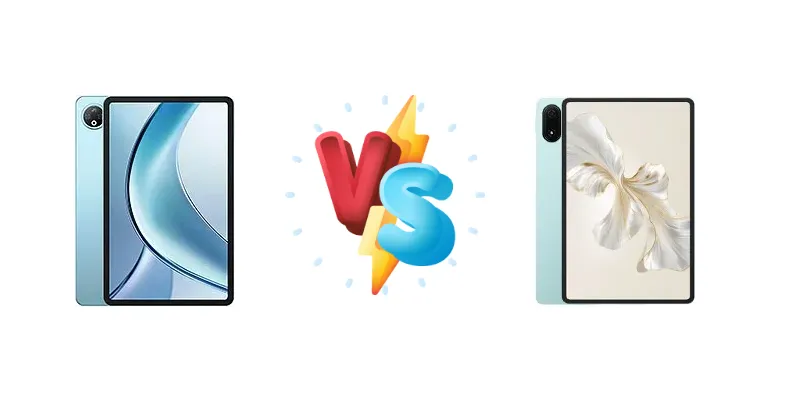
The tablet market is heating up, with options ranging from ultra-premium to budget-friendly. The Doogee V Pad and Honor Pad 9 Pro represent compelling choices in the mid-range, but cater to different priorities. The Doogee V Pad emphasizes longevity with its impressive battery endurance, while the Honor Pad 9 Pro prioritizes raw processing power with its more advanced chipset.
🏆 Quick Verdict
For the average user prioritizing sustained performance and faster content creation, the Honor Pad 9 Pro is the better choice. Its Dimensity 8100 chipset offers a significant performance uplift over the Doogee V Pad’s MT8791, and the 35W charging mitigates the larger power draw. However, users needing maximum uptime between charges will find the Doogee V Pad’s 92-hour endurance invaluable.
| Network |
|---|
| 2G bands | GSM 850 / 900 / 1800 / 1900 | N/A |
| 3G bands | HSDPA 850 / 900 / 1900 / 2100 | N/A |
| 4G bands | 1, 3, 5, 7, 8, 20, 28, B34, 38, 39, 40, 41 | - |
| 5G bands | 1, 3, 7, 8, 28, 38, 41, 77, 78 SA/NSA | - |
| EDGE | - | No |
| GPRS | - | No |
| Speed | HSPA, LTE, 5G | - |
| Technology | GSM / HSPA / LTE / 5G | No cellular connectivity |
| Launch |
|---|
| Announced | 2025, June | 2024, July 12 |
| Status | Available. Released 2025, June | Available. Released 2024, July 12 |
| Body |
|---|
| Build | - | Glass front, aluminum frame, aluminum back |
| Dimensions | 279.5 x 175 x 8 mm (11.00 x 6.89 x 0.31 in) | 277 x 179.9 x 6.6 mm (10.91 x 7.08 x 0.26 in) |
| SIM | Nano-SIM + Nano-SIM | No |
| Weight | 572 g (1.26 lb) | 589 g (1.30 lb) |
| Display |
|---|
| Protection | Mohs level 5 | - |
| Resolution | 1200 x 2000 pixels, 5:3 ratio (~194 ppi density) | 1600 x 2560 pixels, 16:10 ratio (~249 ppi density) |
| Size | 12.0 inches, 409.9 cm2 (~83.8% screen-to-body ratio) | 12.1 inches, 424.5 cm2 (~85.2% screen-to-body ratio) |
| Type | IPS LCD | IPS LCD, 1B colors, 144Hz |
| Platform |
|---|
| CPU | Octa-core (2x2.6 GHz Cortex-A78 & 6x2.0 GHz Cortex-A55) | Octa-core (4x2.85 GHz Cortex-A78 & 4x2.0 GHz Cortex-A55) |
| Chipset | Mediatek MT8791 (6 nm) | Mediatek Dimensity 8100 (5 nm) |
| GPU | Mali-G68 MC4 | Mali-G610 MC6 |
| OS | Android 15 | Android 14, Magic OS 8.1 |
| Memory |
|---|
| Card slot | microSDXC (uses shared SIM slot) | No |
| Internal | 256GB 8GB RAM | 256GB 12GB RAM, 256GB 8GB RAM |
| Main Camera |
|---|
| Features | LED flash | HDR |
| Single | 13 MP | 13 MP, f/2.0, (wide), AF |
| Video | 1080p@30fps | 4K@30fps, 1080p@30fps |
| Selfie camera |
|---|
| Single | 8 MP | 5 MP, f/2.2, (wide) |
| Video | Yes | 1080p@30fps |
| Sound |
|---|
| 35mm jack | No | No |
| Loudspeaker | Yes, with stereo speakers (4 speakers) | Yes, with stereo speakers (8 speakers) |
| Comms |
|---|
| Bluetooth | 5.2, A2DP, LE | 5.2, A2DP, LE |
| NFC | No | No |
| Positioning | GPS, GALILEO, GLONASS, BDS | No |
| Radio | No | No |
| USB | USB Type-C | USB Type-C 2.0, OTG |
| WLAN | Wi-Fi 802.11 a/b/g/n/ac/6, dual-band | Wi-Fi 802.11 a/b/g/n/ac/6, dual-band, Wi-Fi Direct |
| Features |
|---|
| Sensors | - | Accelerometer |
| Battery |
|---|
| Charging | 10W wired | 35W wired |
| Type | 8800 mAh | Li-Po 10050 mAh |
| Misc |
|---|
| Colors | Black, Blue | Sky Blue, Star Gray |
| Price | About 350 EUR | About 290 EUR |
| EU LABEL |
|---|
| Battery | 92:32h endurance, 800 cycles | - |
| Energy | Class E | - |
| Free fall | Class C (104 falls) | - |
| Repairability | Class B | - |
Doogee V Pad
- Exceptional 92-hour battery endurance
- 800 charge cycle rating for long-term battery health
- Potentially more affordable price point
- Slow 10W wired charging
- Less powerful Mediatek MT8791 chipset
- Limited performance for demanding tasks
Honor Pad 9 Pro
- Powerful Mediatek Dimensity 8100 chipset
- Fast 35W wired charging
- Superior performance for gaming and multitasking
- Likely shorter battery endurance than Doogee V Pad
- Potentially higher price point
- May experience more heat under heavy load
Display Comparison
While display specifications are missing for the Doogee V Pad, the Honor Pad 9 Pro’s chipset suggests it’s targeting a high-resolution panel. The core difference lies in the processing power driving the display. The Dimensity 8100 can handle higher refresh rates and more complex visual effects without strain, potentially offering a smoother experience. Without knowing the Doogee V Pad’s panel type or resolution, it’s difficult to assess color accuracy or brightness, but it’s likely positioned as a more cost-optimized solution.
Camera Comparison
Camera details are absent for both devices. However, given the market positioning, it’s reasonable to assume both tablets will feature mid-range camera systems. The Honor Pad 9 Pro, being a more premium offering, likely benefits from a more sophisticated image signal processor (ISP) integrated within the Dimensity 8100 chipset, potentially leading to better image quality and processing speeds. Without specific sensor information, it’s impossible to make a definitive judgment.
Performance
The Honor Pad 9 Pro’s Mediatek Dimensity 8100, fabricated on a 5nm process, represents a substantial leap in performance over the Doogee V Pad’s Mediatek MT8791 (6nm). The Dimensity 8100 boasts a more powerful CPU configuration – 4x2.85 GHz Cortex-A78 cores versus the Doogee’s 2x2.6 GHz Cortex-A78. This translates to faster application loading, smoother multitasking, and improved gaming performance. The 5nm process also contributes to better thermal efficiency, reducing the likelihood of performance throttling under sustained load. The Doogee V Pad will handle everyday tasks adequately, but the Honor Pad 9 Pro is clearly the winner for demanding users.
Battery Life
The Doogee V Pad’s standout feature is its exceptional 92-hour endurance rating. This suggests a large battery capacity and efficient power management. However, the 10W wired charging is a significant drawback, meaning a full recharge will take a considerable amount of time. The Honor Pad 9 Pro, while likely having a shorter endurance, compensates with 35W wired charging, allowing for much faster top-ups. This faster charging is crucial for users who frequently deplete their battery and need to quickly regain uptime. The 800 charge cycles rating for the Doogee V Pad indicates a focus on long-term battery health.
Buying Guide
Buy the Doogee V Pad if you need a tablet for extended use cases away from a power outlet – think long flights, outdoor work, or simply minimizing charging frequency. It’s ideal for content consumption and light productivity. Buy the Honor Pad 9 Pro if you prioritize a smoother, more responsive experience for demanding tasks like video editing, gaming, or multitasking. The faster chipset and charging are worth the trade-off in battery endurance for power users.
Frequently Asked Questions
❓ Is the Mediatek Dimensity 8100 in the Honor Pad 9 Pro prone to overheating during extended gaming sessions?
While the Dimensity 8100 is a powerful chip, Mediatek has implemented thermal management features to mitigate overheating. The 5nm process also contributes to better thermal efficiency compared to older nodes. However, prolonged, graphically intensive gaming will inevitably generate heat. The Honor Pad 9 Pro’s cooling solution will determine how effectively it manages this heat, preventing significant performance throttling.
❓ How long will it realistically take to fully charge the Doogee V Pad with its 10W charging?
Given the likely large battery capacity required to achieve 92-hour endurance, a full charge with 10W charging will likely take upwards of 6-8 hours, potentially even longer. This is a significant trade-off for the extended battery life. It’s best suited for overnight charging.
❓ Does the Honor Pad 9 Pro support external storage expansion via microSD card?
This information is not provided. However, many Honor tablets do *not* include microSD card slots, opting instead for internal storage. Check the official specifications before purchasing if expandable storage is a necessity.